What a LIMS Does Not Cover: 8 Workflow Gaps
A Laboratory Information Management System is purpose-built for what happens inside the lab. The moment a workflow crosses the lab boundary - reaching a client, a courier, a finance system, or a regulatory authority - most LIMS products stop cold. If your team is patching those edges with email threads and spreadsheets, the gaps below will look familiar.
What a LIMS does not cover
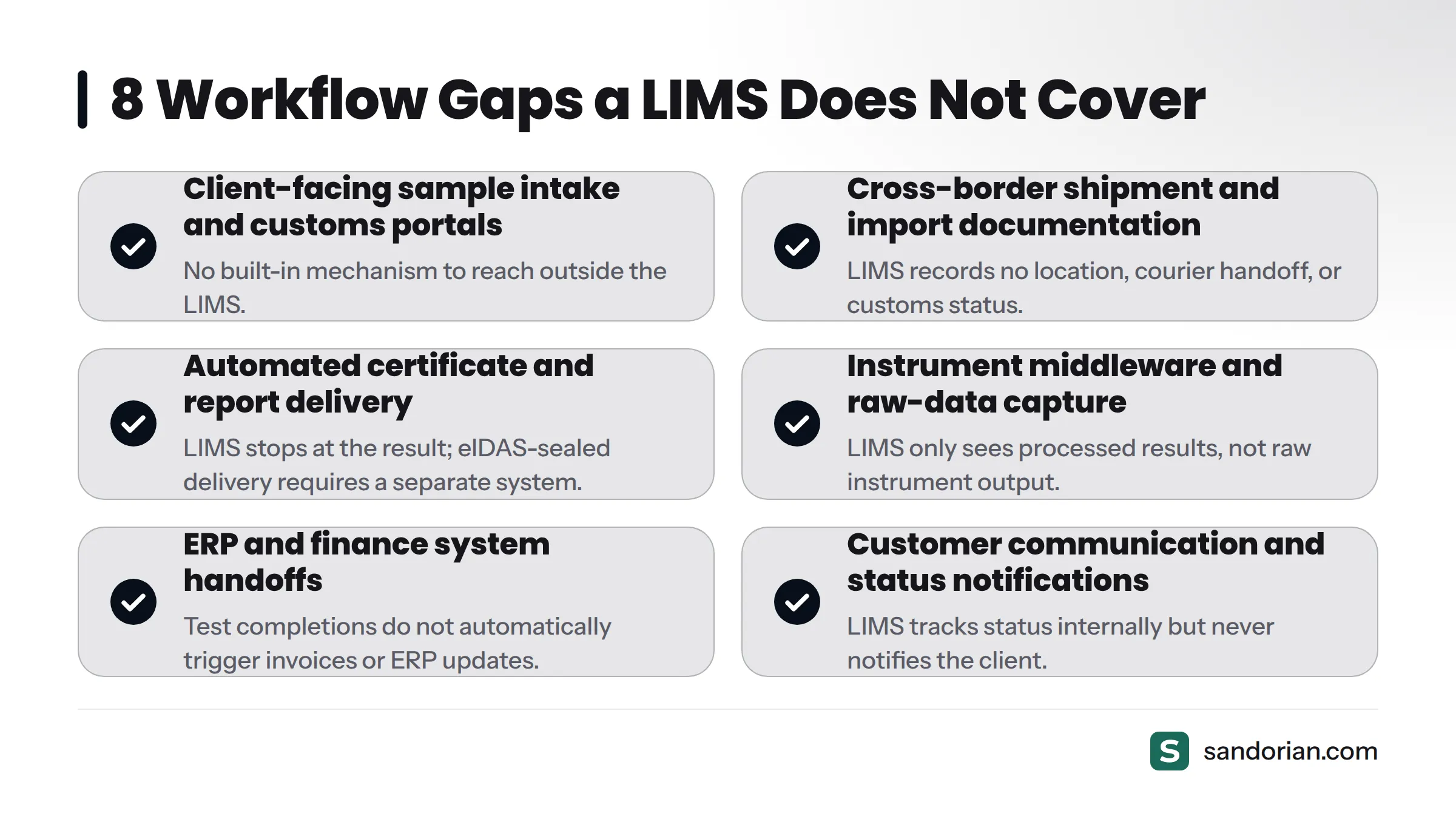
A LIMS manages samples, results, and data inside the lab. It does not cover client-facing request intake, cross-border shipment documentation, automated certificate delivery to external parties, instrument raw-data capture before middleware, ERP and finance handoffs, customer status notifications, chain-of-custody tracking outside the lab, or the orchestration layer that connects all these systems. Those LIMS gaps require additional software or integration work.
The eight gaps below come from Sandorian's direct experience across European lab integration projects - not from LIMS marketing materials.
Here is a quick reference before we go deeper:
- Client-facing sample intake and customs portals
- Cross-border shipment and import documentation
- Automated certificate and report delivery to external parties
- Instrument middleware and raw-data capture
- ERP and finance system handoffs
- Customer communication and status notifications
- Chain-of-custody tracking outside the lab
- Workflow orchestration across disconnected systems
If your lab is filling these gaps with email threads and spreadsheets, you are not alone - and there is a faster path.
Gap 1: Client-facing sample intake and customs portals
A LIMS assumes samples arrive already registered. In practice, clients submit test requests by email, PDF, or phone. Someone on the lab side then manually keys that data into the LIMS. That manual step is a registration error waiting to happen, and it scales badly.
For cross-border shipments - animal health, food, environmental - the problem compounds. Import permits, health certificates, and customs field data must be collected before the sample even leaves the client's premises. No standard LIMS includes a client-facing form to capture that information.
Our work on the ViroVet project made this LIMS gap concrete: the space between a client submitting a sample request and the moment that request appeared in the LIMS required a completely custom intake and customs portal. The LIMS had no mechanism to reach outside itself. Sample registration software is what fills this gap. For a fuller look at the registration process itself, our detailed guide to the sample registration process covers the step-by-step mechanics.
Reducing the manual data entry that fills this gap is also worth examining separately - how to reduce manual data entry in the lab walks through the practical approaches we use across projects.
Gap 2: Cross-border shipment and import documentation
Once a sample is in transit, the LIMS goes dark. It records no physical location, no courier handoff, no estimated arrival, and no customs status. For labs operating across EU borders - veterinary diagnostics, environmental testing, food safety - this is a daily source of manual effort.
Import permits, sanitary certificates, customs declarations, and shipment tracking data all live in email inboxes or carrier portals, entirely disconnected from the LIMS. When a shipment is delayed or held at customs, the lab learns about it from a phone call, not from a system alert.
What fills this gap is a shipment tracking integration and a customs documentation workflow that feeds status back into whatever system the lab uses to manage client communication. The LIMS is not the right place to build this - it was never designed for it.
Gap 3: Automated certificate and report delivery to external parties
A LIMS can generate a result. It cannot seal that result as an accredited certificate and deliver it to an external client portal with legal standing in the EU.
The gap runs like this: completed result - accredited certificate - eIDAS-sealed delivery - client access. The LIMS handles step one at most. Steps two through four require a separate system entirely.
The eIDAS Regulation (EU) No 910/2014 governs electronic seals in the EU. An eIDAS electronic seal gives a certificate the legal standing of a corporate signature - meaning a client, an accreditation body, or a regulator can verify the document's authenticity and integrity without calling the lab. Without that seal, a PDF emailed from a LIMS export is not a legally valid certificate in most EU regulated contexts.
Sealed certificate delivery portals are what close this gap. The certificate portal implementation detail is a separate topic - but the gap itself is clear: the LIMS stops at the result, and the client needs far more than that.
Gap 4: Instrument middleware and raw-data capture
A LIMS stores processed results. What the instrument actually produces - raw spectra, chromatograms, raw counts, unprocessed signals - requires middleware before the LIMS can receive it. The LIMS only sees step three of a three-step chain: instrument - middleware - LIMS.
This matters because the middleware layer is where data quality decisions get made. If that layer is misconfigured, results in the LIMS look fine but the underlying data is wrong. The LIMS has no visibility into this.
LIMS integration covers the patterns for connecting instruments to your LIMS, and connecting lab instruments to your LIMS goes deeper on the integration patterns we use to bridge that gap without creating new data silos.
Gap 5: ERP and finance system handoffs
When a test is complete, the LIMS does not automatically create an invoice, update a project code in an ERP, or trigger an accounts receivable workflow. That handoff is a manual step in most labs.
In European labs, the ERP side of this gap typically involves systems like SAP, Exact, AFAS, or Moneybird. None of them speak natively to a LIMS. Someone exports a CSV, imports it into the finance system, and hopes the project codes match. When they don't, the finance team emails the lab. The lab checks the LIMS. The cycle repeats.
A data handoff layer between the LIMS and the ERP closes this gap. It maps test completions to billing records automatically and removes the manual reconciliation step. LIMS integration covers how that layer is typically structured.
Gap 6: Customer communication and status notifications
The LIMS tracks sample status internally. It does not notify the client when a sample is received, when testing is in progress, or when results are ready. That notification step falls to whoever is managing the inbox that day.
The gap between internal status update and external client notification is one of the most visible LIMS limitations from the client's perspective. Clients call or email to ask where their results are. Lab staff stop testing to answer. The LIMS is not at fault - it was never designed to face outward.
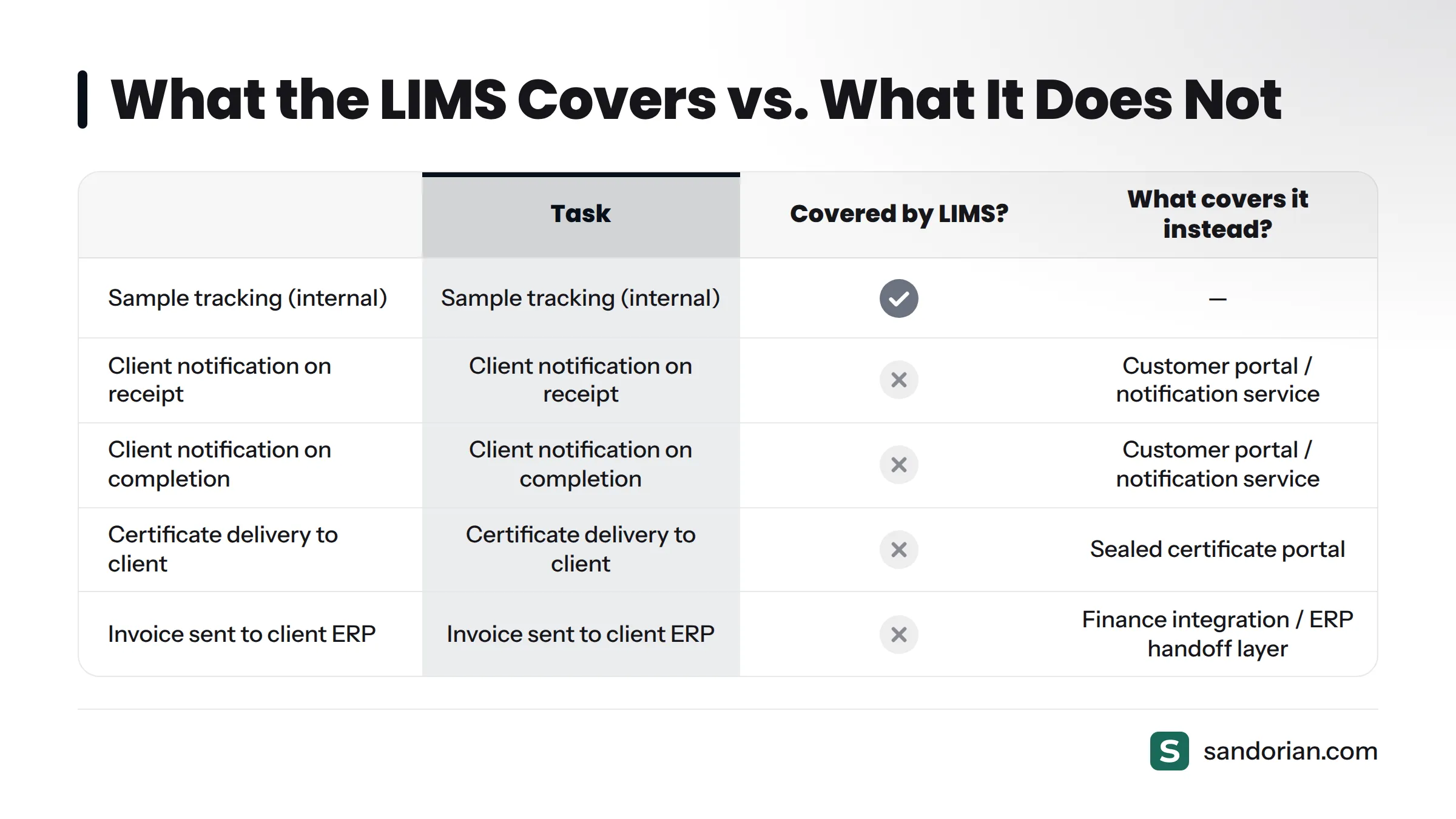
| Task | Covered by LIMS? | What covers it instead? |
|---|---|---|
| Sample tracking (internal) | ✅ Yes | - |
| Client notification on receipt | ❌ No | Customer portal / notification service |
| Client notification on completion | ❌ No | Customer portal / notification service |
| Certificate delivery to client | ❌ No | Sealed certificate portal |
| Invoice sent to client's ERP | ❌ No | Finance integration / ERP handoff layer |
A client notification layer or customer portal with automated status push is what fills this gap. The LIMS feeds status events; the portal surfaces them to the client without anyone picking up the phone.
Gap 7: Chain-of-custody tracking outside the lab
A LIMS records chain of custody from intake to result - but only while the sample is under the lab's direct control. The moment a sample leaves the building, the chain goes dark.
For labs accredited under ISO 17025:2017, documented chain of custody is a requirement that extends to any point where the lab has responsibility for a sample. That includes transit to a sub-contracted lab, courier handoff, and return of residual material. The LIMS cannot document any of that by itself.
For ISO 15189 medical labs and labs operating under the EU's In Vitro Diagnostic Regulation (IVDR), the documentation requirements are equally strict. When an auditor asks for the full chain of custody on a sample that traveled between sites, the LIMS printout will not be enough. ISO 17025 software requirements covers what the standard actually demands from your software stack.
A chain-of-custody integration layer with courier or sub-contractor tracking is what closes this gap.
Gap 8: Workflow orchestration across disconnected systems
This is the meta-gap. A lab may have a LIMS, an ERP, an instrument stack, a customer portal, and a certificate delivery system. None of them talk to each other by default. Each of the seven gaps above is individually addressable - but fixing them one by one, with separate point solutions, creates a different problem: a patchwork of systems with no orchestrating logic.
In our experience across European lab projects, this is the gap labs most consistently underestimate. They address intake, then certificates, then ERP handoffs - each time adding a new tool. Eventually the complexity of managing those tools exceeds the complexity of the original problem.
An orchestration layer connects all systems end to end: events from the LIMS trigger actions in the ERP, which trigger notifications to the client portal, which trigger certificate delivery - all without manual intervention. Custom software for laboratories is how Sandorian approaches this. Automating lab workflows covers what to automate first. And for teams that have already built point solutions and are watching them fail, why lab integrations fail is worth reading before adding another tool.
Which gaps cause the most manual effort?
Based on our observations across European lab projects:
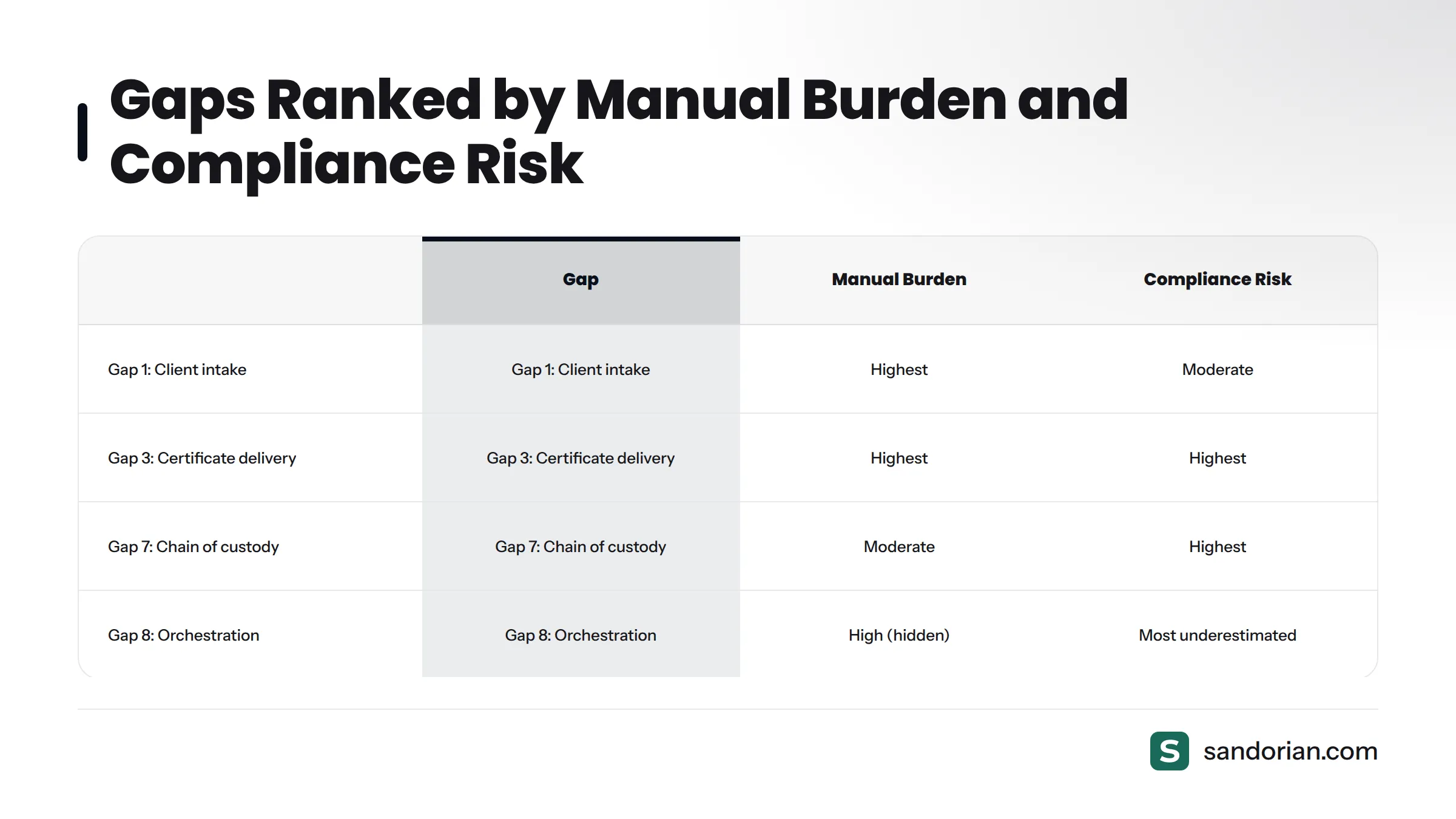
Highest manual burden: Gap 1 (client intake) and Gap 3 (certificate delivery). These touch every single sample and every single result. They are the most frequent, highest-volume manual steps in a typical regulated lab.
Highest compliance risk: Gap 7 (chain of custody outside the lab) and Gap 3 (certificate delivery without an eIDAS seal). Both can surface as findings in an ISO 17025 or ISO 15189 audit.
Most commonly underestimated: Gap 8 (orchestration). Labs address individual gaps without realizing they need a connecting layer. The result is a set of systems that each work in isolation but create new handoff problems at every boundary.
Not sure which gaps apply to your lab? Use the integration requirements checklist to map your workflow against each gap before deciding where to start. Contact Sandorian to request it.
What to do next
Name your gaps before deciding how to address them. The eight gaps above are structural - they are not a failure of your LIMS product, and replacing your LIMS will not fix them. They exist at the boundary of what any LIMS is designed to do.
If you are wondering whether these LIMS missing features mean you need a new system entirely, the answer is almost never yes - read whether to replace your LIMS for a clearer framing of that decision.
If the gaps are costing your team measurable hours every week, the right next step is mapping them precisely and scoping the integration work. Custom software for laboratories is where Sandorian covers that in depth.
Frequently asked questions
Does a LIMS handle customer-facing portals?
No. A LIMS manages data inside the lab. Client-facing portals - for submitting requests, checking status, or accessing certificates - sit outside LIMS scope and require a separate client portal layer connected to the LIMS by integration.
Can a LIMS send automated notifications to clients?
Not by design. A LIMS tracks sample status internally. Automated client notifications require a notification service or customer portal that listens to LIMS status events and pushes them outward. This is a software integration problem, not a LIMS configuration problem.
Does a LIMS cover chain of custody during shipping?
No. A LIMS records chain of custody while the sample is in the lab's direct control. Transit, courier handoffs, and sub-contracted lab transfers are outside its scope. For ISO 17025 and ISO 15189 accredited labs, this is a documentation gap with real audit consequences.
Is ERP integration built into a LIMS?
Rarely in a meaningful way. Most LIMS products offer data export, not live ERP integration. The handoff from a completed test result to an invoice in SAP, Exact, AFAS, or any other ERP system requires a dedicated integration layer.
What is the difference between a LIMS and instrument middleware?
A LIMS stores processed results after a test is complete. Instrument middleware sits between the instrument and the LIMS - it captures raw output (spectra, chromatograms, raw counts), processes or formats it, and passes the result to the LIMS. The LIMS never sees the raw data; it only sees what middleware delivers.
Sources
Let's talk
We build the systems that power your business. Let us know how we can help.
Book a 30-min Call