Laboratory Software by Industry | Sandorian
Testing, calibration, diagnostic, and clinical laboratories all run a Laboratory Information Management System (LIMS). What most LIMS leave out is the layer around it: customer request intake, sample registration, signed and sealed certificate delivery, and the compliance workflows your accreditation body expects. Sandorian builds and integrates that layer - for four regulated lab types, under ISO 17025, ISO 15189, and IVDR.
Find your lab type:
- Testing laboratory software -
/industries/testing-labs/ - Software for calibration labs -
/industries/calibration-labs/ - Diagnostic lab workflow and IVDR software -
/industries/diagnostic-labs/ - Medical laboratory software built for ISO 15189 -
/industries/clinical-labs/
What lab software by lab type actually needs to cover
Every regulated lab shares the same three gaps: request intake, sample registration tied to that intake, and compliant delivery of the final certificate or report. The specifics differ sharply by lab type and by the standard that governs it.
| Lab type | Primary LIMS gap | Standard |
|---|---|---|
| Testing laboratory | Request intake, contract review, signed report delivery | ISO 17025 |
| Calibration laboratory | Certificate generation, uncertainty documentation, eIDAS sealing | ISO 17025 |
| Diagnostic laboratory | IVDR-ready audit trails, sample traceability, result workflow | IVDR |
| Clinical laboratory | Patient-facing processes, ISO 15189 QMS integration | ISO 15189 |
Here is what that gap looks like in practice. A LIMS records test results. It does not manage the moment a customer submits a request, it does not link that request to the registered sample, and it does not push a signed, tamper-evident certificate to a client portal when the work is done. Those three steps - before the test, and after it - are where regulated labs accumulate manual effort, compliance risk, and accreditation findings.
What a LIMS leaves out, across all four lab types:
- Customer or patient request intake
- Sample registration linked to that intake
- Signed and sealed certificate or report delivery
- Compliance workflows not covered by the LIMS
Testing laboratories: from request intake to signed report
A testing laboratory operating under ISO 17025:2017 must document every customer request, perform a contract review before work begins, and issue reports under controlled conditions. Most LIMS platforms start recording data at the point the sample enters the system - the intake and the controlled report issuance happen outside it, often in spreadsheets, email threads, or shared drives that do not meet clause 7.1 and clause 7.8 requirements.
Sandorian builds the intake and delivery layer that sits around the LIMS: structured request forms, automated contract review prompts, and a report issuance workflow where signing and distribution are logged and controlled. For testing labs, this is the difference between an audit finding and a clean report. Go deeper at ISO 17025 software requirements or explore dedicated testing laboratory software at /industries/testing-labs/.
ISO 17025 requires documented request intake and controlled report issuance. Most LIMS stop at results - Sandorian covers the before and after.
Calibration laboratories: certificates, traceability, and eIDAS sealing
Calibration labs carry an additional burden on top of the standard testing workflow: every certificate must document measurement uncertainty, reference the traceability chain back to a national or international standard, and increasingly arrive at the customer in a form that proves it has not been altered in transit. That last requirement is where eIDAS Regulation 910/2014 becomes relevant.
An eIDAS-sealed certificate is digitally signed under EU law in a way that makes any post-issuance modification detectable. For calibration labs selling into European supply chains, this is no longer optional - procurement teams and quality managers increasingly require it. Sandorian's certificate generation module handles uncertainty documentation, traceability references, and eIDAS sealing in a single controlled workflow. Find out more at software for calibration labs at /industries/calibration-labs/.
eIDAS-sealed certificates give your customers tamper-evident proof of calibration - a requirement increasingly expected in European supply chains.
Diagnostic laboratories: workflow automation for IVDR-ready labs
The EU In Vitro Diagnostic Regulation 2017/746 (IVDR) sets strict requirements for how diagnostic laboratories handle and record sample data. An audit trail under IVDR must capture who did what to a sample, when, and with which instrument - at every stage of the lifecycle. Most LIMS record the result; they do not necessarily capture the intake event, the transfer between workstations, or the final result release as a complete, defensible record.
Sandorian builds the workflow layer that makes a diagnostic lab's process IVDR-ready: structured intake, sample lifecycle traceability, and a result release workflow with a complete audit trail. The IVDR compliance roadmap for laboratory software explains the regulatory requirements in detail. For the full diagnostic lab picture, visit diagnostic lab workflow and IVDR software at /industries/diagnostic-labs/.
Clinical laboratories: patient-facing processes and ISO 15189
ISO 15189:2022 governs medical laboratories and sets requirements that go beyond the LIMS: patient-facing result communication must be controlled, the quality management system must be integrated with laboratory processes, and software used in the laboratory must be validated before use and re-validated after significant changes. These are not features most LIMS vendors address out of the box.
Sandorian builds the patient-facing delivery layer and the QMS-integrated workflow scaffolding that ISO 15189 requires around - not inside - the LIMS. The ISO 15189 and software validation knowledge article covers the validation requirements in full. For clinical lab specifics, visit medical laboratory software built for ISO 15189 at /industries/clinical-labs/.
The three gaps that appear in every regulated lab
Call it the Sandorian layer. Three gaps show up regardless of lab type - and this is what custom software around LIMS is actually built to close.
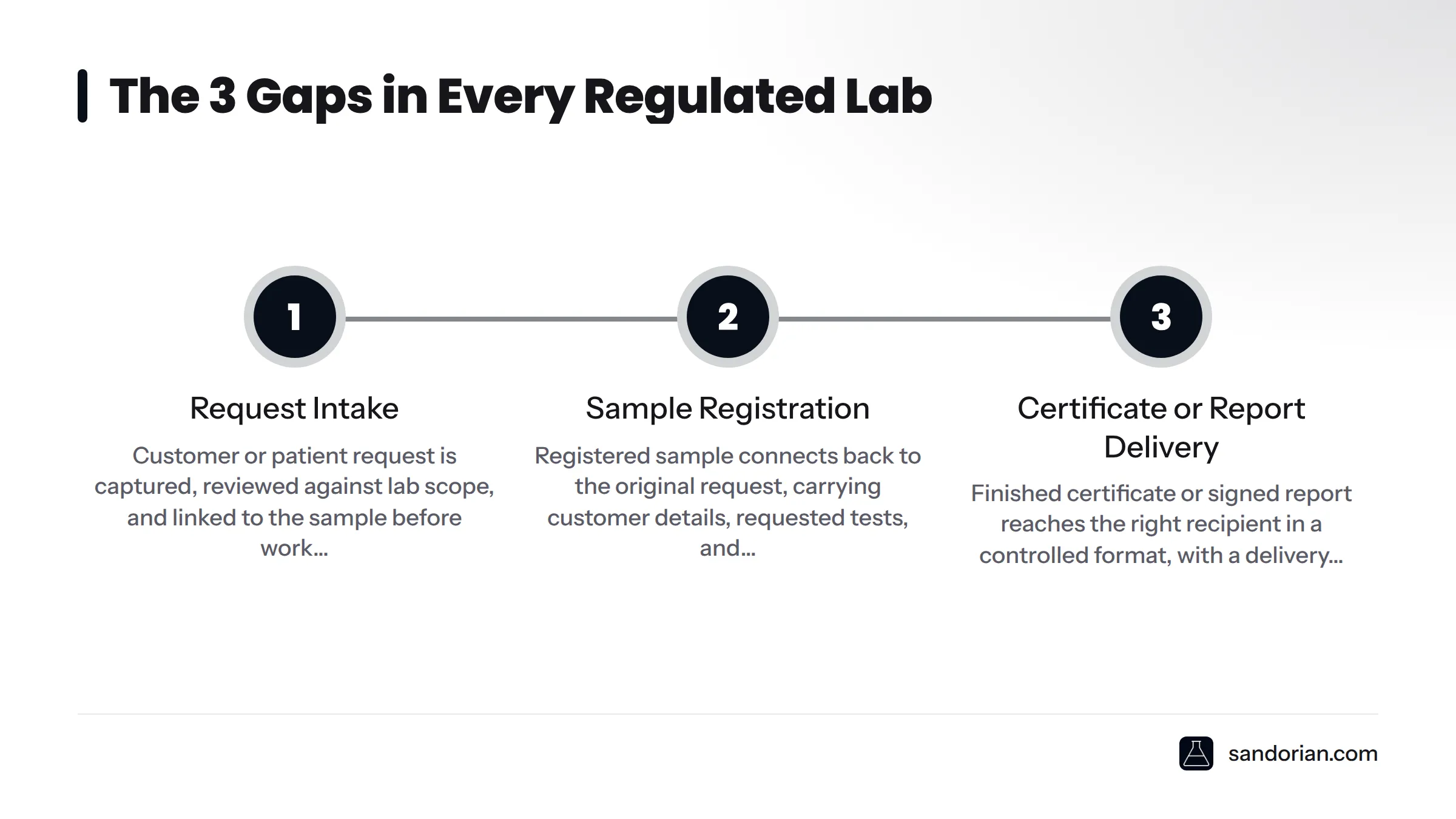
- Request intake. A customer or patient submits a request. That request must be captured, reviewed against the lab's scope, and linked to the sample before any work starts. The LIMS does not manage this.
- Sample registration. The registered sample must connect back to the original request, carrying the right metadata - customer details, requested tests, applicable standards, priority flags. This linkage rarely happens cleanly inside a standard LIMS.
- Certificate or report delivery. The finished certificate or signed report must reach the right recipient, in a controlled format, with a delivery record. For European regulated labs, that means eIDAS sealing. The LIMS produces the result data; it does not manage the delivery event.
The audit-ready lab software article explains what the full picture looks like from an accreditation body's perspective. And custom software for laboratories at Sandorian is where all four lab-type threads come together.
The LIMS manages your test data. The layer Sandorian builds manages everything before the test and everything after it - and everything the LIMS was never designed to handle.
How Sandorian has delivered across regulated lab segments
Proof matters more than positioning. ViroVet, a diagnostic laboratory, partnered with Sandorian to digitize its lab operation. The result was an 80% reduction in manual errors - achieved by replacing fragmented manual handoffs with a structured intake-to-delivery workflow built around the lab's existing systems, under IVDR constraints. The delivery was led by an engineering team with direct regulated lab experience across ISO 17025, ISO 15189, IVDR, and eIDAS projects. Read the full story at how ViroVet digitized its lab operation.
ViroVet - diagnostic lab digitization - 80% reduction in manual errors.
Software for regulated laboratories is not a product you configure from a catalogue. It is a layer you build with an engineering partner who understands what your accreditation body will look at - and what your current system does not cover. That is the work Sandorian does, and the ViroVet outcome is the evidence.
For labs preparing for accreditation, the laboratory accreditation preparation timeline gives a realistic picture of what the process involves and where software fits in.
Choose your laboratory type
Each segment has its own page with the specific workflow gaps we address and the standards we build against. This is laboratory software by industry - built for the actual requirements of each lab type, not a generic configuration:
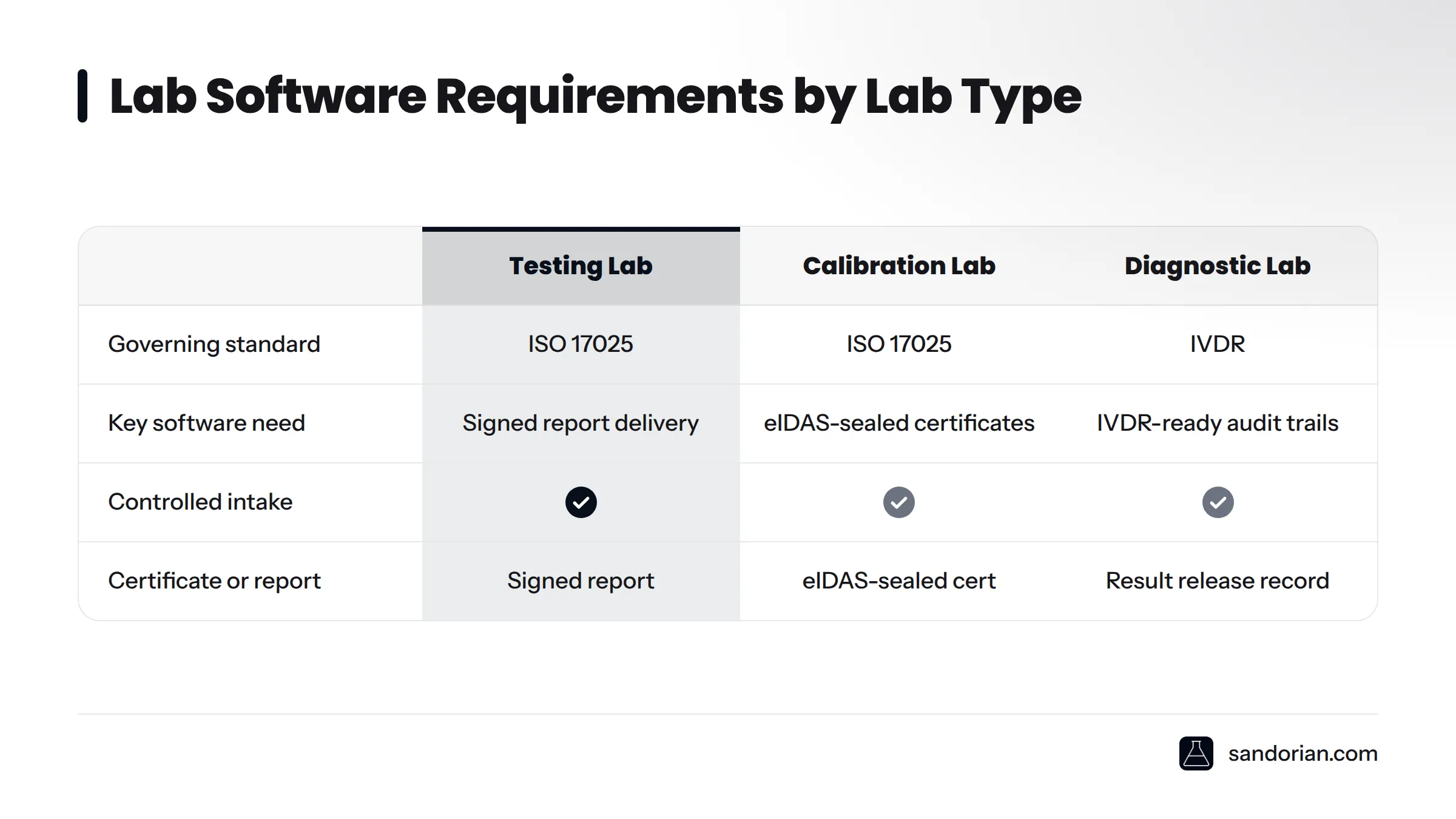
- Testing laboratory - signed report delivery, controlled intake, ISO 17025 clause 7.1 and 7.8 compliance. Visit
/industries/testing-labs/ - Calibration laboratory - certificate generation, measurement uncertainty documentation, eIDAS-sealed delivery. Visit
/industries/calibration-labs/ - Diagnostic laboratory - IVDR-ready audit trails, sample lifecycle traceability, result workflow automation. Visit
/industries/diagnostic-labs/ - Clinical laboratory - patient-facing result delivery, QMS-integrated workflows, ISO 15189 software validation. Visit
/industries/clinical-labs/
Not sure which page fits your lab? Book a scoping call and describe your workflow gap. Bring the standard that governs your lab and the step in your process that is currently manual, error-prone, or missing a controlled record. That is where the conversation starts.
Frequently asked questions
Do you replace our LIMS?
No. Sandorian builds and integrates the software around your existing LIMS: request intake, sample registration, certificate delivery, and the workflows the LIMS does not cover. Whether to replace a LIMS is a separate decision.
Which lab types do you work with?
Testing, calibration, diagnostic, and clinical laboratories working under ISO 17025, ISO 15189, and IVDR. Each has its own page with the specific workflow gaps we address.
Can you build software for a lab type not listed here?
Adjacent regulated settings such as energy operators, R&D institutes, and customs-linked labs are possible. Contact us with the workflow and the standards that apply and we will confirm whether it fits.
Does your software make us compliant with ISO 17025 or ISO 15189?
Software can support the requirements - through audit trails and controlled records, for example - but accreditation is decided by your accreditation body. We build with those requirements in mind and do not give conformity assessments.
Sources
- ISO 17025:2017 - General requirements for the competence of testing and calibration laboratories, ISO
- ISO 15189:2022 - Medical laboratories: requirements for quality and competence, ISO
- EU In Vitro Diagnostic Regulation 2017/746, EUR-Lex
- eIDAS Regulation 910/2014 on electronic identification and trust services, EUR-Lex
Let's talk
We build the systems that power your business. Let us know how we can help.
Book a 30-min Call