Digital Certificate Portal for Labs | eIDAS-Sealed
A digital certificate portal for a laboratory is a secure web application where your customers retrieve sealed test reports and calibration certificates and verify their authenticity. It sits around your existing LIMS, handling delivery, role-based access, eIDAS seals, and audit trails that your LIMS does not provide. Sandorian builds it as the layer between your system of record and the people who depend on what it produces.
What is a digital certificate portal for labs?
Definition and scope
A lab certificate portal is a customer-facing web application that makes approved test reports, calibration certificates, and conformity certificates available to the organisations that commissioned them - with cryptographic proof that the documents are authentic and unaltered.
Here is what it does in practice:
- Delivers sealed test reports and calibration certificates to customers
- Applies eIDAS-qualified electronic seals via QTSP integration
- Embeds PAdES signatures directly in PDF documents
- Provides role-based access control per customer organisation
- Maintains a full audit trail of access and download events
- Offers verification links and QR codes for third-party authentication
The portal is not a replacement for your Laboratory Information Management System (LIMS). Your LIMS records results, manages chains of custody, and drives approval workflows. The portal takes approved, signed-off results and delivers them to customers with legal-grade integrity. They serve different functions, and both need to do their job well.
What it replaces
Most labs still ship certificates by email - a plain PDF with no tamper evidence, no audit trail, and no way for a regulator or customs broker to verify authenticity without picking up the phone. That process breaks down at scale, and it breaks down in ways that cost operations staff real time every day.
A digital certificate portal replaces:
- Manual PDF dispatch by email
- Phone-based verification calls from customers and third parties
- Unprotected file shares with no access control or version management
The gap between emailing a PDF and delivering through an eIDAS-sealed portal is not marginal. The table below shows why.
| Feature | Email PDF delivery | eIDAS-sealed certificate portal |
|---|---|---|
| Tamper evidence | None | Qualified electronic seal (PAdES) |
| Third-party verification | Phone call to lab | Verification link / QR code |
| Access control | None | Role-based, per customer organisation |
| Audit trail | None | Full access and download log |
| Timestamping | None | Qualified electronic timestamp |
| LIMS integration | Manual export | API-driven, automated |
Book a discovery call to scope a certificate portal around your LIMS.
Where the portal sits in a lab's technical architecture
The three-layer model: LIMS, portal, customer
Think of the architecture in three columns.
The LIMS is the system of record. It holds results, manages approval workflows, and carries traceability back to raw measurements and instrument calibration. Nothing in the portal touches this layer except to read from it.
The certificate portal is the delivery and access layer. It authenticates customers, serves the right certificates to the right organisations, applies eIDAS seals through a qualified trust service provider (QTSP), and logs every access and download event.
The QTSP operates as the trust layer. It issues the qualified electronic seal and anchors it with a qualified electronic timestamp. The QTSP must appear on an EU member state's national trusted list under the eIDAS Regulation (EU) 910/2014 - you can check status through the EU Trusted List Browser.
The flow between layers runs in one direction: the LIMS API pushes approved results to the portal, the portal sends a seal request to the QTSP, the QTSP returns the sealed and timestamped PDF, and the portal serves that PDF to the authorised customer with a verification endpoint attached.
What the portal handles that the LIMS does not
Most LIMS vendors do not offer customer-facing, eIDAS-compliant delivery. That gap is structural, not incidental - LIMS are built for internal laboratory workflows, not for regulated external document delivery.
The portal takes on:
- Customer authentication and role-based access control
- eIDAS seal application and PAdES packaging
- Long-term validation (LTV) so certificates remain verifiable after the seal certificate expires
- Notification and download history per customer account
- Audit trail generation without writing back to the LIMS
How Sandorian builds eIDAS-sealed certificate delivery
Signing and timestamping workflow
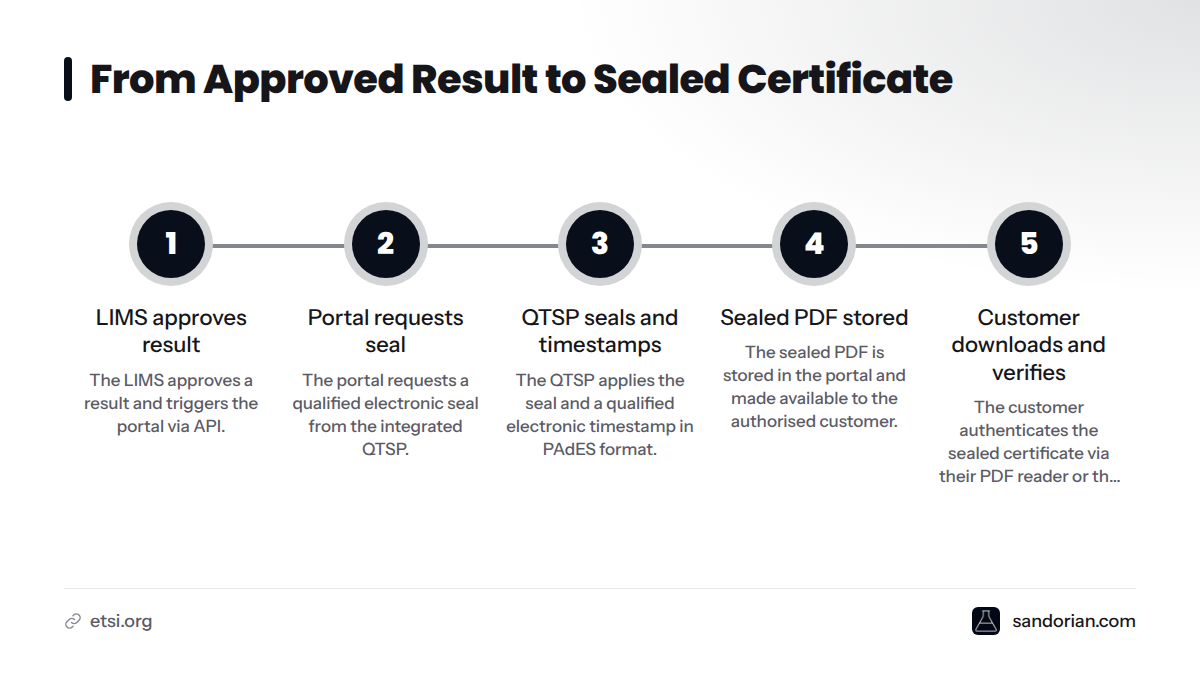
The sequence from approved result to sealed certificate in the customer's hands looks like this:
- The LIMS approves a result and triggers the portal via API
- The portal requests a qualified electronic seal from the integrated QTSP
- The QTSP applies the seal and a qualified electronic timestamp to the PDF in PAdES format
- The sealed PDF is stored in the portal and made available to the authorised customer
- The customer downloads and authenticates the sealed certificate in their PDF reader or via the portal's verification link
Every step is logged. Every sealed PDF carries a cryptographic fingerprint that locks in the document state at the moment of sealing.
PAdES and why it matters for lab certificates
PAdES (PDF Advanced Electronic Signatures), standardised under ETSI EN 319 142, embeds the qualified electronic seal directly inside the PDF file - not as a separate sidecar file or an external reference. This matters for three concrete reasons:
- Recipients can verify the seal without contacting the lab or logging into any system
- Long-term validation (LTV) data is embedded in the file, preserving verifiability even after the underlying seal certificate expires
- Any modification to the document after sealing invalidates the signature, providing tamper evidence that a plain PDF cannot offer
For lab certificates crossing borders, appearing in regulatory submissions, or being presented to customs authorities, PAdES-embedded seals are the technically correct format for durable legal-grade integrity.
LIMS integration without disrupting ISO 17025 workflows
How the integration works
Sandorian builds the portal to connect via the LIMS API or, where the API is limited or undocumented, via a direct database interface. Both connections are read-only. The LIMS stays the system of record. The portal never writes back to it.
Only approved, signed-off results pass through. Draft results, pending approvals, and intermediate data never appear in the customer-facing layer. This is a deliberate design choice, not a limitation - it protects the integrity of the accreditation workflow.
When a LIMS does not expose a well-documented API, Sandorian scopes the integration at the discovery stage. Most laboratory systems - whether commercial or custom-built - offer at least database-level access that supports a read-only connector. We address the specific integration pattern for your LIMS in the first technical conversation.
Preserving ISO 17025 traceability requirements
ISO 17025:2017 requires laboratories to maintain the integrity and traceability of their results. The portal is engineered to support those requirements without touching the accreditation-critical configuration in the LIMS.
- Every certificate delivered through the portal carries a traceable reference back to the LIMS result record
- The portal audit trail captures access events - who downloaded what, and when - without modifying any LIMS data
- Document control version locking ensures customers always receive the approved, immutable version of a certificate, not a draft or superseded issue
The LIMS stays the system of record. The portal never writes back to it.
The same principle applies to labs operating under ISO 15189 (medical laboratories) or in scope of the IVDR (In Vitro Diagnostic Regulation) - the non-disruptive read-only integration model holds regardless of the accreditation framework.
Compliance foundations the portal must satisfy
eIDAS Regulation (EU) 910/2014
The eIDAS Regulation establishes the legal framework for qualified electronic seals - the legal-person equivalent of a qualified electronic signature, used when an organisation rather than an individual needs to assert the authenticity of a document.
Two eIDAS instruments matter for lab certificate delivery:
- Qualified electronic seal: Asserts that the document originated from the issuing organisation and has not been altered since sealing
- Qualified electronic timestamp: Anchors the seal to a specific point in time, preventing backdating and supporting long-term legal validity
Both must be issued by a QTSP that appears on a national trusted list. The EU Trusted List Browser is the authoritative source for checking QTSP status.
For the legal effect of seals in your specific jurisdiction and use case, confirm with qualified legal counsel. Technical detail on how seals work lives on our separate page about how an eIDAS electronic seal works.
ISO 17025 and result integrity
The portal must not alter approved result data - it reads and delivers. Access control must be auditable. Certificate version control must align with the document control requirements that ISO 17025:2017 places on laboratories.
Data protection and access
Role-based access control means each customer organisation sees only its own certificates. No customer can browse another organisation's documents. Retention and deletion policies are configurable to align with GDPR data retention rules and the lab's own data governance requirements.
Verification: how recipients authenticate a sealed certificate
Embedded verification (PDF-native)
Adobe Acrobat and any PDF reader with PKI validation capability display the seal status natively when opening a PAdES-sealed certificate. The reader checks the embedded seal against the QTSP's public certificate and shows whether the document is authentic and unmodified. No portal login, no phone call, no manual check - the software handles it automatically.
Portal-based verification link
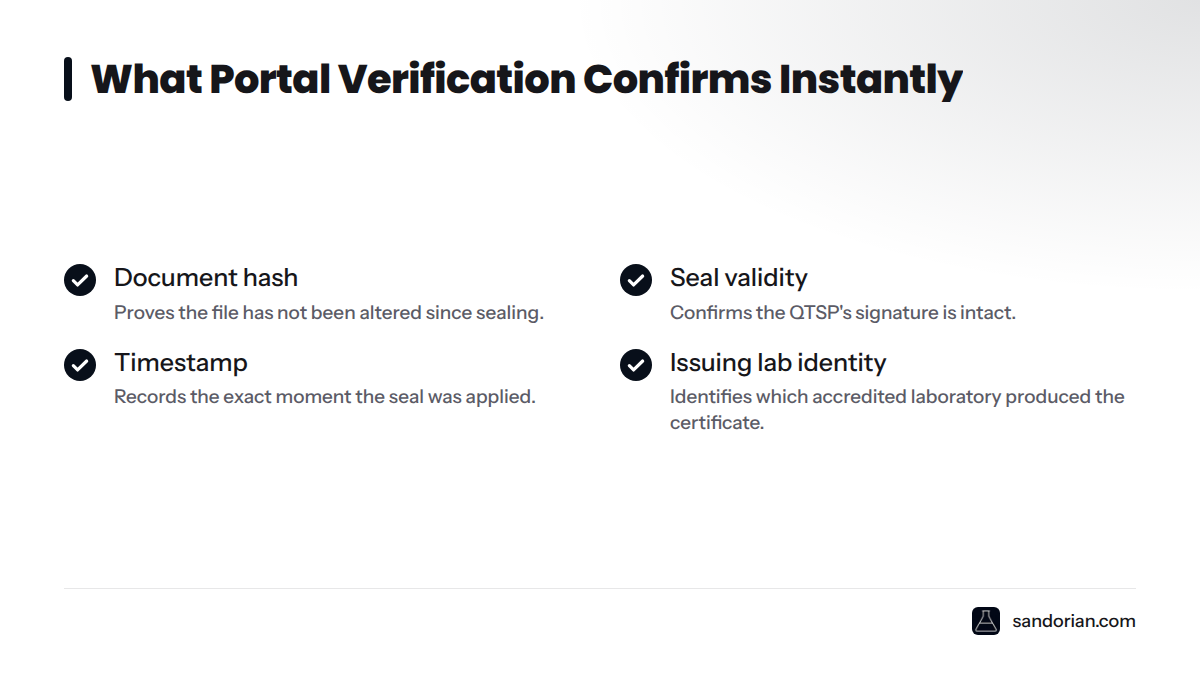
Each certificate delivered through the portal carries a unique verification URL. A recipient - or a third party such as a customs broker, regulator, or industrial client - opens that URL and the portal confirms:
- The document hash (proving the file has not been altered)
- Seal validity (the QTSP's signature is intact)
- Timestamp (the moment the seal was applied)
- Issuing lab identity (which accredited laboratory produced the certificate)
That confirmation comes back in seconds, without involving any lab staff.
QR code verification
Sandorian optionally generates a QR code printed on the PDF that links directly to the verification endpoint. When a broker or inspector has a paper printout of a sealed certificate, they scan the QR code and the portal confirms authenticity instantly. This is the mechanism behind the operational outcome described below.
The customs authority portal that cut verification calls by 98%
A national customs authority required test labs to deliver sealed import certificates to customs brokers before goods could clear customs. Before the portal existed, brokers had no way to confirm certificate authenticity independently - so they called the lab. Every certificate, every shipment: a phone call.
A national customs authority required test labs to deliver sealed import certificates to customs brokers. Before the portal, brokers called the lab to confirm every certificate - dozens of calls per day. Sandorian built a digital certificate portal with embedded eIDAS seals and a public verification endpoint. Result: verification calls dropped by 98%. Brokers verify independently; the lab's operations team handles testing, not the phone.
What this means for your lab
A 98% reduction in verification calls is not an abstract metric. Let's break it down:
- Operations staff spend their time on testing, not on answering the phone
- Customers and regulators can verify at any time - weekends, public holidays, midnight - without lab involvement
- Every verification event is logged in the portal's audit trail, creating a compliance record that a phone call never could
For labs handling high certificate volumes, or serving industries where third-party verification is a regulatory requirement, this outcome is the business case. Sandorian has delivered it once in production; the architecture that produced it is available for your lab.
What Sandorian delivers and how to start
Scope of delivery
When Sandorian builds a lab certificate portal, the delivery covers:
- Customer-facing portal: Authentication, certificate retrieval, role-based access per organisation, download history
- eIDAS-sealed PDF generation: PAdES format, QTSP integration, qualified electronic timestamp
- LIMS integration: API or database connection, read-only, non-disruptive to accreditation workflows
- Audit trail: Access logs, download events, verification events - retained in the portal, not in the LIMS
- Verification layer: Embedded PDF verification, portal verification link, optional QR code endpoint
- Certificate types supported: Test reports, calibration certificates, conformity certificates, and any other structured lab output
What Sandorian does not provide
Honest scoping matters to technical buyers. Here is where the service ends:
- The eIDAS qualified seal itself is issued by a QTSP you choose. Sandorian integrates the provider and builds the signing and timestamping workflow around it - we do not become a QTSP.
- Legal advice on eIDAS compliance is outside scope. We engineer to the eIDAS technical requirements; confirm legal effect for your use case with qualified counsel.
- Cost guidance is not on this page - see what lab software projects cost for scope and cost context.
- The full engagement and onboarding process is described separately on our how it works page.
How to start
Book a discovery call. Sandorian scopes the portal around your LIMS, your certificate types, and your compliance context. It is a technical conversation - your architecture and requirements, not a pitch deck. Most discovery calls take less than an hour and produce a concrete scope outline.
Book a discovery call to scope a certificate portal around your LIMS.
Frequently asked questions
What is a digital certificate portal for a laboratory?
It is a secure web application where customers retrieve sealed test reports and calibration certificates and verify their authenticity. It sits around the LIMS and handles delivery, access control, and verification - functions most LIMS do not cover.
Can the portal work with our existing LIMS?
Yes. Sandorian builds the portal as a layer around the LIMS, pulling approved results through its API or database interfaces. The LIMS stays the system of record.
Do you provide the eIDAS seal itself?
Seals are issued through a qualified trust service provider, which we integrate rather than replace. We build the signing, timestamping, and validation workflow around the provider you choose.
Does the portal give us legal certainty under eIDAS?
We engineer to eIDAS technical requirements but do not give legal advice. Confirm legal effect for your use case with qualified counsel.
How long does it take to build and deploy a certificate portal?
Timeline depends on LIMS complexity, certificate types, and the compliance context of the lab. Sandorian scopes a realistic delivery timeline during the discovery call, after understanding your specific architecture.
Can the portal support long-term validation (LTV) so certificates remain verifiable after the seal certificate expires?
Yes. PAdES supports LTV by embedding validation data at the time of sealing. Certificates sealed through the portal retain verifiability even after the underlying QTSP certificate has expired - a practical necessity for labs whose certificates are referenced years after issue.
Sources
Let's talk
We build the systems that power your business. Let us know how we can help.
Book a 30-min Call