Sample Registration Software for ISO 17025 Labs
Sample registration software handles the intake layer before the LIMS: capturing customer requests online, validating acceptance criteria at receipt, registering samples against confirmed orders, and generating barcode labels. It then passes structured records into your existing LIMS through an integration - eliminating manual re-keying at the point of receipt so analysts keep working in the system they know, and auditors get a complete, traceable intake record from day one.
What sample registration software does for an ISO 17025 lab
Most labs already have a LIMS. What they often lack is the layer that sits in front of it.
The intake layer your LIMS doesn't cover
A LIMS is built to manage samples once they are registered, assigned, and in the queue. It tracks testing, stores results, and generates reports. What it doesn't do - at least not in a structured, auditable way - is handle what happens before a sample is formally received: a customer submitting a request, staff checking that the request maps to the lab's scope of accreditation, the acceptance decision being recorded, and the sample being assigned a unique ID.
This pre-analytical phase is where ISO 17025:2017 places specific requirements on laboratories, including documented receipt conditions, acceptance criteria, and chain of custody from the moment a sample arrives. Sample accessioning - assigning a unique identifier and recording receipt - is the bridge between a customer's request and the lab's internal workflow. Without a dedicated intake layer, that bridge gets built from emails, printed forms, and manual spreadsheet entries.
Validated records handed off without re-keying
Once a sample is registered, the software passes a clean, structured record to the existing LIMS automatically. Analysts see a correctly formatted sample entry in the system they already know. No one transcribes a handwritten login sheet. No one copies data from an email into a LIMS field. The record that arrives in the LIMS matches the request the customer originally submitted, because both came from the same structured source.
Sample registration software ≠ LIMS replacement. It feeds your LIMS - it doesn't compete with it.
Manual intake creates errors and audit gaps
If your lab still receives sample requests by email, phone, or paper form, the intake step is the highest-risk point in your entire workflow - and it's the step your LIMS cannot protect you from.
Re-keying from emails and paper is where errors enter
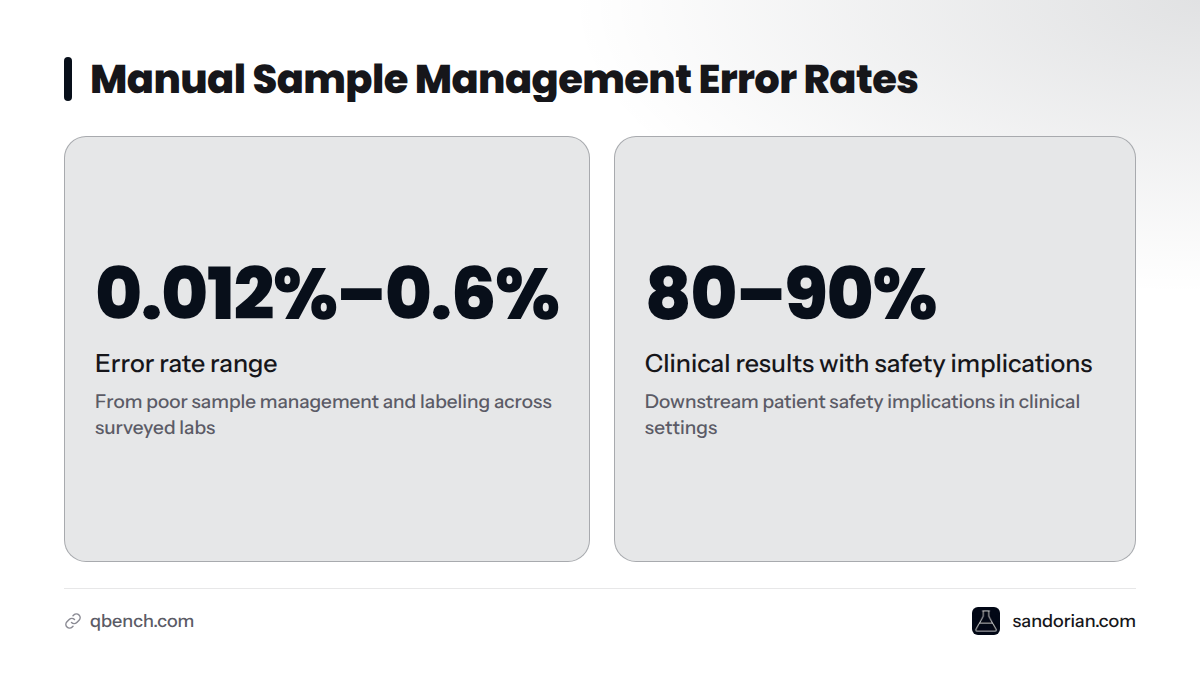
Research cited by QBench across surveyed laboratories found that error rates from poor sample management and labeling range from 0.012% to 0.6% - and in clinical settings, up to 80–90% of test results carry downstream patient safety implications. Every manual re-keying step multiplies the chance of a sample ID being misread, a test code being entered incorrectly, or a client reference being lost entirely.
Here is what the pain chain looks like without lab sample intake software:
- Unstructured email requests arrive with incomplete or inconsistent data, and staff fill the gaps from memory
- Paper-based acceptance decisions disappear into a filing cabinet with no timestamped record
- Manual sample ID generation creates mislabeling risk, particularly under volume or shift-change pressure
- LIMS entries typed from a spreadsheet create duplicate effort and a second opportunity for error
Missing receipt conditions and acceptance decisions become an audit liability
When an ISO 17025 auditor reviews the pre-analytical phase, they look for documented evidence that acceptance criteria were checked and that any out-of-condition samples were handled per procedure. If that decision lived in someone's head or in an unmarked email thread, it doesn't exist from an audit perspective. The gap isn't malicious - it's structural. The right software closes it by design.
Our approach: digitised intake that hands off cleanly to your LIMS
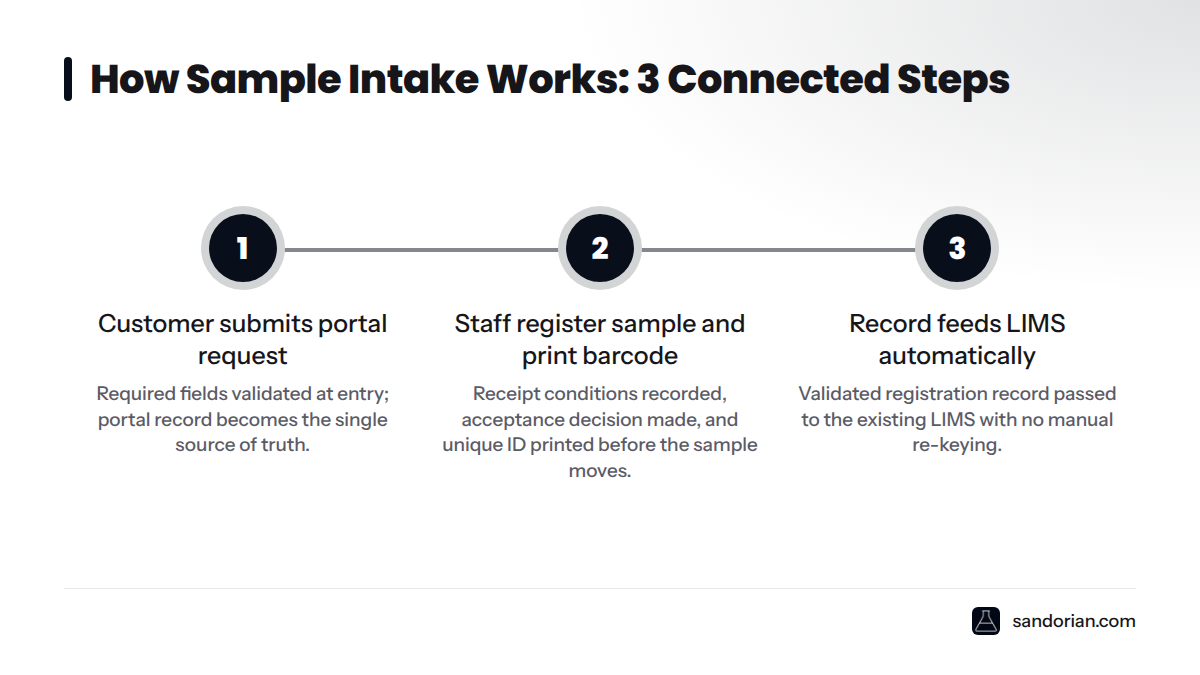
Sandorian builds custom sample registration software for laboratories scoped to the lab's actual workflow, not a generic template. The intake layer we deliver covers three connected steps.
Customers submit structured requests through a portal
Instead of sending an email or calling in, external clients submit a structured request form through a dedicated portal. Required fields are validated at entry - test codes, sample types, quantities, special conditions - so incomplete or inconsistent requests are caught before they reach lab staff. The portal record becomes the source of truth for everything that follows.
Staff register samples against the request, not a re-typed email
When the sample arrives, staff match the physical sample to the existing portal request. They record receipt conditions - temperature on arrival, packaging integrity, any deviation from expected state - and make the acceptance decision against predefined criteria. The sample gets a unique ID. A barcode label is printed at the point of registration, using a connected label printer, before the sample moves anywhere. Chain of custody starts here, with a timestamped, attributed record tied to the original customer request.
For labs that want a broader view of digital traceability for ISO 17025 labs, the intake layer is typically the first and most impactful place to start.
The intake record feeds your LIMS automatically
The completed registration record - sample ID, customer data, test codes, receipt conditions, acceptance decision - passes to the existing LIMS through an integration. The LIMS receives a clean, structured entry. No analyst touches the keyboard to create it. Integrating intake with your existing LIMS covers the technical architecture of that handoff in detail.
Here is the intake-to-LIMS flow from end to end:
- Customer submits a structured request through the portal
- Request is validated against acceptance criteria before it enters the registration queue
- Staff register the sample against the confirmed request and record receipt conditions
- A unique barcode label is generated and printed at the point of registration
- The completed intake record passes automatically to the LIMS
- The analyst picks up the sample in the LIMS and begins testing
What the software covers
| Capability | What it does |
|---|---|
| Customer request portal | Customers submit structured intake forms online; data validated at entry |
| Contract review support | Request fields map to acceptance criteria before registration proceeds |
| Sample registration | Staff register samples against the confirmed request; no free-text re-entry |
| Barcode labeling | Unique IDs generated and printed at registration |
| Receipt condition capture | Temperature, packaging condition, and acceptance decision stored with the record |
| Audit trail | Every step timestamped and attributed; auditor-accessible without manual assembly |
| LIMS handoff | Validated records passed to your existing LIMS through an integration |
Understanding what audit-ready lab software actually needs is the foundation for scoping any intake project correctly.
Who this is built for
Not every lab has the same intake problem. Here is where this service fits:
- Testing labs under ISO 17025 losing hours each week to manual sample receipt, email triage, and spreadsheet-based logging
- Calibration labs where each customer request must map precisely to a declared scope of accreditation before a job is accepted
- Diagnostic labs under ISO 15189 or IVDR where pre-analytical traceability is a hard compliance requirement, not a nice-to-have
- Labs that already have a LIMS and need a structured intake layer in front of it, without replacing or re-implementing the LIMS itself
If you're still deciding whether your lab needs a new LIMS or a better workflow around the one you already have, that question is answered directly at does your lab need a new LIMS, or a better workflow.
What labs gain: fewer errors and a self-assembling audit trail
Fewer manual errors at the point of highest risk
The intake step - before the LIMS, before testing - is statistically where most laboratory errors originate. A purpose-built sample registration system for laboratories removes the manual re-keying step entirely. Structured data that was validated when the customer submitted the request arrives in the LIMS without a human copying it between systems.
In our delivery for ViroVet, digitising the full intake workflow cut manual errors by 80%. Read the full account at ViroVet lab digitization results.
An audit trail that assembles itself
Every intake event - request received, acceptance decision made, sample registered, barcode printed, record sent to LIMS - is timestamped and attributed to the staff member who performed it. When an auditor asks for the intake record for a specific sample batch, it is retrieved in seconds. No one assembles it from emails and paper logs the night before an audit visit. For a detailed breakdown of what auditors expect, the audit trail requirements for regulated laboratories article covers each requirement by standard.
How ViroVet used this pattern to cut manual errors by 80%
ViroVet ran a manual intake process that relied on email, phone communication, and re-keyed LIMS entries. The volume of sample requests created a compounding error risk at every handoff point. Sandorian digitised the full intake workflow - from customer request submission through to LIMS handoff - replacing each manual step with a structured, validated, automatically recorded equivalent.
The result was an 80% reduction in manual errors across the intake workflow. The full project narrative, including scope, delivery approach, and outcomes, is at ViroVet lab digitization results.
The same intake-to-LIMS handoff pattern is available for testing, calibration, and diagnostic labs of similar complexity.
Ready to digitise your sample intake?
We scope every project after a short discovery of your current intake flow - no assumptions, no off-the-shelf templates. A 30-minute intake workflow review with a Sandorian engineer is the fastest way to understand what custom sample login software would look like for your lab.
Book an intake workflow review at sandorian.com.
Frequently asked questions
Does sample registration software replace our LIMS?
No. Sample registration software handles the intake layer before the LIMS - customer request capture, acceptance criteria validation, sample registration, and barcode labeling. It then passes clean, structured records into your existing LIMS through an integration. Your analysts continue working in the LIMS they already know. The two systems work together; neither replaces the other.
Can it capture customer requests online?
Yes. The software includes a customer request portal where external clients submit structured intake forms. Required fields are validated at the point of submission, so incomplete or inconsistent requests are flagged before they reach lab staff. This replaces unstructured email and phone-based intake with a single, traceable record that follows the sample from request through to LIMS registration.
How does it support ISO 17025 audits?
ISO 17025:2017 requires laboratories to document sample receipt conditions, acceptance decisions, and chain of custody from the moment a sample is received. The intake software records each of these steps - timestamped and attributed - automatically, without manual assembly. Auditors access a complete pre-analytical record for any sample batch without staff needing to reconstruct it from scattered sources. Accreditation decisions remain with your accreditation body; the software provides the documented evidence those decisions are based on.
Which labs is this built for?
This service is built for testing laboratories under ISO 17025, calibration laboratories where customer requests must map to a defined scope of accreditation, and diagnostic laboratories operating under ISO 15189 or the EU In Vitro Diagnostic Regulation (IVDR). It is suited to labs that already operate a LIMS and need a structured, auditable intake layer in front of it. If your lab is still evaluating LIMS options, see does your lab need a new LIMS, or a better workflow before investing in request intake automation for your lab.
How long does an intake project take?
Project duration depends on the complexity of your current intake workflow, the number of sample types handled, and the integration requirements of your existing LIMS. A focused, single-workflow scope typically runs a few weeks; labs with multiple sample streams, multiple customer types, or a bespoke LIMS integration may take a few months. The first step is a 30-minute discovery call where a Sandorian engineer reviews your current process and gives you a realistic scope estimate.
Sources
Let's talk
We build the systems that power your business. Let us know how we can help.
Book a 30-min Call