Long-Term Signature Validation: What It Is and How It Works
A signed lab report is only as useful as it is verifiable. The moment the signing certificate expires or the issuing Certificate Authority goes dark, that signature becomes unconfirmable - unless the document was built with long-term signature validation in place from the start.
Long-term signature validation (LTV) solves this by embedding the proof of validity inside the document itself. The signed PDF carries its own OCSP CRL revocation data, full certificate chain, and archive timestamps, so any verifier can confirm the signature years or decades later without calling out to any external service.
In our work building certificate portals for ISO 17025 and ISO 15189 accredited labs, the most common gap we see is treating LTV as a signing-time checkbox rather than an ongoing archive discipline. That framing leads to archives that look compliant today and fail silently in year eight of a ten-year retention window.
This article explains what breaks without LTV, how the standard works, and what an archive strategy looks like in practice.
What long-term signature validation actually means
LTV signature practice is the technical discipline of embedding all evidence needed to verify a digital signature - revocation status, certificate chains, and timestamp proofs - directly inside the signed document. The goal is independence from external infrastructure: no live CA endpoint, no OCSP responder, no online service of any kind.
The two governing standards are ETSI EN 319 102 (signature validation procedures) and ETSI EN 319 142 (PAdES specification for PDF). Together they define what evidence must be collected, how it must be structured, and when a signature qualifies as verifiably long-term.
Key terms worth knowing:
- DSS (Document Security Store): a named dictionary structure inside a PAdES PDF that holds embedded validation evidence.
- OCSP response: a signed statement from a CA's Online Certificate Status Protocol responder confirming a certificate was not revoked at a specific moment.
- CRL (Certificate Revocation List): a CA-published list of revoked certificates, used when OCSP is unavailable.
- Archive timestamp: a qualified timestamp applied over the entire DSS, proving the evidence existed and was unaltered before a given point in time.
- Trusted certificate chain: the full sequence of certificates from the signer's end-entity certificate up to a recognized trust anchor.
Three ways a signed lab report loses its verifiability
Each failure mode is distinct, and each one demands a different technical fix.
Certificate expiry. A signing certificate is valid only within its stated validity window. After expiry, a verifier cannot confirm the certificate was valid at the moment of signing without an embedded record of its status at that time. The certificate itself carries no historical proof.
CA revocation and shutdown. The issuing CA's own certificate may eventually expire or be revoked. More critically, the CA's OCSP responder - the online service that answers "was this certificate valid?" - may go offline permanently. Once that endpoint disappears, retroactive revocation checking is impossible without an already-embedded OCSP response or CRL snapshot.
Cryptographic algorithm deprecation. Algorithms protecting signatures eventually weaken. Public key infrastructure depends on the continued computational difficulty of breaking the underlying mathematics. SHA-1 and short RSA key lengths have already been deprecated by both ETSI and national cryptography authorities. A signature made with a deprecated algorithm cannot be reliably verified without a covering archive timestamp applied while the algorithm was still trusted.
Accreditation bodies require records to be retrievable and verifiable across the full retention period. A signed report that cannot be verified is a compliance failure, not a minor inconvenience. For specific retention obligations, review your accreditation body's requirements and your data retention policy in software.
How LTV embeds revocation and trust evidence
The Document Security Store (DSS) is the structural core of long-term archiving of signed PDFs under PAdES. It is a named dictionary embedded inside the PDF carrying three categories of evidence:
- OCSP responses confirming the signing certificate's revocation status at signing time.
- CRLs as an alternative or supplement when the CA publishes them.
- Full certificate chain from the end-entity certificate up to the trust anchor.
Embedding this evidence freezes the proof. Any verifier - reading the document years later - can inspect the DSS and confirm the certificate was valid and unrevoked at the moment of signing without contacting any external service.
The archive timestamp then seals the DSS itself. Applied over the entire DSS contents, it proves the evidence existed and was unaltered before a specific point in time. Archive timestamps are issued by a qualified trust service provider (QTSP) under the eIDAS Regulation (EU No 910/2014).
The initial signing steps for creating a PAdES-compliant signature are covered in the guide on signing lab PDFs in PAdES format. What archive timestamps are and how they are issued is explained in the article on qualified timestamps. This article picks up where those leave off: keeping evidence valid for the life of the document.
Here is the distinction that matters most: a signing-time timestamp (PAdES-T) only proves when the signature was made. It does not embed revocation proof or the full certificate chain. Without those, the timestamp alone cannot reconstruct verifiability after the certificate infrastructure disappears.
PAdES conformance levels and LTV readiness
The PAdES standard, defined in ETSI EN 319 142, specifies a progression of conformance levels. Each level adds evidence on top of the previous one.
| Level | What it adds | LTV ready? |
|---|---|---|
| PAdES-B | Signature and signing certificate only | No |
| PAdES-T | Signature timestamp (proves signing time) | Partial |
| PAdES-LT | DSS with OCSP/CRL and full certificate chain | Yes (static) |
| PAdES-LTA | Archive timestamp over the DSS | Yes (renewable) |
Note: The normative designations in ETSI EN 319 142 are PAdES-B-LT and PAdES-B-LTA. Both terms refer to the same conformance levels.
Only PAdES-LTA supports renewable, algorithm-agile long-term validation. PAdES-LT is static: it embeds evidence once but provides no mechanism to extend coverage if an algorithm is later deprecated. PAdES-LTA adds the archive timestamp that can be renewed, creating a chain of trust that extends the document's verifiability forward in time.
Building an archive strategy for LTV-enabled lab reports
LTV is not a one-time configuration. The re-timestamping archive must be actively maintained across the document's full retention period. Here is the architecture pattern that works in production:
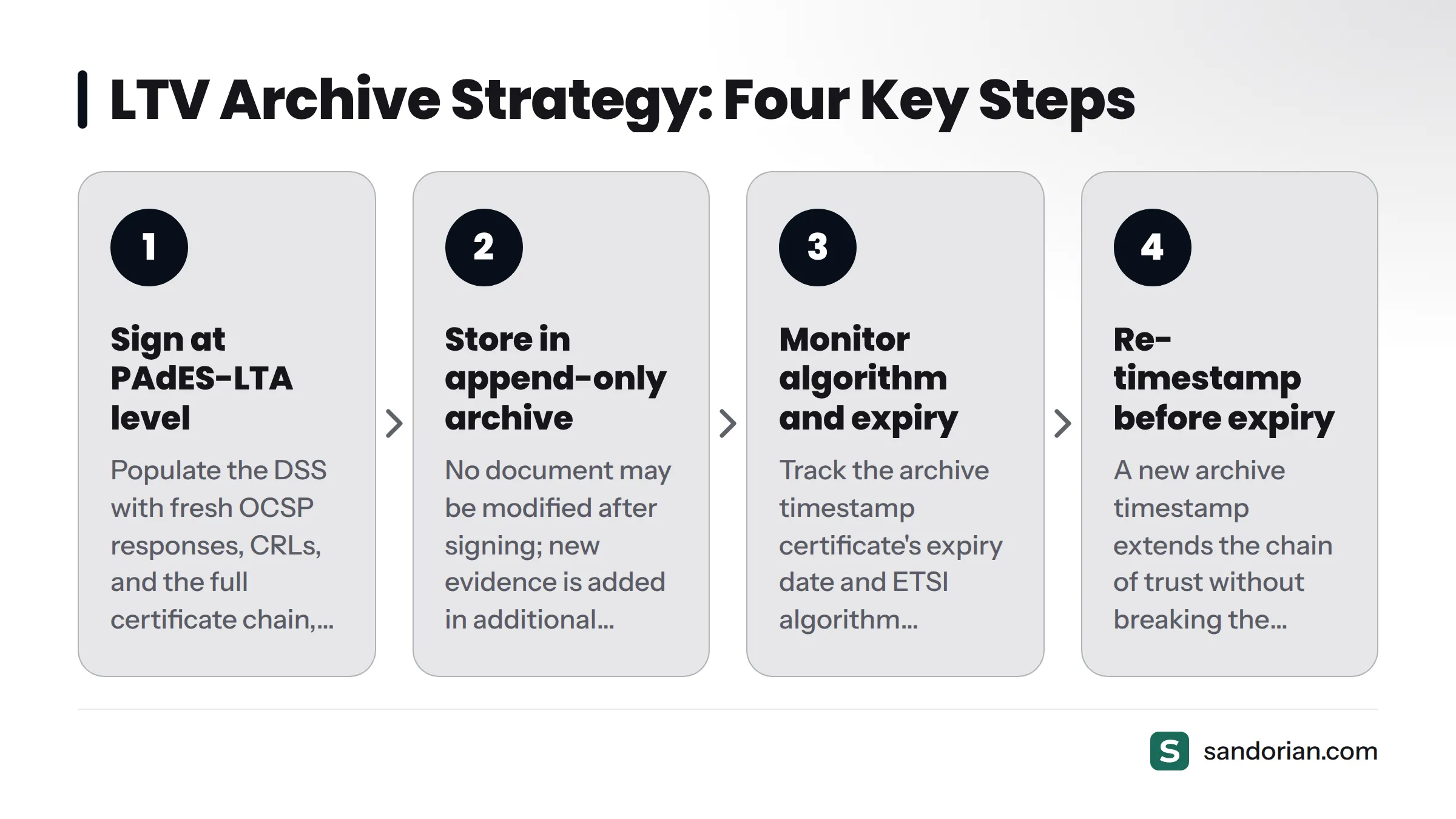
- Sign at PAdES-LTA level. Populate the DSS with fresh OCSP responses, CRLs, and the full certificate chain, then apply an archive timestamp in the same signing transaction.
- Store in an append-only archive system. No document may be modified after signing. New evidence is added in additional revisions, never by overwriting.
- Monitor algorithm validity and timestamp expiry. Track both the archive timestamp certificate's expiry date and the algorithm deprecation guidance issued by ETSI and national cryptography authorities.
- Re-timestamp before evidence expires. A new archive timestamp covers all previous timestamps, extending the chain of trust without breaking the original signature's integrity.
Cryptographic algorithm agility deserves specific attention. Your archive strategy must be able to switch to a stronger algorithm - for example, moving from SHA-256 to SHA-3 or a larger RSA key - before an in-use algorithm is deprecated. A signing library that cannot upgrade its timestamp algorithm is a long-term liability, not a minor technical detail.
The eIDAS electronic seal applied to lab reports is typically the outermost integrity layer; LTV keeps that seal verifiable over time. For teams building the full archive infrastructure, our sealed certificate portal development service covers the end-to-end design.
Triggering archive timestamps before evidence expires
The re-timestamping cycle is the operational discipline that separates a genuinely LTV-ready archive from one that will fail silently in year eight of a ten-year retention window. A new archive timestamp must be applied before either of these events:
- The previous archive timestamp's signing algorithm is deprecated by ETSI or a relevant national authority.
- The timestamp token's own signing certificate expires.
The new timestamp covers all previous timestamps. The chain of trust extends forward without breaking the original signature.
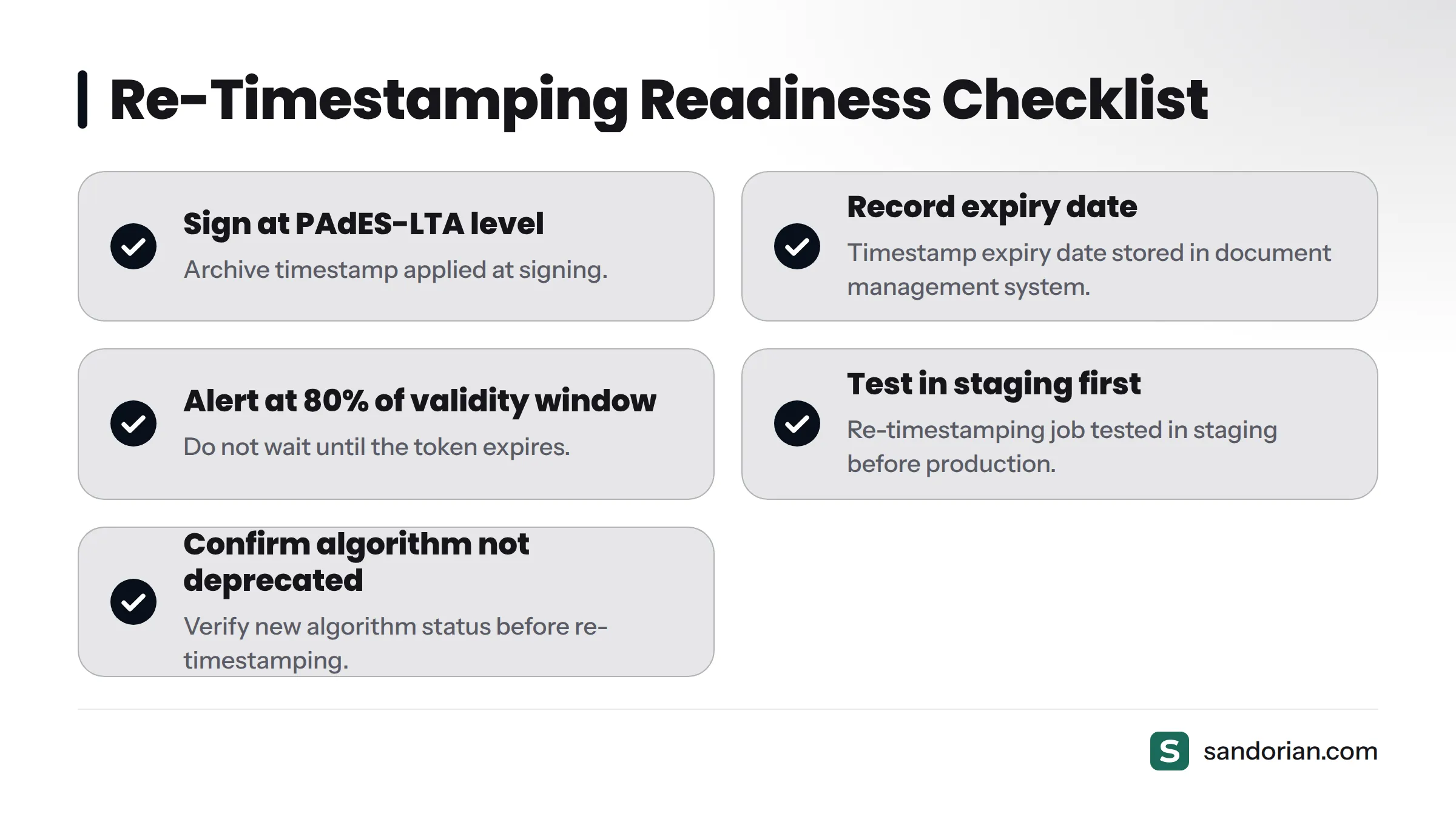
Practical monitoring rule: set a calendar alert at 80% of the archive timestamp token's stated validity window. Do not wait until expiry. By the time an alert fires at 100%, there may not be enough time to test and deploy a new timestamp before the window closes.
Integrating this into the lab portal's automated workflow - rather than relying on a manual calendar review - is the difference between a compliant archive and a compliance risk.
Re-timestamping readiness checklist:
- Archive timestamp applied at signing (PAdES-LTA)
- Timestamp expiry date recorded in document management system
- Alert triggered at 80% of validity window
- Re-timestamping job tested in staging before production
- New algorithm confirmed not deprecated before re-timestamping
Here is a short video from Signicat that explains why LTV matters from a business and compliance perspective:
https://www.youtube.com/watch?v=XSC9GJkbLII
Common pitfalls when implementing LTV in lab portals
These are the errors we see most often when reviewing archive implementations for European labs.
- Stale OCSP responses. An OCSP response has its own validity window, often just a few hours. Fetching the response too early and embedding it too late means the embedded data may already be outside its valid window when a verifier reads it. Fetch the OCSP response as close to the moment of signing as possible.
- Missing intermediate certificates. The DSS must contain every certificate in the chain up to the trust anchor, not only the end-entity signing certificate. A missing intermediate causes chain-building failures during verification.
- Forgetting the LT-to-LTA upgrade. Some signing libraries produce PAdES-LT by default and require an explicit additional step to apply the archive timestamp. Confirm in your implementation that the archive timestamp is applied in the same signing transaction, not left as an optional post-processing step.
- Assuming the archive timestamp lasts forever. SHA-256-based timestamps are secure today, but cryptographic algorithm guidance evolves. Monitor ETSI and national authority publications and act before deprecation, not after.
- No re-timestamping workflow. The most common gap in lab portal implementations is treating LTV as a signing-time concern. Without an automated re-timestamping workflow, the archive degrades silently over years.
- Algorithm lock-in. A signing library or service that cannot upgrade its timestamp algorithm when the current one is deprecated will eventually force a costly migration under time pressure.
Frequently asked questions
What happens to a signed PDF if its signing certificate expires?
Without LTV, a verifier cannot confirm the certificate was valid at signing time, because the certificate is no longer reachable or checkable against an active revocation service. With LTV (PAdES-LT or PAdES-LTA), the OCSP response or CRL proving validity at signing time is embedded in the DSS. The signature remains independently verifiable regardless of the certificate's current status.
Can a PAdES-B or PAdES-T document be upgraded to PAdES-LTA after the fact?
Yes, but only if the original OCSP response or CRL for the signing certificate is still retrievable from the CA's infrastructure. Once a CA's revocation infrastructure goes offline, retroactive LTV embedding becomes impossible. This is why LTV must be applied at or immediately after the moment of signing, before any CA infrastructure changes.
How often should archive timestamps be renewed?
Renew before the archive timestamp's signing algorithm is deprecated or the timestamp token's certificate expires - whichever comes first. The practical rule is to renew at 80% of the token's stated validity window and to track cryptographic algorithm guidance from ETSI and relevant national authorities on an ongoing basis.
Does LTV satisfy accreditation retention requirements?
LTV keeps signed documents technically verifiable for the required period, which is a necessary condition for meeting retention rules. Whether it is sufficient depends on your accreditation body and jurisdiction. Confirm specific obligations with your accreditation body and review your data retention policy in software.
Ready to review your archive design? Designing a sealed-report archive that stays verifiable across your accreditation retention period is an engineering and compliance challenge. If you want an expert review of your archive and validation design, get in touch with the Sandorian team.
Sources
Let's talk
We build the systems that power your business. Let us know how we can help.
Book a 30-min Call