Qualified Electronic Timestamp: What It Is, Why Labs Use It
Technical disclaimer: This article is technical guidance, not legal advice. For evidentiary admissibility questions, consult a qualified legal professional.
A qualified electronic timestamp is issued by a Qualified Trust Service Provider (QTSP) listed on an EU Trusted List, following the RFC 3161 protocol. Under eIDAS Regulation (EU) 910/2014, it carries a legal presumption that the data it seals existed at the stated time and has not been altered since - making it the strongest available proof of existence for a lab report.
What a qualified electronic timestamp proves - and what it doesn't
The eIDAS definition and legal presumption under Article 42
Article 42 of eIDAS Regulation (EU) 910/2014 sets three requirements for a qualified electronic timestamp: it must bind date and time to data in a way that reasonably precludes undetectable change, it must draw from an accurate time source linked to Coordinated Universal Time, and it must be signed using an advanced electronic signature or sealed using an advanced electronic seal of a QTSP.
The legal effect is a presumption, not an absolute proof. That distinction matters in practice. Any party disputing the time or integrity of a timestamped document must affirmatively disprove what the qualified timestamp asserts. No non-qualified timestamp carries that standing.
Proof of existence - the precise scope
The eIDAS qualified timestamp presumption covers two things and only two things:
| What a qualified timestamp proves | What it does not prove |
|---|---|
| ✓ The data existed at the stated date and time | ✗ The identity of the person who created or signed the report |
| ✓ The data has not been altered since timestamping | ✗ The accuracy or correctness of the content |
| ✗ The legal intent or agreement of any party | |
| ✗ That the document was validly signed or sealed | |
| ✗ Long-term validity beyond the TSA certificate lifetime |
This distinction matters enormously in lab contexts. A timestamp on a falsified result still proves the falsified result existed at that moment - it does not vouch for its accuracy. The timestamp is an integrity guarantee, not a truth guarantee.
How the RFC 3161 timestamp protocol works
The request-response cycle
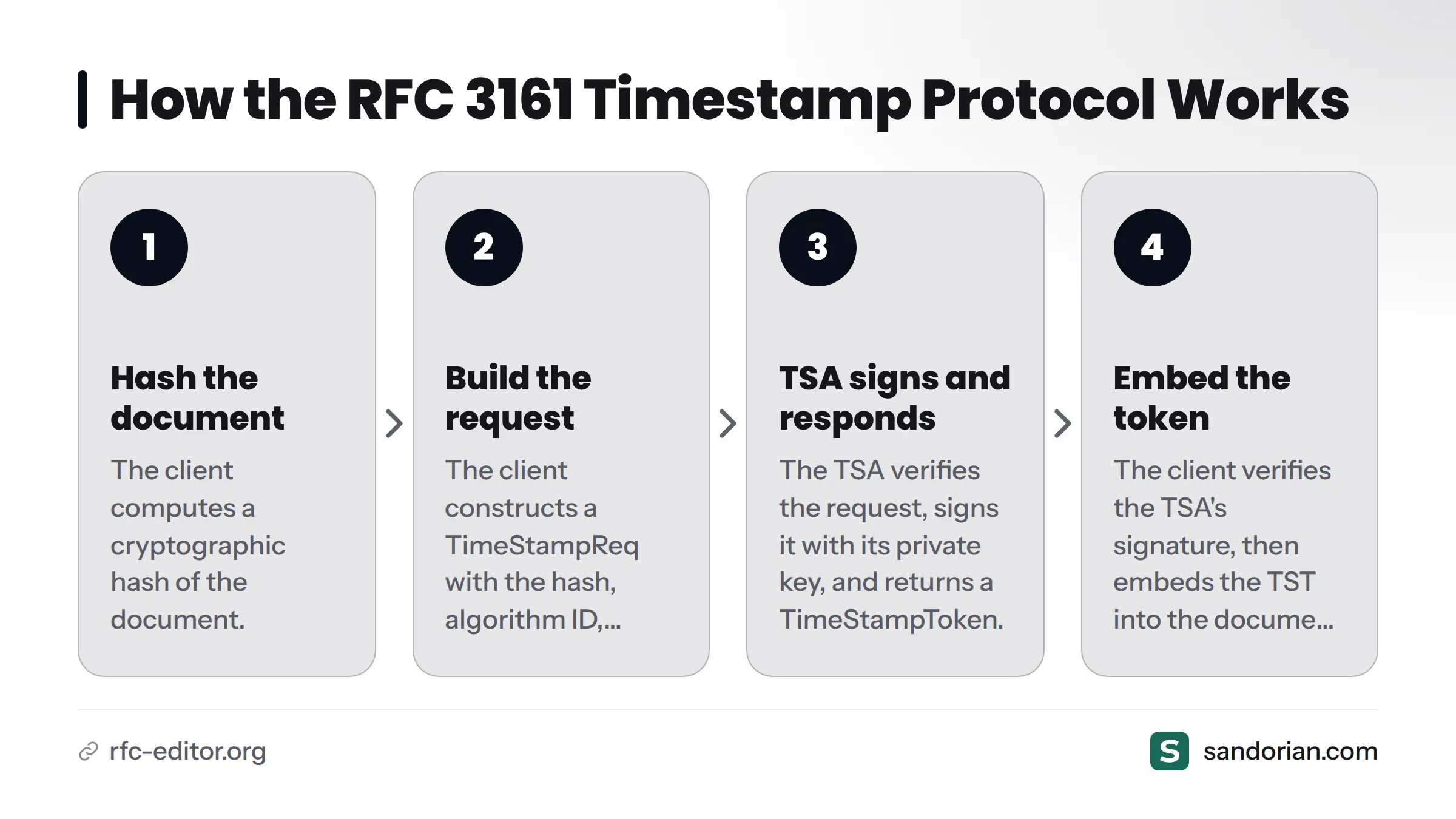
RFC 3161 defines the Internet X.509 Public Key Infrastructure Time-Stamp Protocol (TSP). The cycle has four steps:
- The client computes a cryptographic hash of the document.
- The client constructs a
TimeStampReqmessage containing the hash, the hash algorithm identifier, an optional policy OID, a nonce, and a flag requesting the TSA's signing certificate. - The TSA verifies the request, signs the response using its own private key, and returns a
TimeStampRespcontaining aTimeStampToken(TST). - The client verifies the TSA's signature on the TST, then embeds the TST into the document or signature container.
The TSA never receives the document itself - only its hash. This keeps sensitive lab data off a third-party server while still binding the trusted timestamp to the exact content.
Inside a TimeStampToken: what the structure contains
A TimeStampToken (TST) is a CMS SignedData structure. Its signed attributes include:
- messageImprint - the hash algorithm OID plus the hash value submitted by the client
- genTime - the TSA's
generalizedTimefield, expressing the timestamp to millisecond precision in UTC - nonce - a random value generated by the client and echoed back by the TSA
- policy - the OID of the TSA's timestamp policy under which the token was issued
- tsa - the TSA's GeneralName (optional but typically present), identifying the issuing authority
The TSA wraps these fields in its digital signature, creating a tamper-evident record that ties the hash to the genTime under the TSA's certified key.
Why the nonce matters: A nonce is a random integer the client generates and includes in every
TimeStampReq. The TSA is required to echo the identical nonce in itsTimeStampResp. If the nonce in the response does not match, the client must reject the token. This one-round-trip mechanism prevents replay attacks - where an attacker tries to reuse an old TST for a different document - because a recycled response will carry a stale nonce that does not match the client's fresh request.
What gets hashed and bound in a lab report timestamp
SHA-256 and the document fingerprint
The standard hash algorithm used in current TST construction is SHA-256, defined in NIST FIPS 180-4. SHA-256 produces a 256-bit digest that is computationally infeasible to reverse or collide under present cryptographic conditions. Using a weaker algorithm such as SHA-1 would undermine long-term validity; accreditation bodies and national supervisory bodies increasingly expect SHA-256 or stronger.
Hash, not content
The TST contains the SHA-256 hash of the document, not the document itself. A PDF lab report may be several megabytes; transmitting the file to an external TSA would create latency, bandwidth costs, and data-security concerns. The hash is a fixed-size fingerprint: any single-bit change to the report produces a completely different hash, so the TST effectively binds every byte of the content without exposing any of it.
Locating the TSA's generalizedTime field
When verifying a TST, the genTime field is the authoritative timestamp value. It is expressed in GeneralizedTime format (YYYYMMDDHHMMSS.sssZ) and must derive from a trusted time source - typically a national time authority synchronised to UTC. QTSPs are required by ETSI EN 319 421 to operate synchronised time sources and to log any drift events.
Qualified vs. non-qualified timestamps: what changes for labs
The table below captures the practical differences that matter for accreditation and legal standing.
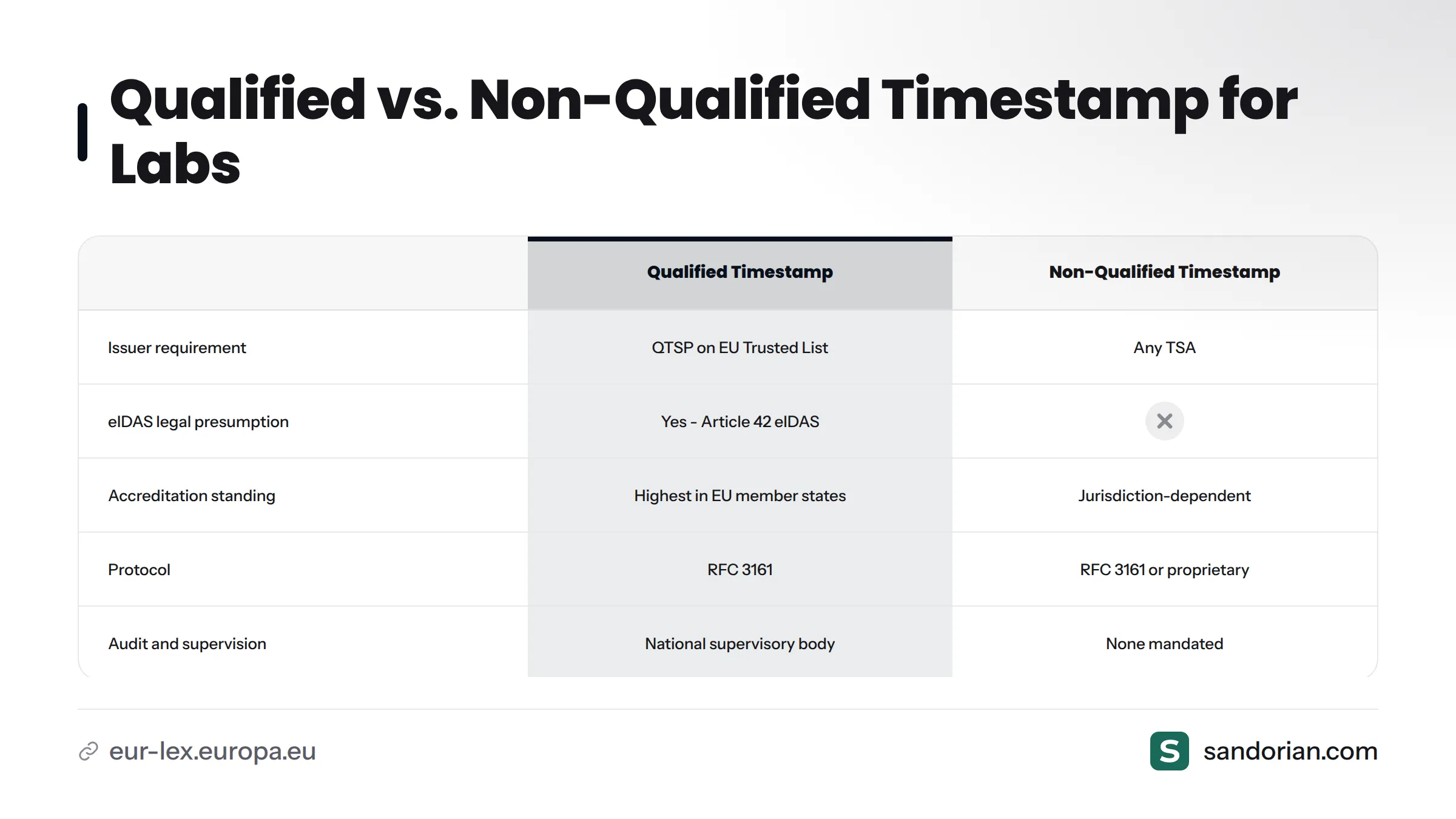
| Feature | Qualified timestamp | Non-qualified timestamp |
|---|---|---|
| Issuer requirement | QTSP listed on an EU Trusted List | Any TSA |
| eIDAS legal presumption | Yes - Article 42 of eIDAS (EU) 910/2014 | No |
| Accreditation body acceptance | Highest standing in EU member states | Jurisdiction-dependent |
| Protocol | RFC 3161 | RFC 3161 or proprietary |
| Audit and supervision | National supervisory body | None mandated |
For ISO 17025-accredited testing labs, this choice is not purely technical. If your accreditation body or customer contracts require demonstrable, legally presumed data integrity, a qualified timestamp from a qualified time stamp authority is the defensible option. A free or open TSA may use RFC 3161 mechanically, but it carries no eIDAS presumption and faces no mandatory supervision.
Where labs must - or should - apply qualified timestamps
At report finalisation, before the PDF is delivered
The correct moment to apply a qualified electronic timestamp is immediately after the report PDF is sealed and before the delivery record is written. Timestamping a draft or a partially signed document creates ambiguity about which version the TST covers. Timestamping after delivery creates a gap during which the file could theoretically be altered.
Alongside a qualified electronic seal - not instead of one
A qualified timestamp and a qualified electronic seal serve different functions and must both appear on a lab report that claims full eIDAS standing. The seal proves organisational origin - it binds the issuing lab's identity to the document via the lab's certificate. The timestamp proves the document existed at a specific time and has not changed since. Neither replaces the other. For a closer look at how the seal works, see our article on the eIDAS electronic seal.
ISO 17025 traceability and the timestamp's role
ISO 17025:2017 requires laboratories to maintain records with sufficient integrity to demonstrate that the testing process was followed correctly. Section 7.11 specifically addresses records management, requiring that records be legible, stored and retained in a way that prevents deterioration, and protected from unauthorised modification. A qualified timestamp provides cryptographic evidence of when a record was finalised and that it has not been modified - directly supporting the traceability chain an accreditation body will inspect. Our digital traceability guide for ISO 17025 labs covers the broader traceability architecture.
PAdES-B-T and PAdES-LT - where the TST lives in the PDF container
In a PDF report, the TST is embedded according to PAdES profiles defined in ETSI EN 319 122. PAdES-B-T (baseline with timestamp) adds the TST to the signature container inside the PDF, proving the signature existed at the time of timestamping. PAdES-LT (long-term) goes further, embedding the full certificate chain and revocation data alongside the TST, so the signature can be validated without contacting external services years later. Step-by-step instructions for embedding timestamps in PDF reports are covered in our guide on adding timestamps when signing PDFs with PAdES.
Integrating TSA calls into automated report issuing
Finding a qualified TSA on the EU Trusted List
The EU Trusted List browser is the normative tool for identifying qualified TSAs. Each EU member state publishes its national Trusted List; the European Commission aggregates these into the List of Trusted Lists (LOTL). Filter by service type QTSAnonAdESQCwithQSCD or TSA with status "granted" to find currently supervised QTSPs offering qualified timestamping. Never rely on a TSA's self-declared qualification - the EU Trusted List is the authoritative source.
The TSA endpoint: constructing and sending the request
A qualified TSA exposes an HTTP or HTTPS endpoint, typically at a path such as /tsa or /timestamp. The request uses Content-Type: application/timestamp-query and Accept: application/timestamp-reply. Here is the sequence:
- Compute
SHA-256(document_bytes)to produce themessageImprint. - Generate a cryptographically random 64-bit nonce.
- Build a
TimeStampReqASN.1 structure: setversion=1, includemessageImprint(algorithm OID + hash), include the nonce, setcertReq=TRUE. - HTTP POST the DER-encoded
TimeStampReqto the TSA endpoint. - Receive the
TimeStampResp; checkstatus.status == 0(granted) before proceeding. - Verify the TSA's signature on the TST against the TSA's certificate chain, obtained via the EU Trusted List or the embedded
tsacertificate. - Embed the DER-encoded TST into the PDF's signature container or as a document-level timestamp.
From our own pipelines: In Sandorian's certificate portal integrations, we construct the RFC 3161 timestamp request immediately after the report PDF is sealed, before the delivery record is written. This ordering ensures there is never a finalised PDF in storage without a corresponding TST - a gap that would create an audit question we cannot answer.
Handling TSA downtime, timeouts, and retry logic
Why TSA endpoints fail and how often
Even well-operated QTSPs experience brief outages. Planned maintenance windows, network partitions, and certificate renewal operations all cause temporary unavailability. In a high-volume lab environment issuing hundreds of reports per day, hitting a TSA outage without a resilience strategy means either delayed delivery or, worse, reports sent without valid timestamps.
Timeout thresholds and exponential backoff
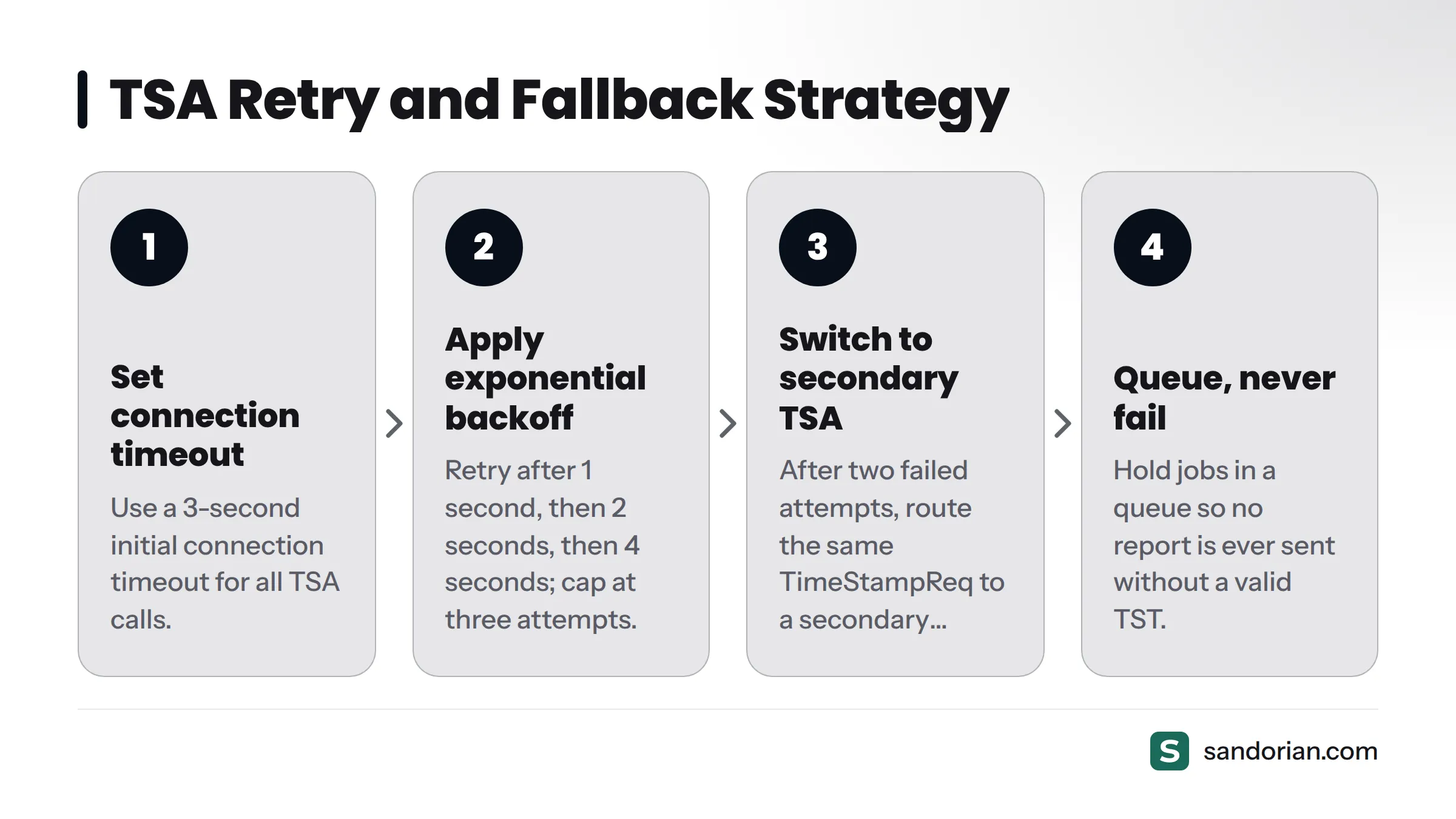
We recommend a 3-second initial connection timeout for TSA calls. Network round-trips to a European QTSP from within the EU typically complete in under 500ms; a 3-second ceiling catches genuine failures without blocking the report pipeline for too long.
After a timeout or a non-granted response, apply exponential backoff: retry after 1 second, then 2 seconds, then 4 seconds. Cap retries at three attempts on the primary TSA before escalating.
Fallback TSA configuration
Configure a secondary QTSP endpoint - ideally from a different provider hosted in a different geography - as a fallback. After two failed attempts against the primary TSA, route the same TimeStampReq to the secondary endpoint. Both must be qualified TSAs on the EU Trusted List; substituting a non-qualified fallback would silently downgrade the legal standing of affected reports.
From production: In our deployments, we route to a secondary TSA after two failed attempts with a 3-second timeout per attempt. The delivery job is queued, not failed, so the report is never sent without a valid TST. A dead-letter queue holds jobs that exhaust all retry attempts; an alert fires immediately so an engineer can inspect and manually release once the TSA recovers.
When timestamping cannot complete - hold, queue, or fail?
Queue, not fail - and never proceed without a TST. Sending a report without a qualified timestamp because the TSA was temporarily unavailable creates a compliance gap that is hard to explain to an accreditation body after the fact. A held job released an hour later - with a TST confirming the document was unchanged - is a defensible position. A sent report with no TST is not.
What a qualified timestamp cannot prove
Honest scope limits build more trust than overpromising. A qualified electronic timestamp gives you a strong, legally presumed claim, but only within its defined boundary.
- Identity of the creator or signatory. The TST binds a hash to a time. It says nothing about who produced or approved the content. For organisational identity, you need a qualified electronic seal; for individual identity, see our guide to qualified electronic signatures under eIDAS.
- Accuracy or correctness of the content. A timestamped report containing a measurement error is still timestamped accurately. The TST proves the error was present at that time, not that the measurement was correct.
- Legal intent or agreement. A timestamp is not a signature. It does not indicate that any party agreed to, approved, or accepted the contents.
- Validity of an accompanying signature or seal. If the seal certificate was already revoked at the time of signing, the timestamp does not rescue it. Signature and seal validity are independent questions.
- Long-term validity beyond the TSA certificate lifetime. Once the TSA's signing certificate expires or its algorithm is deprecated, the TST needs to be covered by a renewal timestamp or embedded revocation data. This is addressed by the PAdES-LT profile and long-term signature validation procedures.
Frequently asked questions
What is the difference between a qualified and a non-qualified electronic timestamp?
A qualified timestamp is issued by a QTSP supervised under eIDAS and listed on an EU Trusted List. It carries a statutory legal presumption of accuracy and integrity under Article 42 of eIDAS (EU) 910/2014. A non-qualified timestamp may use the same RFC 3161 protocol but has no mandated supervision and creates no legal presumption.
Which regulation defines a qualified electronic timestamp in the EU?
eIDAS Regulation (EU) 910/2014, specifically Article 42, sets out the requirements. Articles 3(34) and 41 provide the general definition and legal effects.
What is a TimeStampToken (TST) and what does it contain?
A TST is a CMS SignedData structure returned by a TSA in response to an RFC 3161 timestamp request. It contains: (1) the messageImprint - the hash algorithm and hash value of the submitted data; (2) genTime - the TSA's certified UTC time; (3) the nonce - the client-generated random value echoed back; (4) the TSA's digital signature over all of the above.
How does a lab verify that a timestamp is qualified?
Check the TSA that issued the TST against the EU Trusted List browser. The TSA must appear with a service type indicating qualified timestamping and status "granted" at the time the TST was issued. The TSA's signing certificate must chain to a certificate listed in the Trusted List.
Can a qualified timestamp replace a qualified electronic seal?
No. They prove different things. The timestamp proves existence at a time and post-timestamp integrity. The seal proves organisational origin. Both are needed for a fully eIDAS-compliant lab report delivery.
Where do I find a list of qualified TSAs in Europe?
The EU Trusted List browser, maintained by the European Commission under eIDAS Article 22, lists all qualified trust service providers by member state, including those offering qualified timestamping services.
How does a qualified timestamp support ISO 17025 traceability?
It provides cryptographic evidence that the finalised report existed at a specific time and has not been altered since - directly supporting the record integrity requirements in ISO 17025:2017 Section 7.11 and the traceability requirements an accreditation body will examine.
What happens if the TSA is unavailable when my system tries to timestamp a report?
Queue the report delivery job and retry using exponential backoff (1s, 2s, 4s). After exhausting retries on the primary TSA, route to a secondary qualified TSA endpoint. Never send the report without a valid TST; hold the job until timestamping succeeds.
Does a qualified timestamp prove who signed the document?
No. A qualified timestamp proves that a specific byte sequence existed at a stated time. It does not identify any person or organisation. For identity binding, a qualified electronic seal (organisation) or qualified electronic signature (individual) is required.
How long is a qualified timestamp valid?
The TST itself does not expire, but its long-term verifiability depends on the TSA's signing certificate remaining valid and the hash algorithm remaining cryptographically strong. For archival periods beyond the certificate lifetime, PAdES-LT profiles embed revocation data alongside the TST, and long-term signature validation procedures apply.
Ready to see how qualified timestamping fits into a complete, automated report delivery pipeline? Read about our digital certificate portal service to understand how every report leaves your lab with a TST, a qualified seal, and a verifiable delivery record - built for ISO 17025 and ISO 15189 environments.
Sources
Let's talk
We build the systems that power your business. Let us know how we can help.
Book a 30-min Call