Mollie vs Stripe: Which Fits a European Platform?
Disclosure: Sandorian is a Mollie Preferred Integration Partner and the maintainer of laravel-cashier-mollie. We also integrate Stripe across client engagements. This article reflects integration behaviour observed in production, not vendor marketing. You can read the announcement of our official partnership with Mollie for full context.
For a European platform that needs iDEAL, Bancontact, SEPA Direct Debit, and a marketplace-ready split payment architecture, Mollie fits better out of the box. That is the short answer. Stripe is the stronger choice when global reach, a mature ecosystem, or maximum API composability matter more than European payment method depth. Every criterion below qualifies that rule.
Quick answer: Mollie or Stripe for a European platform?
For most European platforms - marketplaces, SaaS products, or multi-merchant products operating in the eurozone - Mollie is the better default. It activates local payment methods natively, manages sub-merchant KYC through Mollie Connect, and prices per method rather than as a blended percentage. Stripe wins when your platform is global first, when you need the deepest API composability, or when you depend on Stripe's broader product suite.
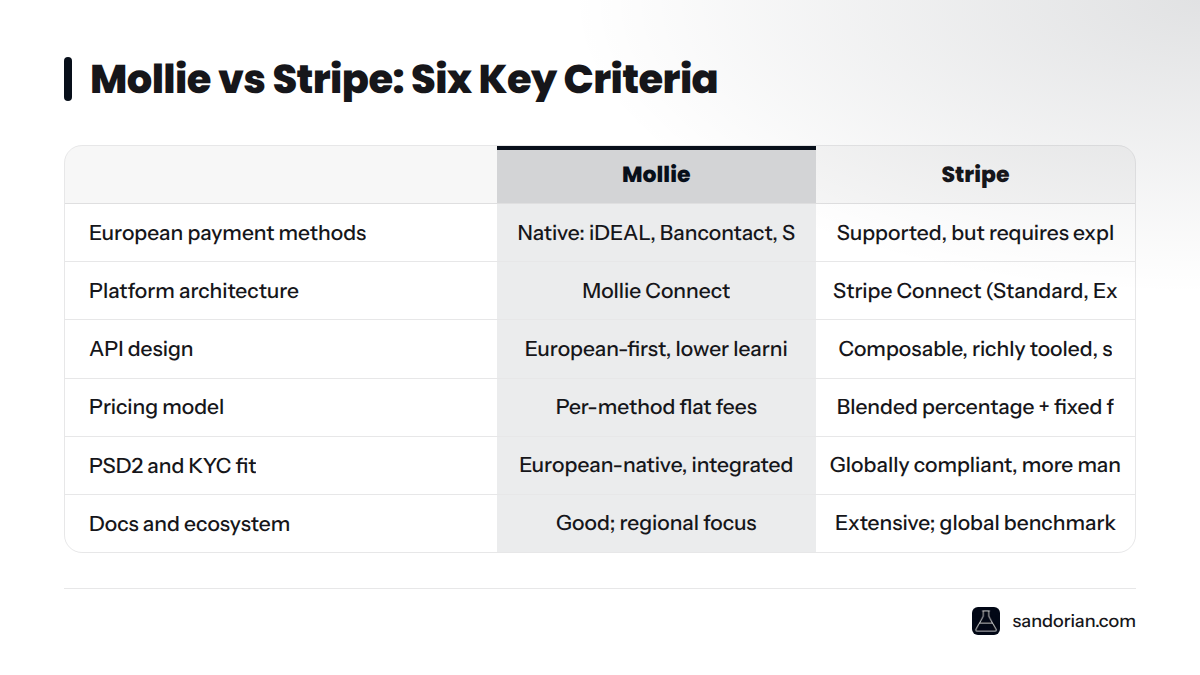
Here is the side-by-side view across the six criteria this article covers:
| Criterion | Mollie | Stripe |
|---|---|---|
| European payment method coverage | Native: iDEAL, Bancontact, SEPA DD, Klarna, and more | Supported, but requires explicit activation |
| Marketplace and platform architecture | Mollie Connect | Stripe Connect (Standard, Express, Custom) |
| API design | REST-based, European-first, lower learning curve | Composable, richly tooled, steeper ramp |
| Pricing model | Per-method flat fees | Blended percentage + fixed fee |
| PSD2 and KYC compliance fit | European-native, integrated KYC for sub-merchants | Globally compliant, more manual KYC setup |
| Documentation and partner ecosystem | Good; regional focus | Extensive; global benchmark |
Criterion 1: European payment method coverage
Which local methods does Mollie support natively?
Mollie was built for Europe. Its payment method library covers iDEAL (the dominant bank-transfer method in the Netherlands), Bancontact (the primary debit network in Belgium), SEPA Direct Debit across the eurozone, Klarna, Sofort, Przelewy24 (Poland), and EPS (Austria), among others. According to Mollie's payment methods documentation, these are available to merchants without needing separate contracts with each scheme - you activate them through the Mollie dashboard and they are ready to use.
That design choice matters operationally. A platform entering three eurozone markets simultaneously does not need three separate acquiring relationships. Mollie handles the scheme contracts, making method activation a configuration decision rather than a procurement project.
How does Stripe handle European payment methods?
Stripe supports iDEAL, Bancontact, and SEPA Direct Debit - but each method requires explicit activation in the Stripe dashboard, and some require additional configuration to handle mandate collection for recurring use. According to Stripe's payment methods documentation, Stripe's default onboarding flows are designed around card payments, with local methods layered on top. That is not a flaw; it reflects Stripe's global-first architecture. It does mean European method support is not the starting point in the way it is with Mollie.
Note: If your platform's primary market is the Netherlands, Belgium, or Germany, local payment method coverage is the first filter - not pricing. Readers who need detail on the iDEAL integration specifically can find it in the integrating iDEAL guide.
Criterion 2: Platform and marketplace architecture
Mollie Connect for multi-merchant platforms
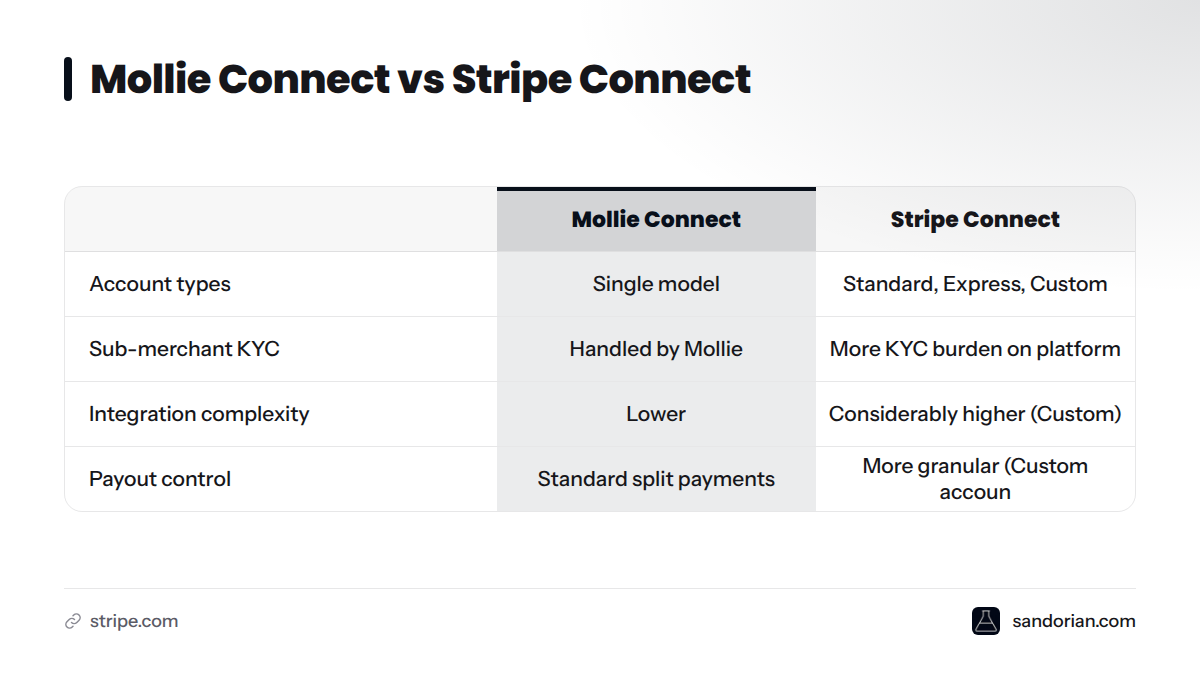
Mollie Connect lets a platform onboard sub-merchants, route incoming payments to the right recipient, and split funds. The most significant operational advantage, in our integration experience, is that Mollie handles Know Your Customer (KYC) verification for sub-merchants as part of the Connect onboarding flow. A platform does not need to build a separate KYC layer - the compliance obligation passes to Mollie for the merchants it onboards. The full architecture detail for platform builders lives in Mollie Connect for platforms. According to Mollie's Connect documentation, the model supports both application fees and split payments, covering the two most common revenue structures for European marketplaces.
Stripe Connect for marketplaces
Stripe Connect is mature and well-documented. It offers three account types - Standard, Express, and Custom - each representing a different point on the trade-off between integration effort and platform control. Standard accounts give sub-merchants their own Stripe dashboard and reduce the platform's compliance surface. Express accounts offer a hosted onboarding UI. Custom accounts give the platform full control over every UX element, at the cost of owning the full compliance burden. Stripe's Connect documentation covers these distinctions in depth.
The trade-off is real: Custom accounts give you more granular payout control than Mollie Connect currently matches, but the integration complexity is considerably higher.
Which platform architecture fits which use case?
Mollie Connect is the better fit for European marketplaces that want simplified KYC onboarding and need local payment methods as first-class options from day one. Stripe Connect is stronger for global marketplaces or platforms that require granular payout control, multi-currency disbursements, or the flexibility that Custom accounts provide. The PSP selection guide for European SaaS covers how to frame this decision at the product scoping stage.
Criterion 3: API design and integration complexity
Mollie's API design philosophy
Mollie's API is REST-based, resource-oriented, and consistent in its pagination and response structure. Webhooks follow predictable patterns - a status callback arrives on the endpoint you register, carrying the payment or order ID, and you fetch the resource to get its current state. In our integration experience, this is an approachable model for mid-sized engineering teams that do not have a dedicated payments specialist. The Mollie API Integration Patterns for Production Applications guide documents the patterns we use across client engagements, including idempotency handling and webhook retry logic.
One practical point: understanding API idempotency matters with any payments API, and Mollie's implementation is predictable enough that teams can reason about it without needing to reverse-engineer edge cases.
Stripe's API design philosophy
Stripe's API is widely considered the benchmark in API design - composable, exhaustively documented, and supported by a CLI, test helpers, and libraries across every major language. If you have a payments engineer who lives in the Stripe ecosystem, that investment pays off. If your team is smaller and needs to move fast, the surface area can slow you down. Stripe's API documentation covers every resource in depth. From integration experience, Stripe rewards teams that invest time upfront in understanding its object model; teams that skip that step often end up with fragile webhook handling.
SDK and library ecosystem
Sandorian maintains laravel-cashier-mollie, an open-source library that brings Mollie subscription billing into the Laravel Cashier interface - covering mandate management, SEPA Direct Debit subscriptions, and billing cycles. Stripe has its own official Laravel Cashier package. Both provide strong PHP and Laravel support. The difference is that laravel-cashier-mollie is designed specifically for the SEPA mandate flow, which Stripe's official Cashier package does not handle natively for European subscription patterns.
Criterion 4: Pricing transparency and fee structure
How Mollie charges
Mollie uses a per-method flat fee model. According to Mollie's pricing page, iDEAL transactions carry a fixed fee per transaction rather than a percentage of the transaction value - which means an iDEAL payment for €800 costs the same as one for €80. For platforms with higher average order values and a local-method-heavy transaction mix, this model is materially cheaper than a percentage-based alternative. Mollie also offers volume pricing for high-throughput platforms, negotiated on request.
How Stripe charges
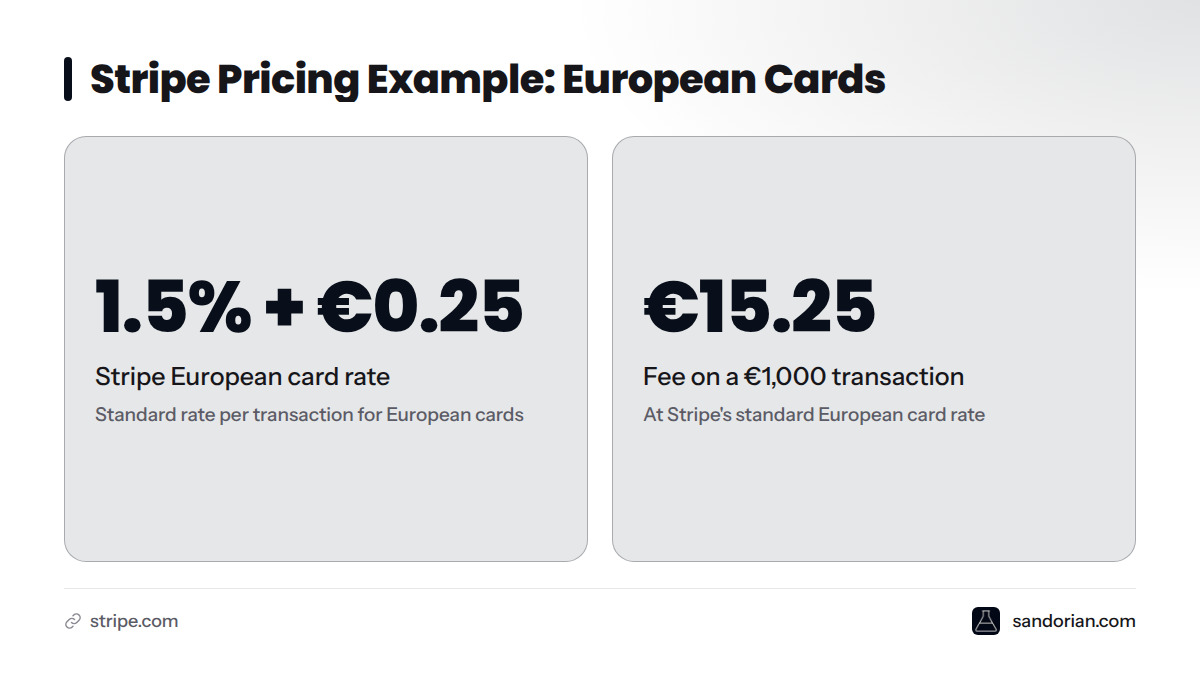
Stripe's standard model is a blended percentage plus a fixed fee per transaction. According to Stripe's pricing page for the Netherlands, the standard European card rate is 1.5% + €0.25 for European cards. For a €1,000 card transaction processed at that rate, the fee is €15.25. For local payment methods like iDEAL, Stripe charges a lower fixed amount, though the exact figure depends on your Stripe account configuration and region. Stripe offers custom pricing for large volumes.
Total cost of ownership for a European platform
The right model depends on your transaction mix. A SaaS platform collecting mostly SEPA Direct Debit subscriptions from German and Dutch customers will find Mollie's per-method flat fees noticeably cheaper. A marketplace processing high volumes of international card payments - where Stripe's interchange-plus or custom rates become available - may find Stripe competitive or cheaper. The variables that matter are: average order value, split between local methods and card, refund and dispute rate, and volume tier.
For a specific cost model, a scoping conversation with a Mollie integration partner is more useful than a generic estimate - or see how to choose a payment service provider for European SaaS for a structured framework.
Criterion 5: Compliance, KYC, and regulatory fit for Europe
PSD2 and Strong Customer Authentication
Both Mollie and Stripe are compliant with PSD2 (Directive 2015/2366/EU), the European regulation that mandates Strong Customer Authentication (SCA) for online payments. Both support 3D Secure 2 (3DS2) and both implement SCA exemption logic - so low-risk transactions and recurring payments with mandates in place can skip the 3DS challenge where the technical standards permit it. The European Banking Authority's regulatory technical standards on SCA define the conditions for those exemptions. For a deeper look at how 3DS2 works in practice, the 3D Secure payments deep dive covers implementation for both providers.
KYC onboarding for sub-merchants
This is where the practical difference is sharpest. Mollie Connect delegates sub-merchant KYC to Mollie - the platform triggers the onboarding flow and Mollie collects and verifies the merchant's identity documentation. According to Mollie's Connect documentation, onboarded organisations must meet Mollie's KYC requirements, but the compliance process runs through Mollie's infrastructure rather than requiring the platform to build its own. For European platforms that are not themselves regulated financial institutions, this removes a real operational and legal burden.
Stripe's equivalent - particularly with Custom Connect accounts - places more of the KYC obligation back on the platform. The KYC and KYB workflow design guide covers what this means in practice for platforms considering either architecture.
Data residency and GDPR
Both providers operate within EU-compliant data frameworks. Mollie is headquartered in Amsterdam and regulated by De Nederlandsche Bank (DNB). Stripe's European entity is Stripe Payments Europe Limited, regulated by the Central Bank of Ireland. Both process cardholder data within PCI-DSS compliant environments and maintain GDPR-aligned data processing agreements for EU merchants.
Criterion 6: Documentation, support, and partner ecosystem
Mollie's documentation is well-structured and European-focused, covering local payment method specifics - mandate cancellation flows for SEPA DD, iDEAL issuer selection, Bancontact QR - in a way that Stripe's global documentation does not prioritise. Stripe's documentation is the industry benchmark for breadth: it covers every API surface, every edge case, and includes interactive examples and a CLI that can replay webhook events locally.
On the support side, Mollie offers regional support with European business hours as a priority lane for partners. Stripe's global support infrastructure is larger in absolute terms but less regionally specialised. For implementation support on Mollie, Sandorian is a declared member of the Mollie partner network, which means partner-level access to Mollie's integration team when edge cases arise.
When to choose Mollie and when to choose Stripe
Choose Mollie when:
- Your primary market is the Netherlands, Belgium, Germany, or another eurozone country
- You need iDEAL, Bancontact, or SEPA Direct Debit as first-class payment methods from day one
- You are building a European marketplace and want sub-merchant KYC handled through Mollie Connect
- Your engineering team wants a straightforward API without a steep learning curve
- Transparent per-method pricing matters more than a single blended rate
Choose Stripe when:
- You are building a global product and Europe is one market among many
- You need maximum API composability and have dedicated payments engineers
- Your marketplace model needs the granular payout control of Stripe Connect Custom accounts
- You rely heavily on Stripe's broader product suite - Stripe Tax, Stripe Billing, Stripe Radar
Consider using both when:
- You are running payment orchestration across multiple PSPs and routing by method, market, or risk profile - see payment orchestration: when and how to route across multiple PSPs
Our perspective as a Mollie Preferred Integration Partner
Sandorian is a declared Mollie Preferred Integration Partner and the team that maintains laravel-cashier-mollie, an open-source library used by Laravel platforms across Europe for Mollie subscription billing. We also integrate Stripe in client engagements where it is the right fit. This article is based on integration behaviour observed across real production systems - not on Mollie's marketing materials.
We also built Vatly, a Merchant of Record service for European SaaS, on top of Mollie. That gives us operator-level experience with Mollie in a live payment environment, not just integrator-level familiarity. Where claims in this article require a source, they are cited. Where they reflect our integration experience, we say so.
The bias is stated openly. We believe transparency is more useful to you than a directory listing that ranks both providers as equally neutral when it has no integration experience with either.
Ready to decide? Not sure which provider fits your platform's architecture? Book a call with the Sandorian team. We help European platforms choose and integrate the right PSP - as a Mollie integration partner with hands-on experience across both Mollie and Stripe.
Frequently asked questions
Is Mollie cheaper than Stripe for European transactions?
It depends on your payment method mix. Mollie charges per-method flat fees; Stripe charges a blended percentage plus a fixed amount per transaction. For high-value transactions completed via local methods like iDEAL, Mollie's flat fee is noticeably cheaper than a percentage-based model. For standard European card payments, the difference narrows and depends on your volume tier. Check Mollie's pricing page and Stripe's pricing page to model your specific mix.
Does Stripe support iDEAL and Bancontact?
Yes. Stripe supports iDEAL, Bancontact, and SEPA Direct Debit, but these payment methods require explicit activation in the Stripe dashboard and - for recurring use - additional configuration to collect mandates correctly. Mollie activates them more natively for European merchants, with local method support built into the default onboarding experience. See Stripe's payment methods documentation for the activation steps.
What is the difference between Mollie Connect and Stripe Connect?
Both enable platform and marketplace architectures - routing payments to sub-merchants, splitting funds, and managing onboarding. Mollie Connect is designed for the European market and delegates sub-merchant KYC to Mollie's own compliance process, reducing the platform's operational burden. Stripe Connect offers three account types (Standard, Express, Custom) with more flexibility at the cost of higher integration complexity and, for Custom accounts, greater KYC responsibility falling on the platform. See Mollie Connect for platforms for the full architecture detail on the Mollie side.
Can Mollie handle subscription billing and recurring payments?
Yes. Mollie supports recurring payments through SEPA Direct Debit mandates and card mandates. A mandate is collected on the first payment and subsequent charges happen without further customer authentication, subject to PSD2 exemption conditions. See how Mollie subscriptions work for implementation detail, including mandate lifecycle management.
Is Stripe or Mollie better for a SaaS product selling to European customers?
Mollie is generally the better fit for SaaS products with a primarily European customer base, particularly where SEPA Direct Debit or local payment methods drive conversion. Stripe is stronger when global expansion is on the roadmap, when you need advanced billing logic from Stripe Billing, or when your team already has real Stripe expertise in-house.
Sources
- Mollie payment methods documentation - docs.mollie.com
- Mollie pricing - mollie.com/pricing
- Mollie Connect documentation - docs.mollie.com/connect
- Stripe payment methods overview - stripe.com/docs/payments
- Stripe pricing (Netherlands) - stripe.com/en-nl/pricing
- Stripe Connect documentation - stripe.com/docs/connect
- Stripe API reference - stripe.com/docs/api
- PSD2 - Directive 2015/2366/EU - EUR-Lex
- European Banking Authority - eba.europa.eu
- De Nederlandsche Bank - dnb.nl
Related: the merchant of record alternative
Let's talk
We build the systems that power your business. Let us know how we can help.
Book a 30-min Call