Electronic Seal vs Electronic Signature: Key Differences
Disclaimer: This article explains the conceptual distinction under eIDAS and is not legal advice.
Under eIDAS Regulation (EU) No 910/2014, the difference between an electronic seal and an electronic signature comes down to one question: who - or what - is the signing party?
An electronic seal is attributed to a legal person (an organisation). An electronic signature is attributed to a natural person (an individual). Both protect data integrity and support non-repudiation. But they prove different things: a seal proves organisational origin; a signature proves individual consent or approval.
That distinction has real consequences for lab workflow design, certificate automation, and compliance.
Electronic seal vs electronic signature: the core distinction under eIDAS
The confusion between these two instruments is understandable. Both involve cryptographic certificates, both are issued by a qualified trust service provider (QTSP), and both protect document authenticity. The difference lies in who the instrument is attributed to, and therefore what it proves.
What eIDAS says about electronic signatures (Article 25)
Article 25 of eIDAS Regulation (EU) No 910/2014 defines an electronic signature as data in electronic form that is attached to, or logically associated with, other data in electronic form, and that the signatory uses to sign. The regulation attributes this act to a natural person - a human being with a verifiable identity.
What it proves: the identity of the individual who signed, and that individual's intent or consent at the time of signing. When a QA manager approves a non-conformance report, their electronic signature records that they, specifically, reviewed and endorsed the document.
For deeper coverage of how qualified electronic signatures work in regulated lab contexts, Sandorian's qualified signature guide for labs covers the certification and device requirements in full.
What eIDAS says about electronic seals (Article 35)
Article 35 of eIDAS Regulation (EU) No 910/2014 introduces the electronic seal as the organisational equivalent: data in electronic form attached to, or logically associated with, other data in electronic form, ensuring the latter's origin and integrity - but attributed to a legal person, not an individual.
A legal person in EU law is an organisation: a company, a laboratory, a public authority. When a lab seals a calibration certificate, the seal says "this document was produced by this organisation and has not been altered." No named individual needs to act. For a full explanation of how the seal instrument works technically, see Sandorian's guide on what an eIDAS electronic seal is.
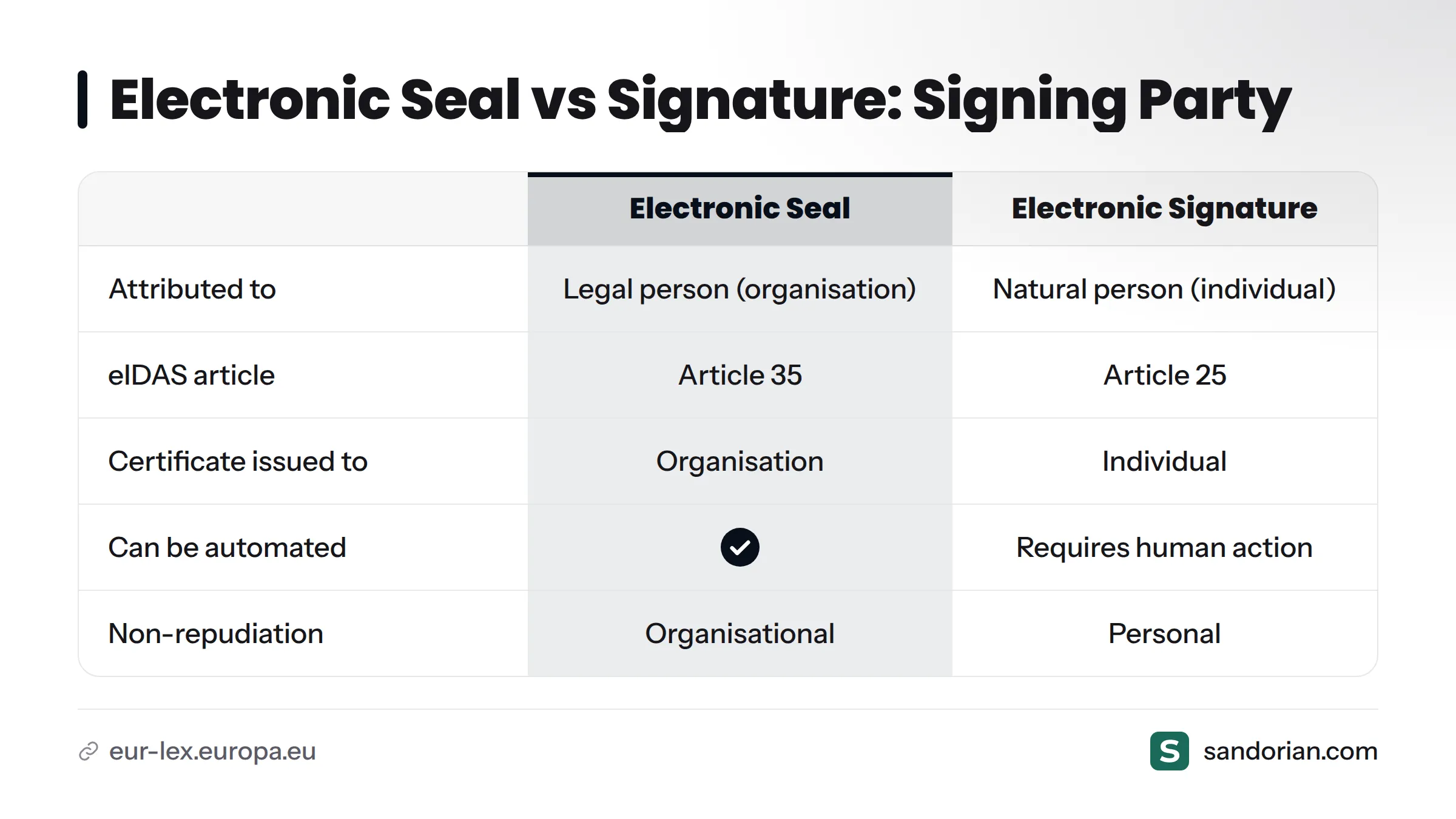
Comparison table: electronic seal vs electronic signature
| Dimension | Electronic seal | Electronic signature |
|---|---|---|
| Attributed to | Legal person (organisation) | Natural person (individual) |
| Primary purpose | Prove data origin and integrity | Prove individual consent or approval |
| Signing party | Organisation (automated or delegated) | Named individual |
| eIDAS article | Article 35 | Article 25 |
| Certificate issued to | Organisation | Individual |
| Automation-friendly | Yes - can run without human intervention | Typically requires human action |
| Non-repudiation | Organisational (output attributed to entity) | Personal (act attributed to individual) |
| Typical use case | Issued certificates, test reports, batch documents | Approval steps, authorised signatory sign-off |
Who or what is the signing party?
Here is why this question matters more than it first appears.
When a lab applies an electronic seal, the legal entity - the lab, the company, the accredited authority - is the signer. No named individual is required. The signing key is held by the organisation's certificate infrastructure, and the seal can be applied automatically at the moment a document is generated.
When a lab applies an electronic signature, the natural person - the analyst, the reviewing scientist, the quality manager - is the signer. Their identity must be verified, typically through a certificate issued to them personally by a Qualified Trust Service Provider (QTSP). The act of signing must be initiated by that individual.
This distinction determines the certificate type, the QTSP relationship, the accountability chain, and - most practically - whether the signing step can be automated.
A lab that issues 500 calibration certificates a day cannot have a named person manually sign each one. That is exactly what the electronic seal is designed for.
Automation and workflow implications for labs
Automated sealing is one of the most practical advantages of the eIDAS seal instrument. The organisation's signing key is held securely - typically in a hardware security module managed by a QTSP - and every document is sealed at issuance without any human action required. This is the right approach when the document is an organisational output: a test report, a calibration certificate, an analytical result that the lab is responsible for as an entity.
The named signatory step works differently. It is required when a specific individual's professional judgement, review decision, or approval must be recorded in the document trail. The person signs using their own certificate - not the organisation's. Automated lab workflow automation can route documents to the right person for signature, but the act of signing itself cannot be delegated to a machine.
The key question for lab engineers designing a workflow: does this document represent the lab's output (use a seal) or a person's decision (require a signature)?
For guidance on named signatory workflows in laboratory records specifically, see Sandorian's guide on electronic signatures in laboratory records.
Trust levels and certificate requirements
Both seals and signatures exist at three trust tiers under eIDAS: simple, advanced, and qualified.
An advanced electronic seal (AdES) and an advanced electronic signature (AdES) both require a certificate that links the seal or signature to the issuing organisation or individual, and both must protect data integrity so that any post-signing alteration is detectable.
The qualified tier carries the highest legal presumption of validity. For signatures, it requires a QTSP-issued certificate and a qualified signature creation device (QSCD). For seals, the qualified tier requires an equivalent QTSP-issued certificate under a qualified electronic seal scheme. The regulation's legal presumptions for each tier are set out in Articles 25 and 35 respectively - any compliance decision should be taken with direct reference to those texts, not secondary summaries.
For PDF-specific delivery format considerations, see Sandorian's guide on signing PDF reports in PAdES format.
When to use a seal, when to require a signature - decision guidance for lab workflows
Deciding between an e-seal or e-signature for reports is not purely a technical call. It follows from what the document represents and whose accountability it needs to carry.
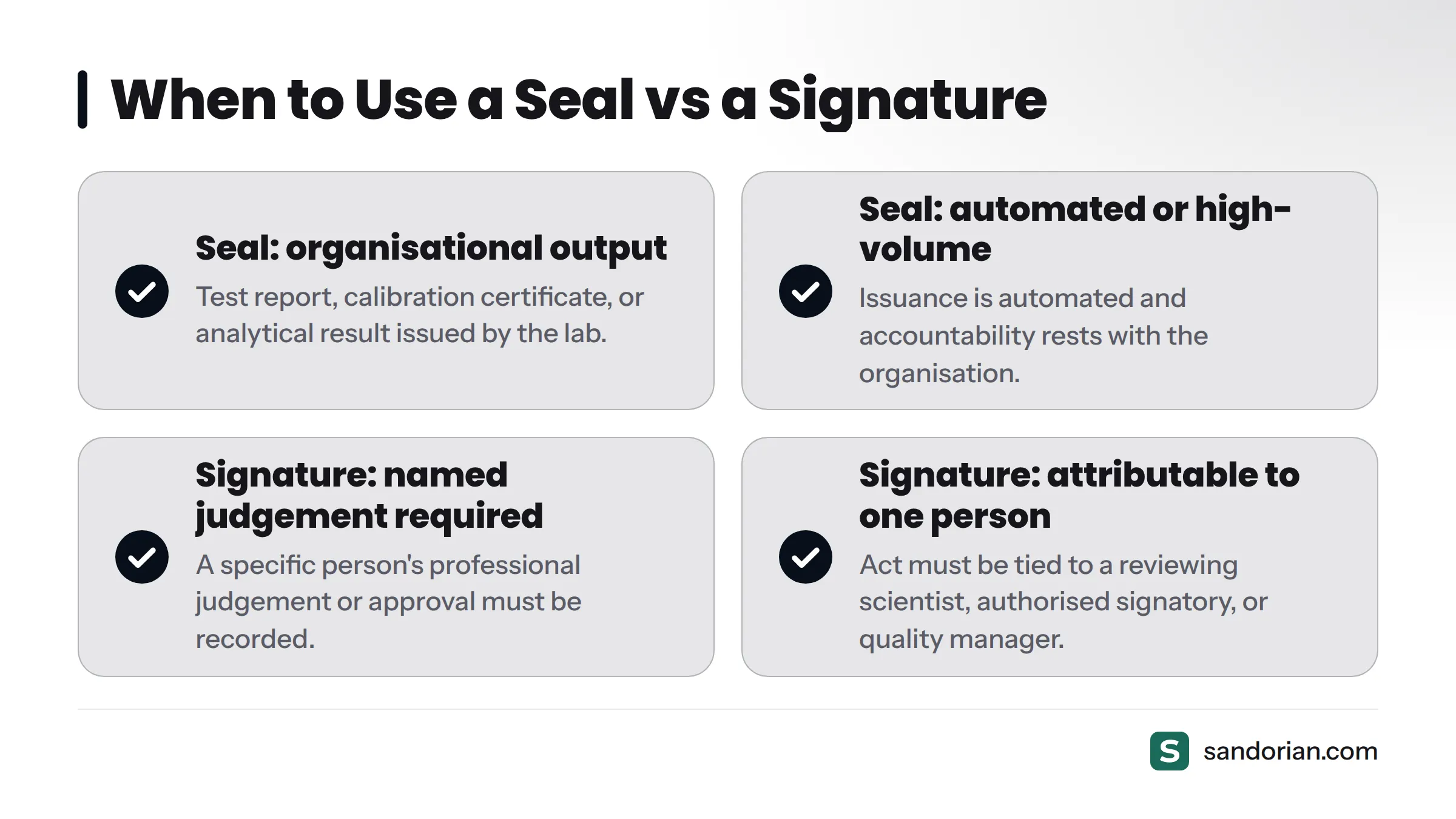
Use an electronic seal when:
- The document is an organisational output - a test report, calibration certificate, or analytical result
- Issuance is automated or high-volume
- Accountability rests with the organisation, not a named individual
- The requirement is to prove: "this document came from our lab and has not been altered"
Require an electronic signature when:
- A named individual's professional judgement or approval must be recorded
- The act must be attributable to a specific person - a reviewing scientist, an authorised signatory, a quality manager
- The requirement is to prove: "this person reviewed and approved this document"
Decision callout:
| Scenario | Instrument |
|---|---|
| Automated calibration certificate | Seal only |
| QA manager's approval of a non-conformance | Signature only |
| Signed-then-sealed test report with authorised reviewer | Signature + seal |
Using both together: seal-then-signature and signature-then-seal workflows
Many regulated lab environments need both instruments, applied in sequence. Here is how the two common patterns work.
Seal-then-signature: The lab system seals the draft report at the point of generation, proving organisational origin and content integrity at that moment. A named signatory then applies their electronic signature, recording their individual review and approval. The final document carries both - the seal proving what the lab produced, the signature proving who approved it.
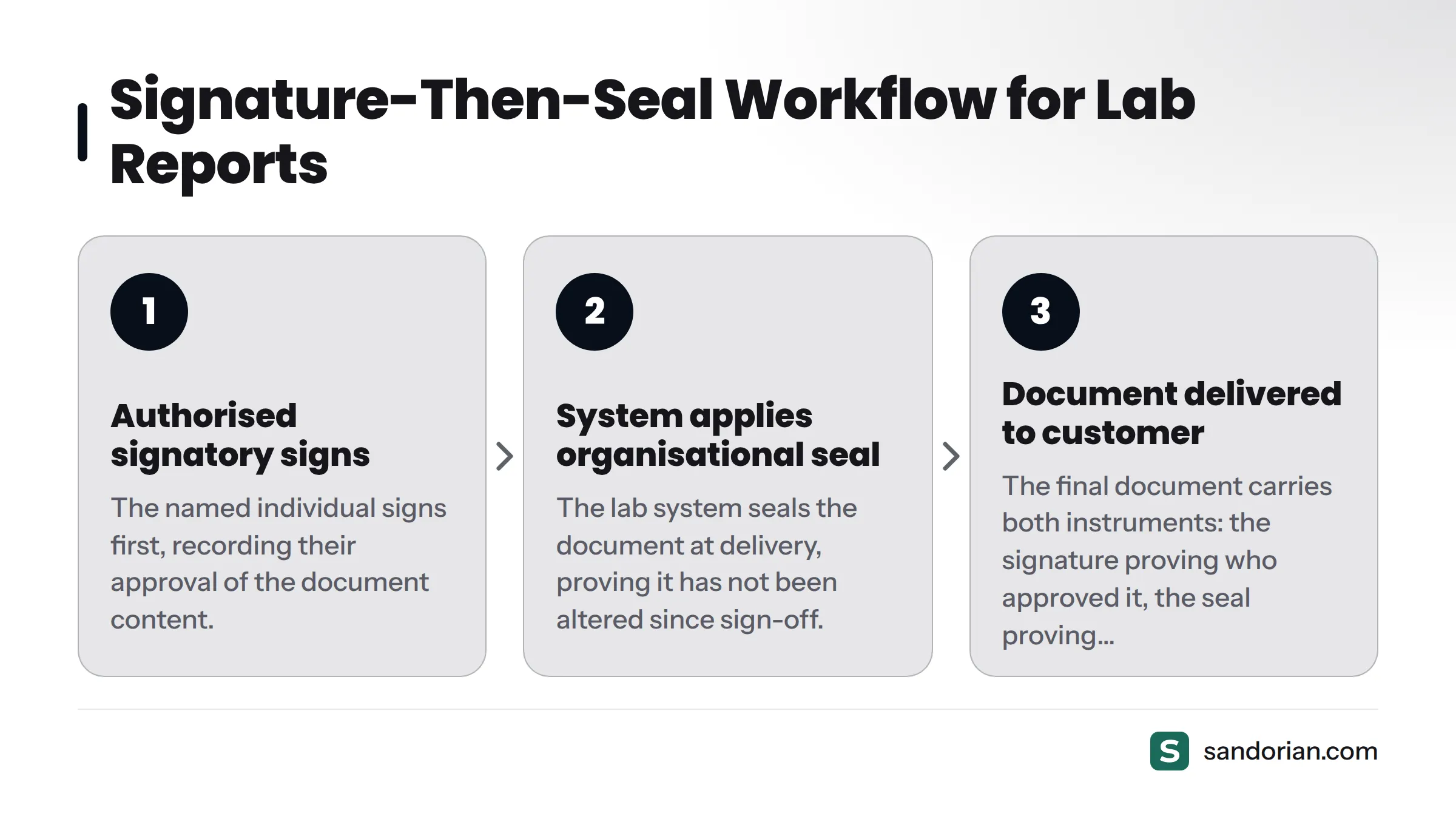
Signature-then-seal: The authorised signatory signs first, recording their approval of the content. The system then applies the organisational seal at the point of delivery to the customer portal, proving that the document delivered is authentic and has not been altered since sign-off.
Which order suits a given lab depends on the quality process design and accreditation requirements - this is a workflow engineering decision, not a legal one.
From our experience working with ISO 17025 and ISO 15189 labs at Sandorian: some labs apply an automated seal for every routine result and add a named signature step only for amended reports, high-stakes results, or cases where an authorised signatory's professional responsibility must appear on the face of the document. The right model depends on the lab's volume, accreditation scope, and the expectations of its customers and regulators.
This short video from Youtrust covers what an electronic seal is and how it secures documents, which complements the workflow discussion above:
https://www.youtube.com/watch?v=Z6fBB34q904
Frequently asked questions
What is the main difference between an electronic seal and an electronic signature under eIDAS?
An electronic seal is attributed to a legal person (an organisation) under Article 35 of eIDAS, and proves that a document originated from that organisation and has not been altered. An electronic signature is attributed to a natural person (an individual) under Article 25, and proves that a specific person signed - expressing their identity and intent. That is the defining distinction in the seal vs signature eIDAS framework.
Can an organisation use an electronic signature instead of an electronic seal?
Technically, an organisation could arrange for a designated individual to sign every document using their personal electronic signature. In practice this is unworkable at any volume, and it misrepresents the accountability - the document is an organisational output, not a personal act. The electronic seal exists precisely to let organisations assert origin without naming an individual signatory.
Does an electronic seal require a named person to sign?
No. The electronic seal is applied using the organisation's signing key, which is held securely and can be operated automatically. No named individual needs to initiate or approve the sealing action for each document, though an organisation's internal processes may still require human oversight at a workflow level.
What is non-repudiation, and does it apply to seals?
Non-repudiation is the property that prevents a party from credibly denying they produced or approved a document. For electronic signatures, non-repudiation is personal - the named individual cannot deny they signed. For electronic seals, non-repudiation is organisational - the organisation cannot credibly deny the document originated from its systems. Both instruments support non-repudiation, but at different levels of attribution.
Can a lab report carry both an electronic seal and an electronic signature?
Yes, and in regulated environments this is often the right design. A seal proves the lab produced the document; a signature proves a named person reviewed and approved it. Applying both - in either order depending on the workflow - gives the document both organisational authenticity and individual accountability.
Not sure whether your lab's reports need seals, signatures, or both - and in what order? Talk to a Sandorian engineer about how we design sealed certificate workflows for ISO 17025 and ISO 15189 labs.
Sources
Let's talk
We build the systems that power your business. Let us know how we can help.
Book a 30-min Call