What Is the US CLOUD Act? Risk for EU-Hosted Data
Not legal advice. This article reflects an engineering perspective on the CLOUD Act's technical and architectural implications. Your legal counsel should review your specific provider agreements, data types, and jurisdiction before drawing any compliance conclusions.
The US CLOUD Act - Clarifying Lawful Overseas Use of Data Act, enacted 23 March 2018 - requires providers of electronic communications services under US jurisdiction to disclose stored data on demand, regardless of where that data physically sits. Data stored in EU data centres by US-incorporated cloud providers can be subject to US law enforcement orders. Data location does not determine legal reach. Provider incorporation does.
Key facts at a glance
| Field | Detail |
|---|---|
| Full name | Clarifying Lawful Overseas Use of Data Act |
| Enacted | 23 March 2018 |
| Amends | Stored Communications Act (SCA), 18 U.S.C. Chapter 121 |
| Operative provision | 18 U.S.C. § 2713 |
| Jurisdiction trigger | Provider nexus (incorporation, ownership, operational control) - not data location |
How the CLOUD Act works: jurisdiction over providers, not data
The operative provision - 18 U.S.C. § 2713
The statute's core clause, codified at 18 U.S.C. § 2713, reads: a provider of electronic communication service or remote computing service shall comply with an order to preserve, backup, or disclose the contents of a wire or electronic communication and any record or other information pertaining to a customer regardless of whether such communication, record, or other information is located within or outside of the United States.
The phrase "regardless of location" is not incidental - it is the entire point of the law. Congress inserted it to close the gap exposed by Microsoft Corp. v. United States, where courts disagreed over whether a warrant could reach email stored in Dublin.
What "possession, custody, or control" means in practice
US courts apply a two-part test: does the provider have the legal right to obtain the data, and does it have the practical ability to do so? Both must be true. For a US-incorporated cloud provider operating an EU region, courts have consistently found that the parent entity's technical access to its own infrastructure satisfies both prongs. The same logic extends to European subsidiaries where the US parent exercises operational control - assigning staff, owning the infrastructure, or setting engineering policy.
The US-person nexus requirement
The CLOUD Act does not stretch to every company on earth. A provider must have a US-person nexus - typically incorporation in the United States, a US parent company, US-based officers or staff with operational authority, or a material US customer base. An EU-incorporated provider that operates entirely within European jurisdictions, with no US parent and no US operational presence, falls outside this reach. That structural fact becomes a mitigation strategy, which we return to below.
Provider nexus scenarios: CLOUD Act reachability
| Provider type | US nexus? | CLOUD Act reachable? |
|---|---|---|
| US-incorporated hyperscaler (AWS, Azure, GCP) operating an EU region | Yes | Yes - data location is irrelevant |
| European subsidiary of a US parent | Likely yes - control test applies | Almost certainly yes if parent has operational control |
| EU-incorporated provider with no US parent, no US staff, no US operations | No | No - jurisdictional trigger is absent |
When CLOUD Act orders can reach EU-hosted data
The trigger: a provider under US jurisdiction receives a lawful order
The process begins when a US law enforcement agency - the FBI, the DOJ, or a state-level equivalent - obtains a warrant or court order. That order goes to the provider, not to the data centre. The provider must either comply or file a motion to quash. The warrant-quashing mechanism allows a provider to challenge an order on grounds that compliance would cause the foreign government to object and that the foreign nation's interests outweigh the US government's interest in disclosure. This is called comity analysis. In practice, these challenges are difficult and rarely succeed outright.
Mutual legal assistance treaties and their role
Before the CLOUD Act, mutual legal assistance treaties (MLATs) were the primary mechanism for cross-border law enforcement data requests. Under an MLAT, one government formally requests evidence from another through diplomatic channels. The CLOUD Act does not replace MLATs - it supplements them by allowing US authorities to compel US-incorporated providers directly, without routing through the foreign state's judicial system. The CLOUD Act also creates a framework for bilateral executive agreements that can allow foreign governments to make direct requests to US providers, bypassing MLATs altogether.
How often this actually happens
Actual orders reaching EU-stored data are rare. We are not aware of published figures on enforcement frequency, and we will not invent any. The exposure is a legal risk sitting in the background of every contract with a US-incorporated provider - not a daily operational event. That said, regulated data categories such as health records, payment transaction data, and biometric information attract higher sensitivity from law enforcement and are more likely targets when orders do occur.
Why GDPR conflict does not automatically block a disclosure
GDPR Article 48 - what it says
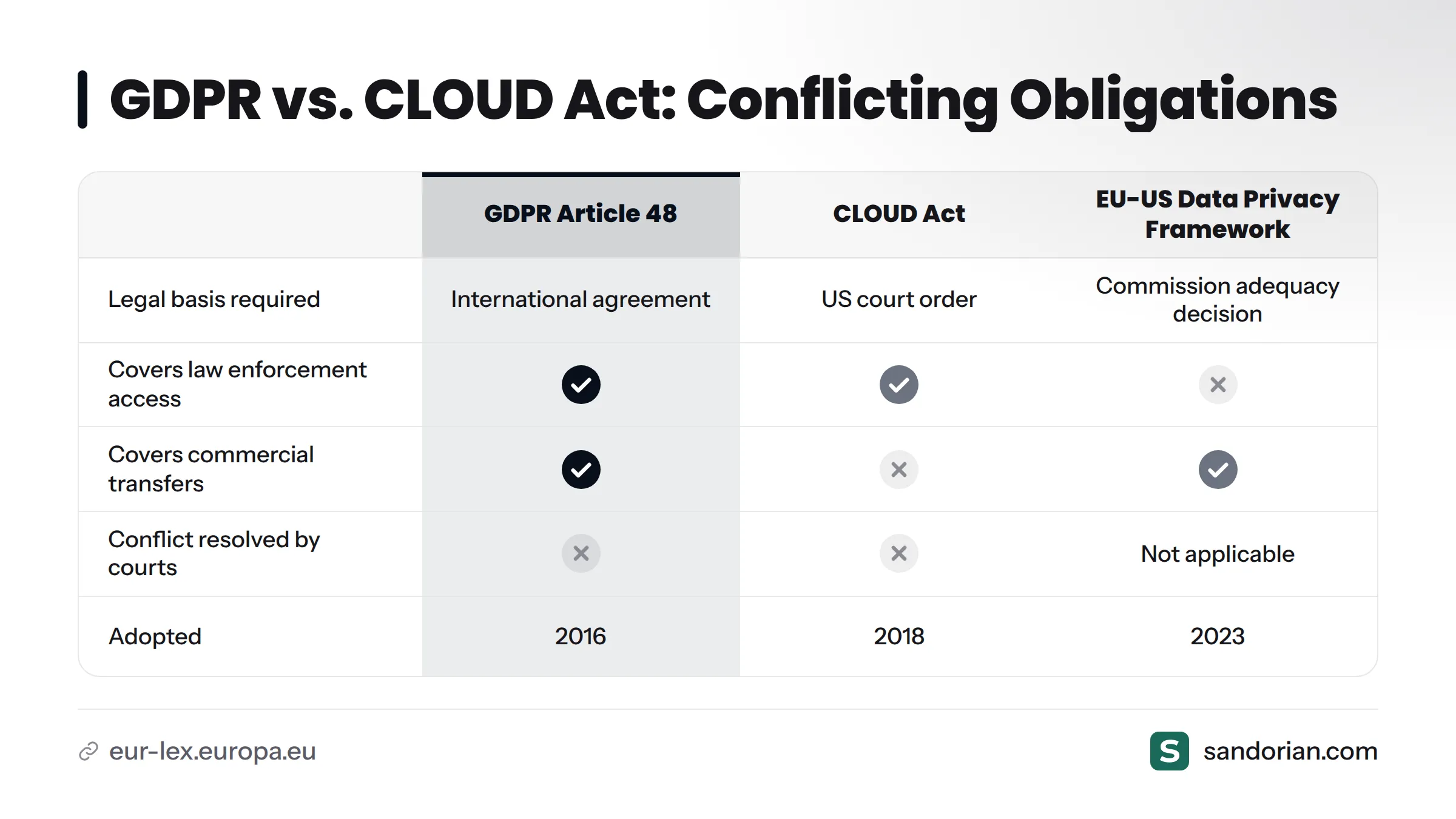
GDPR Article 48 states that any judgment of a court or tribunal and any decision of an administrative authority of a third country requiring a controller or processor to transfer or disclose personal data may only be recognised or enforceable in any manner if based on an international agreement, such as a mutual legal assistance treaty, in force between the requesting third country and the EU. In plain terms: a European data controller or processor cannot lawfully hand data to a non-EU authority unless that transfer has an EU legal basis. A US CLOUD Act order, standing alone, does not provide that basis.
The provider's dilemma: two conflicting legal obligations
Here is the problem in full: a US-incorporated provider that complies with a CLOUD Act order risks violating GDPR Article 48. A provider that refuses risks contempt of a US court. The European Data Protection Board and European Data Protection Supervisor issued a joint opinion in 2019 confirming that this conflict is real and that neither obligation automatically overrides the other. No court - in the US or the EU - has definitively resolved which obligation prevails. Providers sit in genuine legal uncertainty, and so do their customers.
Why the EU-US Data Privacy Framework does not resolve this
The EU-US Data Privacy Framework, adopted by the European Commission in 2023, governs commercial personal data transfers from the EU to US companies. It does not govern law enforcement access. CLOUD Act orders are issued by law enforcement authorities, not by commercial parties - which puts them entirely outside the DPF's scope. The DPF and the CLOUD Act operate on separate legal tracks. Relying on DPF certification as protection against CLOUD Act exposure is a category error.
Data residency alone does not eliminate CLOUD Act exposure. Storing data in an EU AWS or Azure region does not place it beyond US legal reach. The server's postcode is irrelevant. The provider's incorporation jurisdiction is what matters.
Engineering mitigations: key custody, tenant separation, and provider choice
This is where an engineering perspective adds something legal analysis cannot. The CLOUD Act problem is partly a legal one - and partly an architectural one. Here are the controls worth considering.
Customer-managed encryption keys and key custody
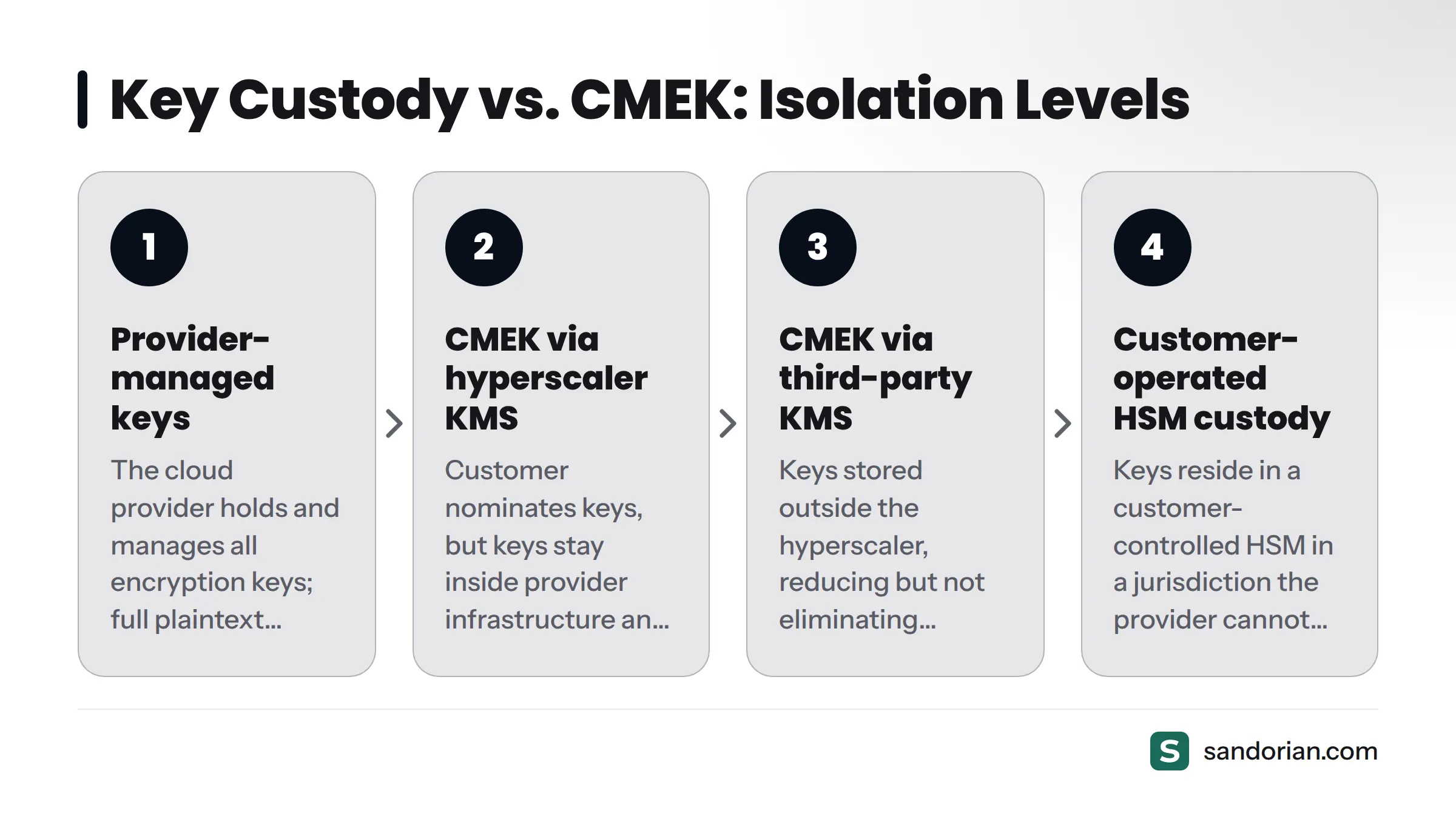
Customer-managed encryption keys (CMEK) allow an organisation to hold its own encryption keys outside the cloud provider's infrastructure, typically in a hardware security module (HSM) the customer controls or in a third-party key management service. When CMEK is properly implemented, the cloud provider stores only ciphertext. It cannot produce plaintext in response to a lawful order because it does not hold the decryption keys.
Key custody goes one step further: the keys never reside in infrastructure the provider can access, even indirectly. In the architectures we design for European labs and payment platforms at Sandorian, key custody is treated as a first-class requirement - not an add-on. The difference between CMEK and key custody matters: CMEK offered by the hyperscaler itself (such as AWS KMS customer-managed keys stored within AWS infrastructure) still leaves keys technically accessible to the provider under certain conditions. Keys held in a customer-operated HSM, in a jurisdiction the provider does not control, provide stronger isolation.
Tenant isolation and data processor agreement design
Strict tenant isolation limits the data surface that a lawful order could theoretically reach. If a provider's internal architecture conflates customer data across a shared control plane, a broad order could sweep in more than the targeted dataset. Tightly scoped data processor agreements that explicitly limit what data the provider can access, copy, or index - combined with architectural controls enforcing those limits - reduce what a provider can physically produce in response to an order.
Provider incorporation jurisdiction as a structural choice
The cleanest mitigation is choosing an EU-incorporated provider with no US nexus at all. If the jurisdictional trigger does not exist, neither does the CLOUD Act exposure. This is precisely what a sovereign cloud offers against foreign jurisdiction - not just data residency, but a provider structure that sits entirely outside US legal reach.
For teams already committed to a US-incorporated hyperscaler, moving regulated workloads to EU-hosted cloud infrastructure operated by an EU-incorporated entity is the structural path to removing the trigger. This requires more than a region change - it requires a provider change.
Mitigation options: what each reduces, what it does not eliminate
| Mitigation | What it reduces | What it does not eliminate |
|---|---|---|
| CMEK with keys held in customer HSM | Provider's ability to produce plaintext content | Metadata exposure; account-level records; provider cooperation under contempt |
| Tenant isolation + scoped processor agreement | Data surface accessible to a broad order | The underlying jurisdictional obligation on the provider |
| EU-incorporated provider with no US nexus | The jurisdictional trigger entirely | Risks from other foreign-jurisdiction providers in your stack |
Limits of these mitigations: what they cannot guarantee
Not legal advice. Engineering controls reduce technical exposure. They do not resolve the underlying legal conflict or substitute for a transfer impact assessment and counsel review.
Metadata and account-level data may still be accessible
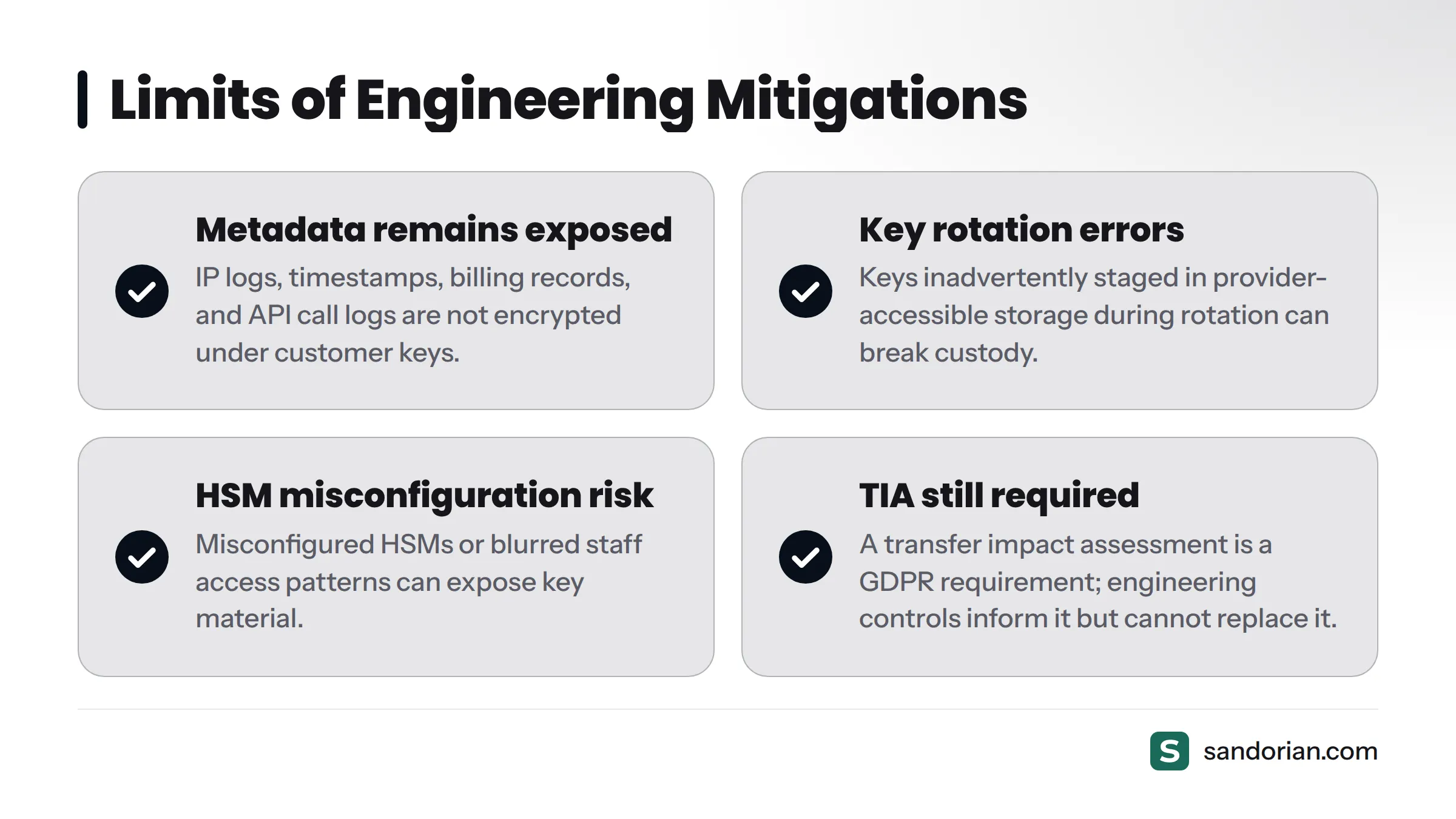
Even with CMEK in place, the cloud provider holds metadata: IP access logs, timestamps, account identifiers, billing records, API call logs. This information is typically not encrypted under customer keys. A lawful order can reach this metadata even when payload content is inaccessible. For some investigations - and for some regulated data types - metadata alone is sensitive.
Key custody is only as strong as its implementation
Operational errors undermine the strongest architectures. Keys inadvertently staged in provider-accessible storage during rotation, HSM misconfiguration that exposes key material, or staff access patterns that blur the custody boundary can all compromise the mitigation. The architecture is only as good as its operational discipline and its regular audit regime.
No engineering control replaces legal review
A transfer impact assessment (TIA) - the structured analysis of whether a data transfer to a third country provides adequate protection given that country's laws and practices - is a GDPR requirement when transferring personal data to a jurisdiction without an adequacy decision covering the specific processing context. Engineering mitigations should inform a TIA, not replace it. Counsel needs to review your specific provider agreements, the data types you process, your sector's regulatory obligations, and the jurisdiction of every entity in your supply chain.
What this means for regulated labs and fintech in Europe
Laboratory data under ISO 17025, ISO 15189, and IVDR
Labs accredited under ISO 17025 (testing and calibration) or ISO 15189 (medical laboratories) hold test results, calibration records, measurement uncertainty data, and - in the case of diagnostic labs under the EU IVDR - patient-adjacent results. This data stored in US-incorporated clouds carries CLOUD Act exposure. Accreditation bodies and notified bodies conducting audits are increasingly asking about data sovereignty and foreign-jurisdiction access risk. A lab that cannot articulate its key custody architecture and provider incorporation posture is behind the curve.
For teams managing lab data integrity obligations, the ALCOA+ principles framework also applies here: attributability, legibility, contemporaneousness, originality, and accuracy require that data remain tamper-evident and that its access history be auditable. Lab data integrity under ALCOA+ becomes harder to demonstrate when a foreign authority may have accessed data outside the lab's knowledge. A cloud migration for a regulated lab requires specific controls - see how to migrate a regulated lab system to the cloud for the architecture considerations.
Payment and financial data under PSD2 and PCI DSS
Transaction records, cardholder data environments, AML audit trails, and payment authorisation logs stored with US-incorporated providers carry the same CLOUD Act exposure as lab data - but with the added dimension that financial regulators are explicitly attentive to third-country access risk. The EU payment regulations framework requires payment institutions to maintain data security controls that hold up to regulatory scrutiny. Financial data security obligations for payment platforms now include articulating your provider jurisdiction posture, not just your encryption posture.
PCI DSS v4.0, effective from 2026, strengthens requirements around access control and third-party risk. A CLOUD Act order against your payment processor is a third-party risk event, and your compliance documentation should reflect your analysis of it.
Starting point: map your provider's incorporation jurisdiction
The practical first step is straightforward. For every cloud provider in your stack, identify whether it is US-incorporated or has a US parent, US staff with operational authority, or a material US-operational presence. That mapping exercise is the prerequisite for every mitigation conversation. Without it, you do not know which parts of your infrastructure carry the exposure.
Frequently asked questions
Does storing data in an EU AWS region protect it from the CLOUD Act?
No. AWS is US-incorporated, so US jurisdiction follows the provider regardless of where the servers are. The EU region endpoint changes your data's physical location, not AWS's legal obligations under US law.
Can a European subsidiary of a US parent receive a CLOUD Act order?
Almost certainly yes. US courts apply a control test: if the US parent has the legal right and practical ability to obtain the data from its subsidiary, the subsidiary's EU incorporation does not block the order.
Does GDPR stop a CLOUD Act disclosure?
GDPR Article 48 restricts transfers to non-EU authorities without an EU legal basis, but it does not automatically override a US court order. The provider faces two conflicting legal obligations simultaneously, and no binding ruling has resolved the conflict.
Does the EU-US Data Privacy Framework protect against CLOUD Act orders?
No. The Data Privacy Framework covers commercial data transfers. Law enforcement access under the CLOUD Act is entirely outside its scope, and DPF certification provides no shelter from a CLOUD Act order.
What is the strongest engineering mitigation against CLOUD Act risk?
Choosing an EU-incorporated provider with no US nexus removes the jurisdictional trigger entirely. Where a hyperscaler is non-negotiable, CMEK with keys held in a customer-controlled HSM outside the provider's infrastructure is the next strongest technical control - combined with a TIA and legal review.
Is CLOUD Act the same risk as FISA?
No, though both apply to US-incorporated providers. The Foreign Intelligence Surveillance Act (FISA) governs national security and intelligence surveillance; the CLOUD Act governs law enforcement access to stored communications. A full threat model for a regulated organisation should account for both, but they operate under different legal standards and warrant different responses.
If your team runs health data, diagnostic results, or payment transaction records through a US-incorporated cloud, the CLOUD Act exposure is real and worth quantifying before your next accreditation audit or regulatory review. We have designed key-management and isolation architectures for regulated labs and payment platforms across Europe. If you want to work through your specific provider stack and data types, the place to start is moving regulated workloads to EU-hosted cloud.
Sources
- 18 U.S.C. § 2713 - Cornell Legal Information Institute
- GDPR Article 48 - EUR-Lex, Regulation (EU) 2016/679
- EU-US Data Privacy Framework adequacy decision - European Commission
- ISO 17025:2017 - General requirements for the competence of testing and calibration laboratories - ISO
- Foreign Intelligence Surveillance Act - Wikipedia
- Mutual legal assistance treaty - Wikipedia
Let's talk
We build the systems that power your business. Let us know how we can help.
Book a 30-min Call