What Is an EU Sovereign Cloud? A 2026 Guide for Regulated IT
An EU sovereign cloud is a cloud environment where data is stored and processed exclusively within the European Union, operations are controlled by entities subject only to EU law, and contracts provide enforceable guarantees against non-EU government access. That definition sounds simple. In practice, it eliminates the majority of offerings currently marketed under the "sovereign cloud Europe" label.
The critical distinction is between a sovereign cloud and a standard EU cloud region. A standard EU region may store your data inside EU borders while remaining operationally or legally tied to a non-EU parent company. That matters enormously when your compliance reviewer asks not just where data lives, but who can reach it and under which law.
What the four sovereignty properties actually mean
"Sovereign cloud" bundles four distinct properties that can exist independently of one another. Marketing copy frequently conflates them, so before evaluating any vendor's claim, let's establish a shared vocabulary.
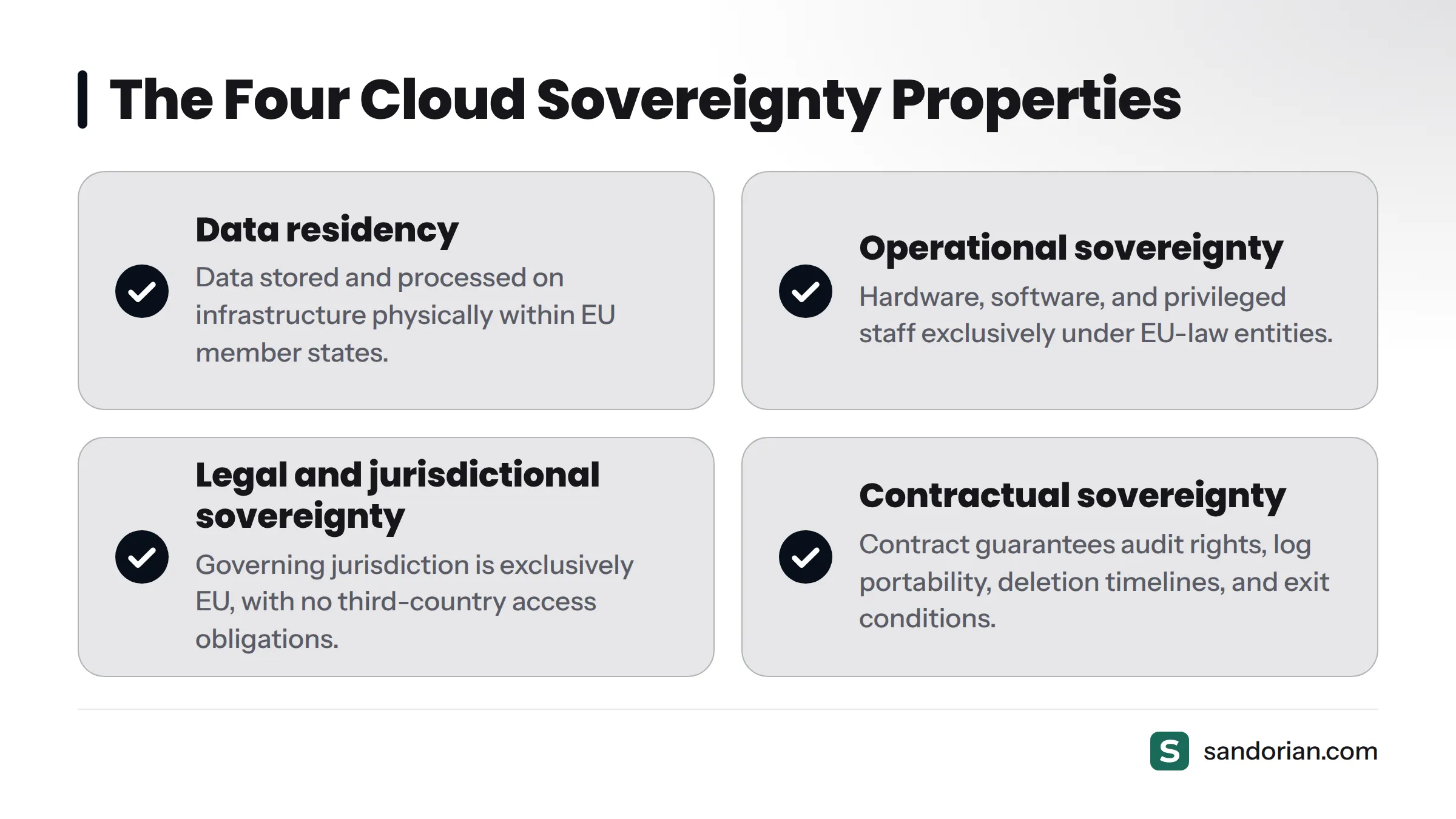
Data residency
Data residency means your data is stored and processed on infrastructure physically located within EU member states. It says nothing about who controls that infrastructure or which courts can compel access to it. Full data residency rules - including the specific obligations under GDPR Article 46 for international transfers - are a separate topic covered in our dedicated data residency breakdown.
Operational sovereignty
Operational sovereignty means that the hardware, software stack, and personnel with privileged access are controlled exclusively by entities subject to EU law. A provider can offer complete data residency while failing on operational sovereignty - for example, if its US-based parent engineering team holds admin access, or if its management plane runs on non-EU software.
Legal and jurisdictional sovereignty
This addresses which country's courts, laws, and enforcement mechanisms govern the provider and your data. An EU-registered subsidiary of a US-headquartered company may be subject to US extraterritorial law regardless of where its servers sit. Legal sovereignty requires that the governing jurisdiction is exclusively within the EU, with no structural obligation to comply with third-country government access orders.
Contractual sovereignty
Contractual sovereignty covers what your agreement actually guarantees: audit rights, log portability, data deletion timelines, and exit conditions - independent of technical controls. A cloud can be technically sovereign but contractually weak if the provider reserves the right to modify access terms unilaterally. If you are thinking through exit conditions, our guide on planning a cloud exit before you commit covers vendor lock-in clauses in detail.
These four properties can exist independently. A cloud can offer data residency without operational sovereignty. A contract can guarantee portability without legal jurisdiction clarity. Marketing often conflates all four into a single "sovereign" badge.
What an EU sovereign cloud does guarantee
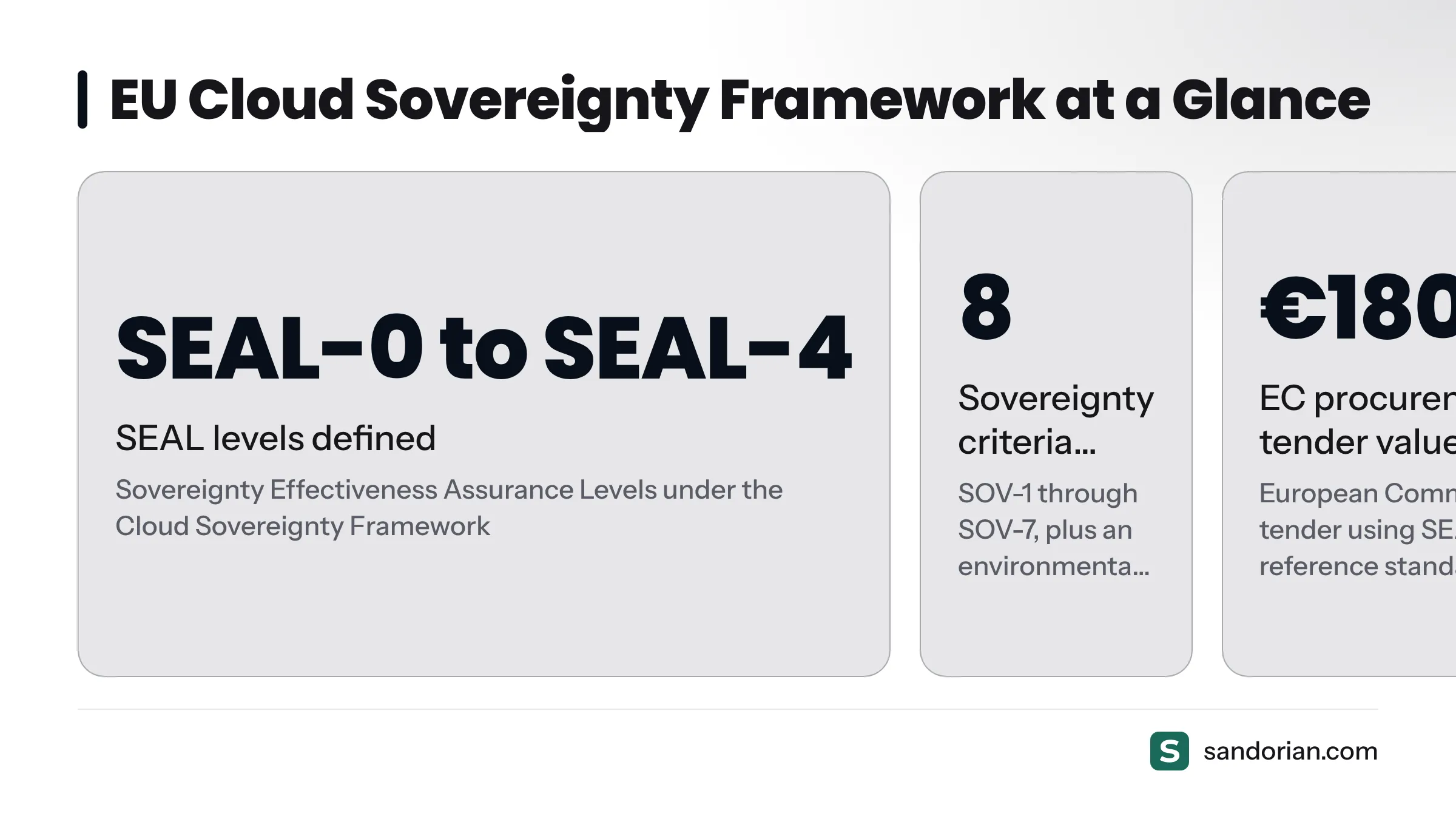
A properly constructed digital sovereignty cloud - particularly one assessed at higher SEAL levels under the European Commission's Cloud Sovereignty Framework published in October 2025 - verifiably provides:
- Data stored and processed exclusively within EU jurisdiction, by design rather than by configuration
- Operations controlled entirely by entities subject to EU law, with no non-EU privileged access
- No contractual obligation to comply with non-EU government access orders
- Audit trail access and log portability under customer control, not provider discretion
- Independently verifiable governance, including SEAL certification where applicable
- Defined exit rights and data portability obligations documented in the contract
The Cloud Sovereignty Framework introduced the Sovereignty Effectiveness Assurance Level (SEAL) scale - SEAL-0 through SEAL-4 - evaluated against eight criteria (SOV-1 through SOV-7, plus an environmental dimension). SEAL-4 represents the highest level of verified sovereignty and is the reference standard for EU institutional cloud procurement, including the European Commission's €180M procurement tender.
What it does not guarantee
This is the section missing from most current analysis of EU sovereign cloud meaning - and for regulated buyers, it matters most.
It does not guarantee immunity from all foreign access. Hardware supply chains frequently include non-EU components. Safespring, a Nordic EU cloud provider, published an honest self-assessment against the SEAL criteria in 2026 and acknowledged that supply chain sovereignty (SOV-5) is the hardest criterion to satisfy because server hardware, firmware, and chips rarely originate entirely in Europe.
It does not automatically satisfy GDPR. GDPR (Regulation (EU) 2016/679) compliance depends on your legal basis for processing, what your data processing agreement (DPA) contains, and how you manage sub-processors - not only on infrastructure location. A sovereign cloud removes certain transfer risks, but it cannot substitute for lawful processing.
It does not replace sector-specific compliance controls. ISO 17025, ISO 15189, IVDR, and PSD2 each impose obligations on data integrity, traceability, and audit trail design that sovereign cloud infrastructure alone cannot satisfy.
It does not guarantee portability or vendor-neutrality unless your contract explicitly requires it. SEAL certification does not automatically include exit rights.
It does not make a hyperscaler's EU subsidiary legally independent of its US parent without structural separation. The debate around the AWS European Sovereign Cloud launch in early 2026 illustrates this clearly: critics, including security consultants cited in contemporaneous reporting, questioned whether operational separation from Amazon's US entity was sufficient to remove extraterritorial legal exposure. For a full analysis of that jurisdictional question, our guide on how the US CLOUD Act affects EU-hosted data covers the legal dimensions without the guesswork.
How it differs from a standard EU cloud region
| Property | Standard EU cloud region | EU sovereign cloud | SEAL-4 sovereign cloud |
|---|---|---|---|
| Data stored in EU | Yes, by configuration | Yes, by design | Yes, by design and certification |
| Operations under EU law | Partial | Yes | Yes, verified independently |
| Legal jurisdiction | Provider's home country (may be non-EU) | EU only | EU only, with contractual guarantee |
| Non-EU government access risk | Present | Reduced | Structurally minimised |
| Audit log access | Provider-controlled | Customer-controlled | Customer-controlled and certified |
| SEAL certification | None | May be claimed | SEAL-3 or SEAL-4 |
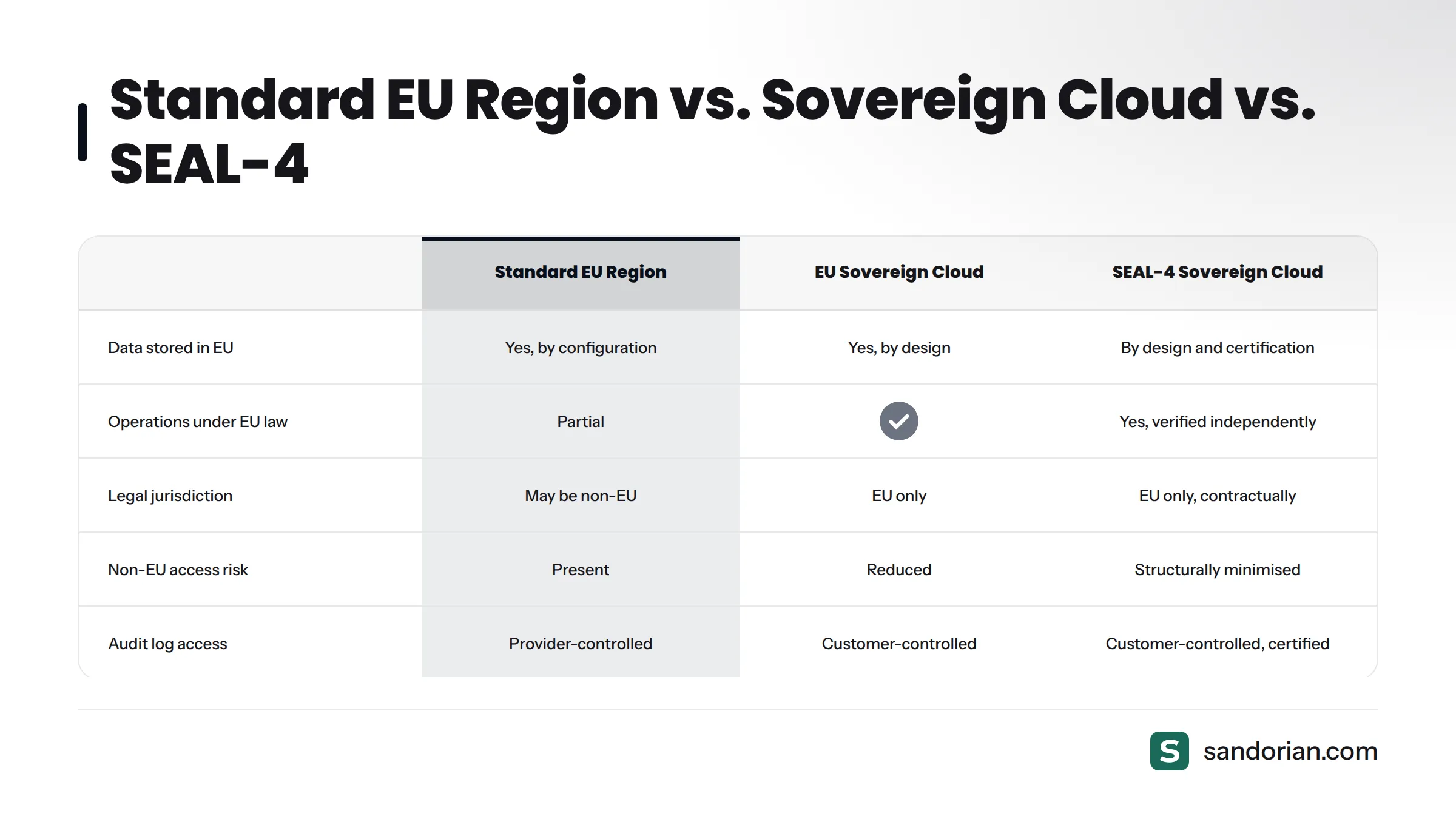
Source: Cloud Sovereignty Framework, European Commission, October 2025.
The critical distinction is "by design versus by configuration." A standard EU region lets you configure data storage to remain in-region, but the operational and legal controls sit with the provider. A sovereign cloud makes those controls structural and, at SEAL-3 or SEAL-4, independently auditable.
Here is a useful framing from the GZERO Media discussion at the 2026 Munich Security Conference, which captures why the definition matters beyond vendor marketing:
The sovereignty properties that matter for audit-ready systems
From our engineering experience delivering regulated software under ISO 17025, ISO 15189, IVDR, and PSD2, the sovereignty properties that trip up compliance reviews are not always the ones vendors highlight.
ISO 17025 and ISO 15189 labs
For accredited testing and medical laboratories, accreditation body assessors want to see that your data integrity controls are unambiguous and demonstrably under your organisation's governance - not your cloud provider's. Three sovereignty properties drive this:
- Operational sovereignty over audit trail infrastructure. If a provider's staff can modify or delete log data, your audit trail is not defensibly tamper-proof under ISO 17025 clause 7.11 or ISO 15189's corresponding requirements.
- Contractual guarantee of log portability and retention control. You need the right to export, retain, and present your own logs to an assessor without depending on the provider's cooperation.
- Legal jurisdiction clarity for accreditation body review. If your data infrastructure sits under a jurisdiction that your national accreditation body cannot assess, that creates a gap during on-site evaluation.
Our guide to audit trail requirements for regulated laboratories covers the specific technical and documentary requirements in detail. If you are also weighing whether cloud deployment is right for your lab at all, the cloud vs. on-premise LIMS decision guide addresses that question directly.
Fintech and payment systems
For payment firms and fintechs operating under PSD2 and EBA guidelines, the sovereignty requirements are less about data location and more about control over critical infrastructure.
- Jurisdictional sovereignty for regulatory reporting. EBA expects firms to demonstrate control over the systems used for regulatory reporting. If your reporting infrastructure is under a non-EU jurisdiction, that is a gap to address with your compliance team.
- Operational sovereignty over encryption key management. If your cloud provider - or its parent company's staff - can access your encryption keys, you do not have full operational sovereignty over your most sensitive payment data.
- NIS2 obligations for essential and important entities. The NIS2 Directive (Directive (EU) 2022/2555), specifically Article 21, requires entities to implement technical and organisational measures covering supply chain security, access control, and incident handling. For some fintechs, satisfying these requirements in practice means sovereign cloud-level controls.
The EU payment regulations overview and our PSD2 compliance guide for payment developers cover the regulatory mechanics in full. For audit trail design, audit trails for regulated software: what good looks like explains the architecture decisions that hold up under regulatory scrutiny.
Which claims are marketing, not architecture
Here is a practitioner checklist for evaluating any vendor's data sovereignty cloud claim.
| Claim type | Verifiable? | How to verify |
|---|---|---|
| "Data stored in EU" | Yes | Contract and DPA |
| "Operated by EU staff only" | Partially | Access control policy and audit log |
| "No foreign government access possible" | No - cannot be guaranteed | Red flag if stated as absolute |
| "SEAL certified" | Yes | European Commission certification register |
| "GDPR compliant" | Partially | DPA and processing records |
| "Immune to CLOUD Act" | No - legal opinion required | Flag for legal review |
| "Fully independent from parent company" | Partially | Corporate structure documents and governance audit |
The pattern to watch for: vendors who conflate data residency with full sovereignty, or who claim GDPR compliance as proof of sovereignty. These are separate properties. For the jurisdictional exposure questions - specifically how the US CLOUD Act affects EU-hosted data - that analysis sits with our sibling page on that topic, where the legal dimensions are covered without the engineering guesswork.
GAIA-X, the European initiative for federated data infrastructure, provides a trust framework and labelling scheme that some EU providers use to demonstrate alignment with European sovereignty values. A GAIA-X label is a useful signal, but it is a framework participation indicator, not a government certification. ENISA's EU Cloud Scheme (EUCS) is the formal certification route under the EU Cybersecurity Act and is distinct from GAIA-X participation and from the SEAL framework - each addresses a different dimension of cloud assurance.
When a regulated team actually needs one
You likely need a sovereign cloud for regulated industries (or equivalent controls) if:
- Your workload processes special category data under GDPR Article 9 - health data, biometric data, genetic data - or financial data subject to sector-specific law
- Your accreditation body or regulator requires you to demonstrate jurisdictional control over your data infrastructure during an assessment
- Your client contracts include explicit data location guarantees that a standard EU region cannot satisfy by design
- You are classified as an essential or important entity under NIS2 and must document supply chain resilience and access control measures
- Your system's audit trail must be demonstrably tamper-proof and exclusively under your organisation's governance - not your provider's
A standard EU cloud region may be sufficient if:
- Your GDPR risk assessment concludes that a standard DPA combined with an EU region configuration satisfies your transfer and storage obligations for the data types you process
- Your sector regulation does not require jurisdictional separation beyond what GDPR already mandates
- Your accreditation standard - including ISO 17025 - can be satisfied through contractual and technical controls without requiring full operational sovereignty from your provider
Engineering, not legal advice. This framework reflects common patterns in regulated system delivery. It is not legal advice. Have your DPO and legal counsel review your specific obligations before making infrastructure decisions.
For teams ready to act, our EU cloud migration for regulated software service starts with exactly this scoping question - which sovereignty properties your compliance context actually requires, before any provider is selected. If you work in a system integration context, system integration in regulated industries explained covers how sovereignty properties interact with multi-system architectures.
If you are evaluating European cloud providers worth shortlisting for sovereign workloads, that topic is covered in a dedicated guide.
Frequently asked questions
Is an EU sovereign cloud the same as GDPR compliance?
No. A sovereign cloud reduces certain jurisdictional risks, but GDPR compliance depends on how data is processed, what legal basis applies, and what your DPA contains - not only on where infrastructure is located. Infrastructure sovereignty and processing lawfulness are separate requirements.
Does a hyperscaler's EU subsidiary count as a sovereign cloud?
Not automatically. Sovereign cloud requires operational, legal, and contractual sovereignty - not just a registered EU entity or an EU data centre. The Cloud Sovereignty Framework's SEAL criteria are the reference standard for evaluating this claim. The key question is whether the subsidiary is structurally and legally independent of its non-EU parent.
What is the EU Cloud Sovereignty Framework?
Published by the European Commission in October 2025, it defines eight sovereignty criteria (SOV-1 to SOV-7, plus an environmental dimension) and assigns each provider a Sovereignty Effectiveness Assurance Level (SEAL-0 to SEAL-4). It is the reference standard used in EU institutional cloud procurement, including the European Commission's €180M procurement tender.
What is GAIA-X and how does it relate to sovereign cloud?
GAIA-X is a European initiative to establish a federated, interoperable data infrastructure based on shared sovereignty standards. It provides a trust framework and labelling scheme that some EU sovereign cloud providers use to demonstrate alignment with European data values. It is a framework, not a government certification - participation signals intent, not guaranteed compliance with SEAL criteria.
What is operational sovereignty?
Operational sovereignty means that the cloud infrastructure - hardware, software, and personnel with privileged access - is controlled by entities subject exclusively to EU law. A provider can store your data in the EU without operational sovereignty if its parent company or key software components are non-EU.
When does NIS2 require a sovereign cloud?
NIS2 does not mandate sovereign cloud by name, but Article 21 of the NIS2 Directive requires essential and important entities to implement appropriate technical and organisational security measures, including supply chain controls and access management. For some entities, satisfying NIS2's resilience and audit requirements will in practice require sovereign cloud-level controls.
What is the difference between data sovereignty and data residency?
Data residency describes where data is physically stored. Data sovereignty - or cloud sovereignty - describes who controls that data and under which legal framework. You can have full data residency without sovereignty if the entity controlling your infrastructure is subject to non-EU law.
Not sure whether your regulated workload needs sovereign cloud controls? We have put together a short hosting-requirements checklist for labs and fintechs. Book a scoping call about EU cloud migration to work through your specific compliance context with our engineering team.
Sources
Let's talk
We build the systems that power your business. Let us know how we can help.
Book a 30-min Call