How to Migrate a Regulated Lab System to the Cloud
Migrating a regulated lab system to the cloud is a validation event, not an IT project. That distinction matters immediately - before any infrastructure work begins, before any data moves, and before anyone touches a configuration file.
The obligations are specific: carry your validation artifacts across intact, open a change control record first, re-qualify the system in its new environment, and produce a closed migration validation package your QA lead can sign and your auditor can inspect.
That is the short version. The rest of this guide walks through each of those obligations in sequence, with the evidence outputs an auditor expects at every stage.
How cloud migration works for a regulated lab system
Cloud migration for regulated industries is the process of moving a validated computerized system - most commonly a Laboratory Information Management System (LIMS) - from on-premise or legacy hosting to a cloud infrastructure, while preserving validation status, audit trail continuity, and compliance with applicable standards such as ISO 17025 or ISO 15189. It is not a lift-and-shift exercise. It is a change to a qualified system, and that distinction determines everything that follows.
Why infrastructure change triggers revalidation
A regulated lab system exists inside a documented validation boundary. That boundary defines the hardware, the operating environment, the network configuration, and the access controls that were in scope when the original Installation Qualification (IQ), Operational Qualification (OQ), and Performance Qualification (PQ) were executed. Move the system outside that boundary - even if the application code is unchanged - and the boundary is broken.
Under computerized system validation (CSV) principles, a major change to a validated system requires a documented impact assessment, updated qualification protocols, and a formal sign-off before the system returns to operational use. A new hosting environment is unambiguously a major change.
The role of change control in a regulated migration
The change control record is the first document you open and the last document you close. It is the spine of the entire migration.
Before any infrastructure work begins, the lab's change control process must formally log the proposed change, document the reason for the migration, assign a risk classification, and require sign-off from the QA lead to proceed. No configuration, no data transfer, and no cutover activity should start without an approved change control record. This is not a bureaucratic formality - it is the evidence that the lab's governance process was functioning at the moment the validated system changed.
A cloud migration is a major change to a computerized system. Under CSV principles, any major change requires a documented impact assessment, updated qualification protocols, and a formal sign-off before the system returns to operational use.
Step 1 - Inventory your validation artifacts before you touch anything
In our work with ISO 17025 and ISO 15189 labs, the single most reliable predictor of a smooth migration is a complete artifact inventory at the start. Labs that skip this step routinely discover, mid-project, that their original IQ protocols are missing, their validation master plan is outdated, or their PQ reports were never formally closed. At that point the migration is blocked while the lab remediates documentation gaps under time pressure.
Do the inventory first. It takes days, not weeks, and it determines the scope of everything else.
What belongs in the validation artifact inventory
- System specification / User Requirements Specification (URS)
- Validation master plan (VMP) or project-level validation plan
- Supplier qualification records for the original system
- IQ, OQ, and PQ protocols and their signed reports
- Risk assessments (FMEA or equivalent)
- Current audit trail configuration documentation
- Full change control history for the system
- Training records for all staff with validated system access
How to identify gaps before migration begins
Review each artifact against the validation lifecycle stage it covers. If a report exists but carries no QA signature, treat it as incomplete. If a protocol references hardware that has since been replaced, record that discrepancy in the impact assessment. The goal is not a perfect archive - it is an honest baseline. A documented gap is manageable; an undiscovered gap becomes an audit finding.
Step 2 - Classify data by regulatory sensitivity and residency requirement
Data classification is the step most labs defer until it's too late to influence provider selection or the migration architecture. For EU labs operating under GDPR (Regulation (EU) 2016/679), the classification exercise directly determines where data can legally reside and which transfer mechanisms apply.
Personal data, patient data, and GDPR data residency
Under GDPR Article 9, patient and donor sample data constitutes special-category personal data. Chapter V of the regulation governs transfers outside the EU/EEA. Labs should confirm, before any data moves, that the target cloud environment satisfies those obligations. Sandorian does not provide legal interpretations of GDPR - seek qualified legal advice for your specific situation. For background on EU-sovereign hosting options, see the guide to what an EU sovereign cloud is and what it means for regulated workloads.
Raw measurement data, calibration records, and audit-trail data
| Data type | Regulatory basis | Residency constraint | Retention minimum |
|---|---|---|---|
| Patient / sample personal data | GDPR Art. 9 | EU/EEA preferred | Per national law |
| Accreditation records (ISO 17025) | Accreditation body rules | Country-specific | ≥5 years typical |
| Electronic signatures and audit trail | ALCOA+ / CSV | Must follow raw data | Life of record |
| Calibration / measurement data | ISO 17025 / 15189 | With accreditation records | ≥5 years typical |
Electronic signatures - including those issued under the eIDAS Regulation - are legally bound to the records they authenticate. Wherever the raw record goes, the signature evidence must follow.
Boundary note: For detailed guidance on selecting an EU-compliant cloud provider for a regulated workload, refer to Sandorian's EU cloud provider selection resources - that topic is out of scope here.
Step 3 - Rebuild your validation baseline in the target environment
Once the artifact inventory is complete and data classification is settled, the technical work begins - but it begins as a validation activity, not a deployment activity. The target environment must be qualified before any real data enters it.
Installation Qualification (IQ) in a cloud environment - what changes
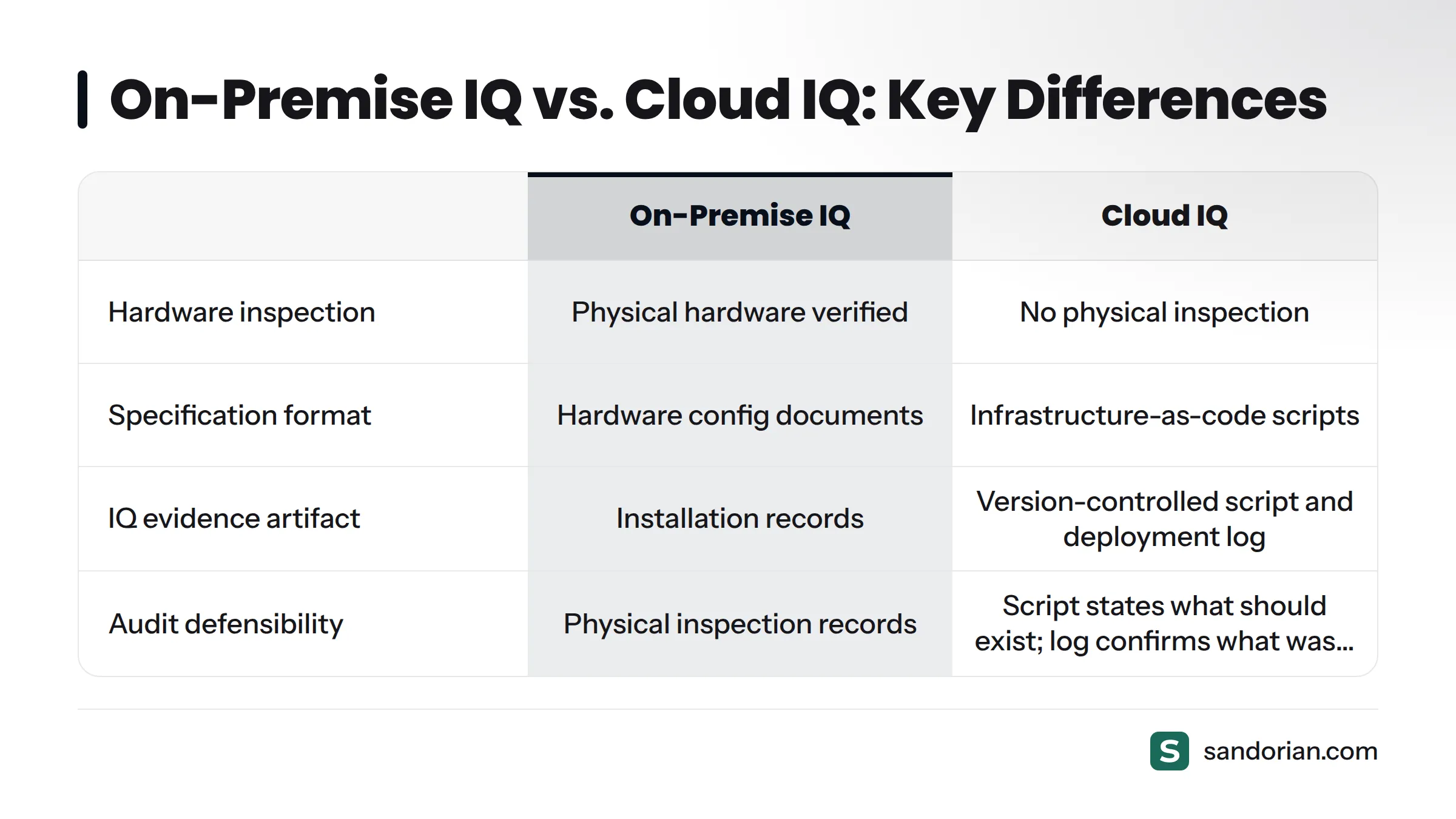
IQ in a cloud environment confirms that the hosting infrastructure has been provisioned correctly, security controls are in place, network segregation matches the specification, and access logs are active and writing. What changes compared to an on-premise IQ is that you are not inspecting physical hardware. Instead, you are verifying that the provisioned infrastructure matches a declared specification - and that specification is typically expressed as infrastructure-as-code.
For deeper background on the CSV lifecycle that underpins this step, the computerized system validation guide for laboratories covers the full qualification sequence in detail.
Documenting infrastructure-as-code as an IQ evidence artifact
Infrastructure-as-code scripts - Terraform, Ansible, and their equivalents - can serve as IQ evidence when they are version-controlled, peer-reviewed, and linked to the IQ protocol. The IQ report then records the script version deployed, the reviewer who approved it, the date of deployment, and the results of any post-provisioning verification checks. This approach is auditor-defensible because the script is itself a form of specification: it states what should exist, and the deployment log confirms what was actually created.
Validation baseline vs. revalidation - how to scope the effort
A validation baseline review asks: does the system in its new environment still meet the requirements documented in the original URS and validation plan? If the answer is yes and the application code is unchanged, you can scope the effort as a re-execution of IQ and OQ rather than a full revalidation from zero. If the migration involves a software version upgrade, a database platform change, or a change in how audit logs are generated, the scope expands accordingly. The impact assessment - opened under the change control record - is the document that makes this scoping decision auditable.
Step 4 - Migrate data with a full audit-trail hand-off
Maintaining audit trail continuity during data migration means verifying completeness before migration begins, logging the migration event itself as an audited activity, applying ALCOA+ principles to every transferred record, and performing a post-migration verification that confirms record counts and checksums match the source.
This is the step where most technical teams underestimate the regulatory weight of what they are doing. Moving data between environments is not a file copy - it is a transfer of regulated records, and those records must arrive intact, attributable, and verifiable.
ALCOA+ compliance during data transfer
ALCOA+ - Attributable, Legible, Contemporaneous, Original, Accurate, plus Complete, Consistent, Enduring, and Available - is the framework that governs how regulated records must be created and maintained. During a data migration, each principle maps directly to a verification step:
| ALCOA+ principle | What to verify during migration |
|---|---|
| Attributable | Every transferred record retains its original author / system identifier |
| Legible | Records remain human-readable in the target system |
| Contemporaneous | Timestamps preserved and timezone-normalized |
| Original | No reformatting that alters the source record structure |
| Accurate | Post-migration query confirms row counts and checksums match source |
| Complete | No records silently excluded; exclusion log produced for any exception |
| Consistent | Date/time stamps consistent across all migrated record sets |
| Enduring | Records stored in a durable, non-proprietary format |
| Available | Records accessible to authorized users within defined access parameters |
Preserving audit trail completeness: what to verify before cut-off
Before the data transfer begins, export and inspect the existing audit trail. Confirm that the trail is complete up to the moment of migration - no gaps, no orphaned records. The audit trail requirements for regulated laboratories set out exactly what an auditor expects to find. Any incomplete trail discovered at this point is a remediation task, not a migration task, and must be resolved before the migration proceeds.
The migration audit trail: logging the migration event itself
The migration event is itself an audited activity. The migration log must record who initiated the transfer, when it started and ended, what transformation (if any) was applied to the data, and the before-and-after checksums for each data set. This log becomes part of the migration validation package.
Boundary note: For the technical approach to cutting over without service interruption, refer to Sandorian's forthcoming guide on how to cut over without downtime - that topic is out of scope here.
Here is a video that covers LIMS architecture, data integrity, and cloud migration at a technical level - useful background if your team is approaching this from an infrastructure rather than a validation angle:
Step 5 - Execute Operational Qualification in the cloud environment
OQ confirms that the system, running in its new cloud environment, behaves as specified under defined operating conditions. For a migrated LIMS, this means running test scripts against the cloud-hosted system before any live samples are processed.
OQ test script design for a migrated LIMS
OQ test scripts for a migration are not written from scratch - they are derived from the original OQ protocol used to qualify the system in its previous environment. Each test case should map to a functional requirement in the URS. The key question for each test is: does the system in the cloud environment produce the same, documented output as the system in the on-premise environment?
Regression testing vs. full OQ - how to decide scope
If the application code is unchanged and the migration impact assessment identified no functional risks, a regression-focused subset of OQ scripts - covering the highest-risk functions and any areas where the infrastructure change could plausibly introduce a difference - is typically sufficient. If the impact assessment identified functional risks, or if the migration included a software update, the full OQ protocol should be re-executed. The decision and its rationale must be documented in the migration validation package.
Documenting OQ evidence for the migration validation package
In the ViroVet lab digitization project, running OQ scripts against the cloud environment before formal cutover identified three configuration differences from the on-premise baseline - all corrected before any live samples were processed. That outcome, drawn from the ViroVet case study, is the clearest possible illustration of why OQ in the cloud environment is not optional. ViroVet's migration ultimately delivered an 80% reduction in manual errors - a result that depended entirely on treating the migration as a validation event, with OQ as a gate before go-live.
Step 6 - Obtain sign-off and close the migration validation package
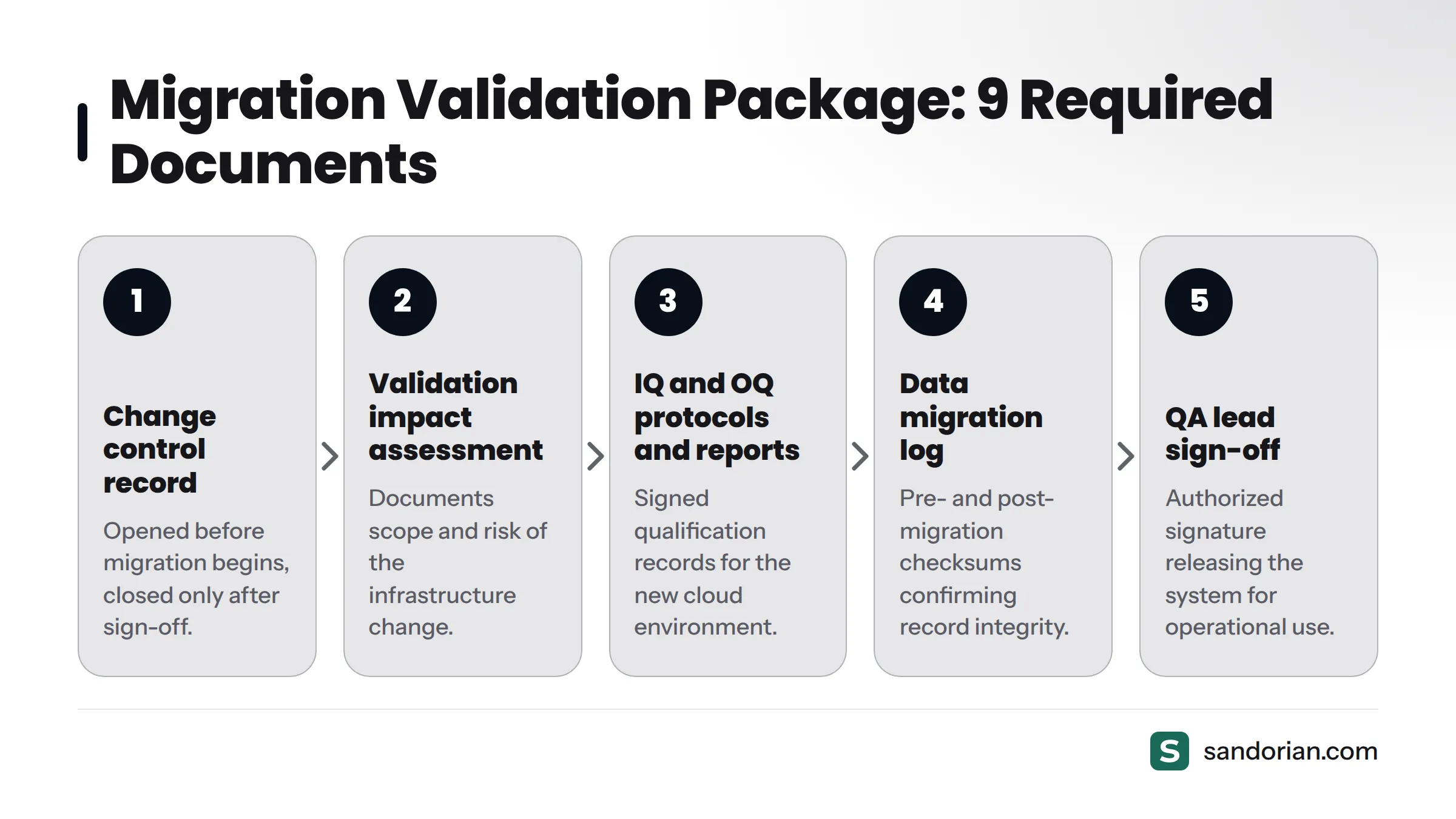
The migration validation package is the closed set of documents that provides evidence the migration was planned, executed, verified, and signed off in accordance with CSV principles. It is what an auditor requests when they want to verify that your cloud-hosted system is in a known, qualified state.
What the migration validation package must contain
- Change control record (opened pre-migration, closed post-sign-off)
- Validation impact assessment
- Data classification register
- IQ protocol and signed report
- OQ protocol and signed report
- Data migration log (pre- and post-migration checksums)
- Audit trail continuity verification record
- Deviation log (required if any deviation from protocol occurred)
- QA lead sign-off with date and electronic signature
For broader context on what makes a lab system audit-ready in its new environment, the article on audit-ready lab software is a useful companion read once the migration is closed.
Who signs - and why sign-off stays with the lab's QA lead
Validation sign-off sits with the lab's QA lead, not with the IT team and not with the cloud migration vendor. The QA lead is accountable for confirming that the system in its new environment meets the requirements documented in the validation package before it is released for operational use. A vendor can prepare the evidence; only the lab's authorized QA lead can release the system.
This is not a procedural nicety. Accreditation bodies and regulatory inspectors expect to see that the lab's internal quality function owns the qualified state of its systems. A sign-off from an external vendor does not satisfy that expectation.
Archiving the closed package for audit readiness
The closed migration validation package must be stored in a controlled, access-logged document system - ideally the same system used for all other quality records. The archive must be retrievable by an auditor on demand. If your accreditation is under ISO 17025, record retention rules apply to the validation package as a quality record. If the lab holds diagnostic accreditation under ISO 15189 or operates under IVDR, equivalent document control obligations apply.
Boundary note: For guidance on designing disaster recovery for the new cloud environment, refer to Sandorian's forthcoming guide on disaster recovery planning for the new environment - that topic is out of scope here.
Where regulated lab migrations most commonly stall
These observations come from first-party delivery experience across ISO 17025, ISO 15189, and IVDR settings - not from theory.
Incomplete validation artifact inventory at kickoff
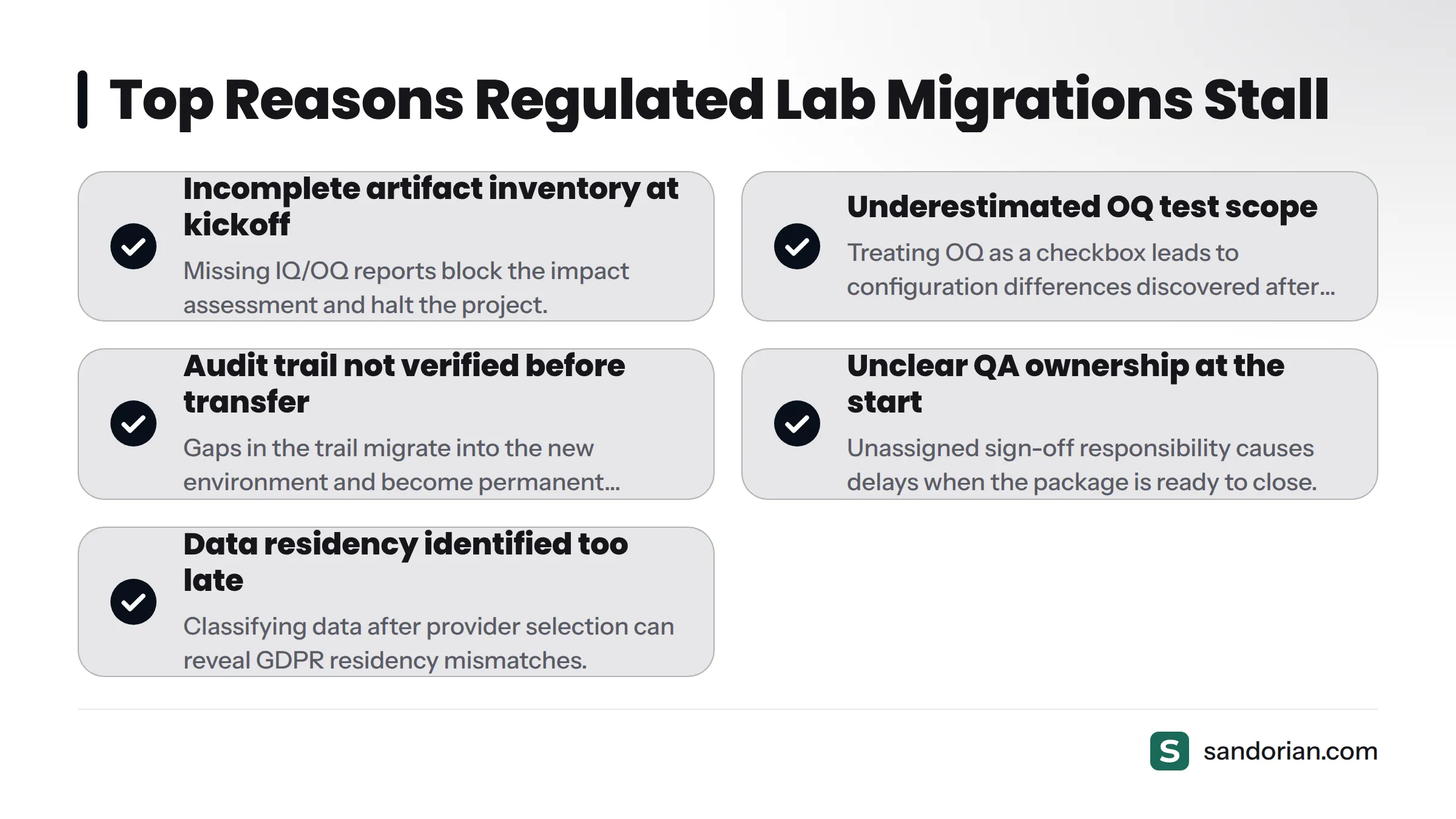
The most common stall: a lab begins migration planning without first locating all its original IQ/OQ reports. Without the baseline, there is no agreed starting point for the impact assessment, and the project cannot move forward until the gap is remediated. On the ViroVet engagement, we began with a full artifact audit. That two-week investment saved months of remediation later.
Underestimating the OQ test scope for a migrated LIMS
Teams that treat OQ as a checkbox rather than a risk-based verification exercise tend to discover configuration differences after go-live, when correction is costly and audit exposure is real. Scope OQ based on the impact assessment, not on what is quickest to execute.
Audit trail continuity not verified before data transfer begins
If the audit trail is incomplete at the point of migration, the gap travels into the new environment and becomes a permanent compliance problem. Verify the trail before the transfer starts, every time.
Sign-off delays caused by unclear QA ownership
When QA sign-off responsibility is not assigned at the start of the project, it defaults to whoever is available at the end - and that person may not have the authority, the knowledge, or the time to review the full package. Assign QA ownership before the change control record is opened.
Data residency requirements identified too late to influence provider choice
Labs that classify data after the cloud provider is contracted sometimes discover that the chosen provider does not satisfy their GDPR residency obligations. Data classification and provider selection must happen in sequence, not in parallel. If your team is still evaluating on-premise versus cloud options, the cloud vs. on-premise LIMS decision guide is a good starting point before committing to a direction.
Frequently asked questions
What is cloud migration in the context of a regulated lab?
In a regulated lab, cloud migration is the process of moving a validated computerized system - such as a LIMS - from an on-premise or legacy hosting environment to a cloud infrastructure, while maintaining validation status, audit trail continuity, and compliance with applicable standards such as ISO 17025 or ISO 15189.
Does moving a LIMS to the cloud require revalidation?
Yes, in most cases. A change of hosting infrastructure constitutes a significant change to a validated system and triggers a validation impact assessment. Depending on the scope of change, you will typically need to re-execute Installation Qualification (IQ) and Operational Qualification (OQ) in the new environment.
How do you maintain audit trail continuity during a cloud migration?
By verifying the completeness of the existing audit trail before migration begins, logging the migration event itself as an audited activity, applying ALCOA+ principles to every transferred record, and performing a post-migration verification that confirms record counts and checksums match the source.
What is a migration validation package?
A migration validation package is the closed set of documents that provides evidence the migration was planned, executed, verified, and signed off in accordance with computerized system validation principles. It typically includes the change control record, IQ/OQ reports, data migration log, audit trail verification record, and QA lead sign-off.
Who should sign off on a regulated lab cloud migration?
Validation sign-off sits with the lab's QA lead, not with the IT team or the cloud migration vendor. The QA lead is accountable for confirming that the system in its new environment meets the requirements documented in the validation package before it is released for operational use.
What are the GDPR data-residency implications for a lab cloud migration?
Under GDPR, personal data - including patient sample data - must be processed in accordance with Chapter V transfer rules when moved outside the EU/EEA. Labs should classify all data by residency obligation before migration and ensure the target cloud environment satisfies those obligations. Sandorian does not provide legal interpretations of GDPR; seek qualified legal advice for your specific situation.
What does ALCOA+ mean in the context of data migration?
ALCOA+ is a set of data integrity principles - Attributable, Legible, Contemporaneous, Original, Accurate, plus Complete, Consistent, Enduring, Available - that govern how records must be created and maintained in regulated environments. During data migration, each principle maps to a specific verification step: confirming timestamps are preserved (Contemporaneous) and that no records were silently dropped (Complete), for example.
Ready to migrate your regulated lab system to the cloud?
Download our regulated migration checklist - the same artifact checklist Sandorian uses on client engagements - or book a scoping call with our team. We have run cloud migrations in ISO 17025, ISO 15189, and IVDR settings and can tell you within one call where your biggest validation risk sits.
Explore Sandorian's EU cloud migration service for regulated software
Sources
Let's talk
We build the systems that power your business. Let us know how we can help.
Book a 30-min Call