Testing Laboratory Software Around Your LIMS
A testing laboratory needs more than a LIMS. The software gaps that create re-keying and audit risk sit outside it: customer request intake, contract review capture, sample registration at the door, and sealed report delivery. These are the four workflows Sandorian builds around whatever LIMS your lab already runs - connecting the customer-facing side of the lab to the system that manages work inside it.
The question most labs ask - and the better one
Most testing labs ask "which LIMS should we use?" The more useful question is "what does our LIMS not cover?" Those are two very different problems. If you want to understand the full picture, this guide on whether your lab needs a new LIMS or a better workflow is a good place to start.
What the LIMS does - and where it stops
A Laboratory Information Management System manages what happens inside the lab: test methods, instrument results, sample status, and internal workflows. It is built for scientists and analysts. It tracks work once a sample is registered and a job is open.
What the LIMS does not cover, in most implementations:
- Receiving a customer's test request in a structured, traceable way
- Capturing the documented review of that request before work begins
- Closing the gap between a sample arriving at the door and a job opening in the LIMS
- Distributing a tamper-evident report to the customer after results are complete
Those four workflows happen around the LIMS - before the job opens and after results are filed. They are where most of the audit risk lives.
The software layer that sits between your customers and your LIMS
Think of it as a wrap around the LIMS, not a replacement for it. On the customer-facing side, a digital intake portal replaces phone calls and emails with a structured request that carries all the information the lab needs to open a job. That request feeds a contract review record, which captures that the lab has reviewed scope, turnaround, and special conditions before a single test begins.
When the sample arrives, registration software closes the chain of custody from physical receipt to LIMS record - no paper log, no typing the same reference number twice. After testing, a sealed certificate portal delivers the report directly to the customer as a tamper-evident PDF, traceable back to the original request.
Data moves through the lab once. No re-keying.
If your team is re-typing customer order details into the LIMS at reception, that is a software gap - not a training problem.
The four friction points that create audit risk and re-keying waste
Every testing lab running manual processes at these four points carries the same risks: transcription errors, broken records, and gaps that become findings at audit.
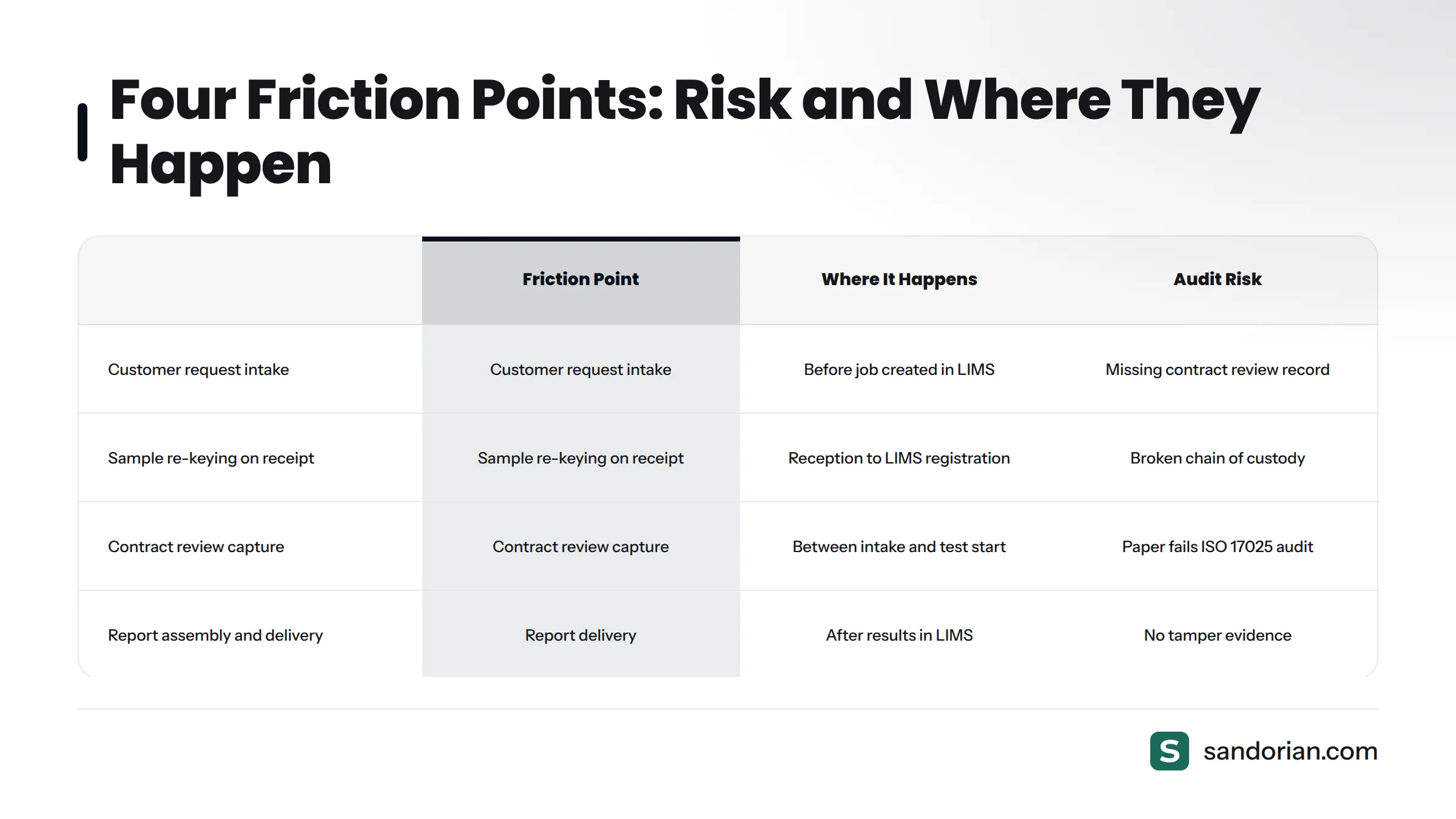
| Friction point | Where it happens | Audit risk |
|---|---|---|
| Customer request intake | Before the job is created in the LIMS | Untracked changes, missing contract review record |
| Sample re-keying on receipt | Between reception and LIMS registration | Transcription errors, broken chain of custody |
| Contract review capture | Between intake and test start | ISO 17025 requires documented review; paper fails audit |
| Report assembly and delivery | After results are in the LIMS | Manual PDF assembly, uncontrolled distribution, no tamper evidence |
Intake: when the request arrives without a system
Most labs receive test requests by email or phone. The information is unstructured, incomplete, and impossible to audit. Someone types it into the LIMS. If the customer changes a requirement before work begins, there is no record of what changed, when, or who agreed to it. That is an audit exposure, not an inefficiency.
Re-keying: when paper travels between people instead of data
Re-keying is the act of manually copying data from one record to another - a customer's email into a job form, a job form into the LIMS, a LIMS result into a Word document. Every transcription is an opportunity for error. In a regulated testing lab, every error without a correction record is a potential nonconformance. The staff time is secondary. The data integrity risk is primary.
Contract review: the ISO 17025 record nobody can find at audit
ISO 17025:2017 requires that a laboratory review a request, tender, or contract before work begins - confirming that the lab has the capability, the resources, and a clear understanding of what the customer needs. That review must be documented. In many labs, it happens verbally or by email. When an auditor asks for the record, it cannot be produced. A software module that captures the review as a structured, timestamped record closes this gap cleanly.
ISO 17025 contract review is an implementation requirement, not an accreditation opinion. Accreditation decisions remain with your accreditation body. For the full picture of how software connects to ISO 17025 requirements, our ISO 17025 accreditation guide for testing labs covers the standard's key clauses in practical terms.
Report delivery: the gap between result and controlled distribution
Once results are in the LIMS, someone assembles a report manually - copying data into a Word template, saving it as a PDF, emailing it to the customer. There is no version control, no delivery confirmation, no way for the customer or an auditor to verify that the document is authentic and unaltered. For testing labs operating under ISO 17025, this is the last uncontrolled step in an otherwise managed process.
Book a workflow scoping call. We review exactly where sample data is re-keyed in your lab and map every gap - before you commit to anything. Start the conversation with Sandorian.
What we build for testing laboratories
Sandorian's laboratory software by industry service builds the four modules that close the gaps above. Each one connects to the LIMS the lab already runs - no migration, no replacement.
Customer request intake portal
The intake portal replaces unstructured email and phone requests with a structured digital form. Customers submit test requests through a branded web portal. Every field is defined, every submission is timestamped, and every change is tracked. The lab receives complete, clean data ready to open a job - not a chain of emails to untangle.
This is what sample registration software for testing laboratories looks like before the sample arrives: structured data capture at the customer's end, feeding the lab's end automatically.
Contract review capture
Before any work begins, the intake record is reviewed against the lab's capability and schedule. The contract review module captures that review as a structured record: who reviewed it, when, what was confirmed, and whether any conditions were agreed. This record is immutable - it cannot be overwritten, only superseded with a new version. When the auditor asks for the contract review record for job number 4471, it is there in three clicks.
Sample registration at the door
When the physical sample arrives, the chain of custody needs to close. The sample registration module matches the physical receipt against the intake record, logs condition on arrival, and sends the registration data directly into the LIMS - without anyone typing a reference number a second time. The chain of custody runs from the customer's original request to the LIMS record with no manual step in between.
Sealed report and certificate delivery
After results are complete, the report is assembled from structured data - not assembled by hand from a template. The finished document is sealed using an eIDAS qualified electronic seal, which means any recipient can verify that the document has not been altered since it left the lab. The customer accesses the report through a secure sealed certificate portal for test reports, not an email attachment. Delivery is logged. The audit trail runs from intake to certificate.
LIMS integration
All four modules connect to the existing LIMS through its available interfaces. Data entered once at intake flows through to registration and onward to report assembly - no duplicate entry, no synchronization problem. For more on how that integration works in practice, our guide to integrating custom workflows with your LIMS covers the architecture in detail.
The lab does not need to replace or migrate from its LIMS. The LIMS keeps doing what it does. Sandorian's software handles the layers around it.
How we keep every layer ISO 17025 audit-ready
Audit-readiness is not a feature added at the end of a build. It is an engineering discipline applied from the first line of code. Here is what that means in practice:
- Audit trails. Every record change is logged with the user identity, a timestamp, and the previous value. Nothing is deleted. The history is always readable.
- Controlled records. Documents cannot be overwritten. When a contract review record or a test report is updated, a new version is created and the prior version is retained. This is what audit-ready lab software actually requires.
- Traceability. Every sample can be traced from the original intake request, through contract review and registration, to the delivered and sealed report. That chain exists in the data, not in a paper folder.
- eIDAS electronic seal. Reports carry a qualified electronic seal under EU Regulation No 910/2014. The seal is verifiable by the customer and by any auditor without contacting the lab - which is exactly what the customs portal outcome demonstrated.
- CAPA integration. When a nonconformance is identified, CAPA workflows in laboratory software can be triggered from within the same system, linking the deviation to the sample and the corrective action to the audit record.
For the full picture of what ISO 17025 requires from a software perspective, we have written a detailed guide to ISO 17025 software requirements and compliance - worth reading before your next surveillance audit.
We build the audit trail into the software from day one. Accreditation decisions remain with your accreditation body.
Proof: customs authorities portal that cut verification calls by 98%
This is not a capability claim. It is a completed project.
A customs authorities organisation needed to issue and verify test-result certificates electronically. The existing process was paper-based at the point of delivery, which meant customers and border officials who needed to verify a certificate had no option but to call the issuing laboratory. The volume of those calls consumed staff time and introduced delays in customs clearance.
Sandorian built a portal with eIDAS sealing and a public verification endpoint. After the portal went live, inbound verification calls to the laboratory dropped by 98%. Verifiers could check the authenticity of a certificate online, in seconds, without speaking to anyone at the lab.
The secondary outcome was equally significant: sample re-keying on receipt was eliminated. Registration data flowed directly from the intake form into the LIMS. The transcription step - and every error it introduced - was removed from the process entirely.
98% fewer verification calls to the lab after the portal went live.
The full case study on the customs portal that cut lab verification calls by 98% is available separately. If this outcome is relevant to what your lab is trying to solve, the scoping call is the right next step.
How to get started
The process is straightforward and carries no commitment until you have a clear picture of scope.
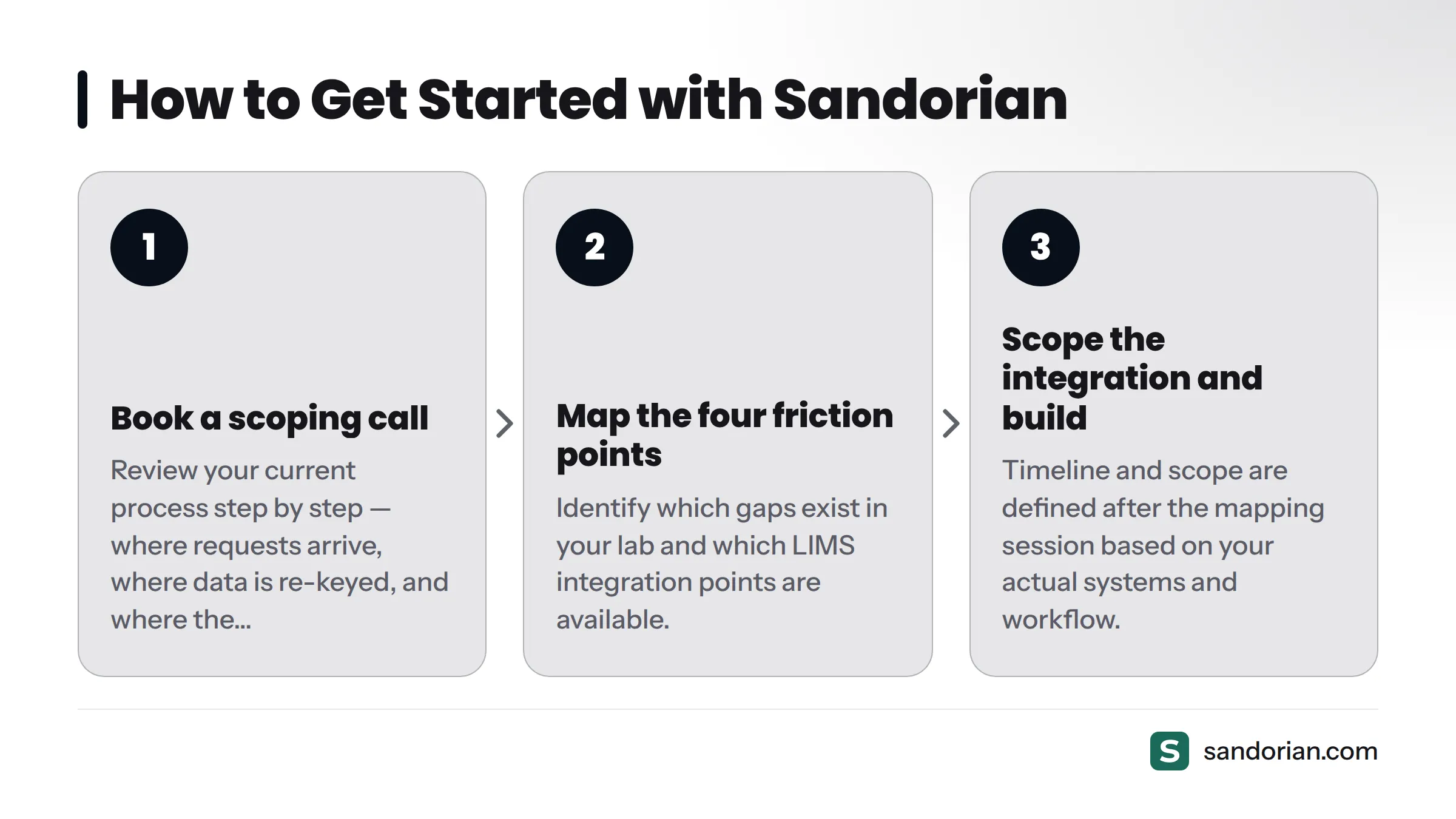
- Book a workflow scoping call. We review your current process step by step - where customer requests arrive, how they reach the LIMS, where data is re-keyed, and where the audit trail breaks. It is a working session, not a sales presentation.
- We map the four friction points against your systems. We identify which of the four gaps (intake, re-keying, contract review, report delivery) exist in your lab and which LIMS integration points are available.
- We scope the integration and the build. Scope and timeline depend on the number of systems involved and the complexity of your workflow. We work through that after the mapping session. For information on project investment, our lab software cost and pricing page covers what drives cost in projects like these.
There is no requirement to change your LIMS. If you are weighing a different question - whether a full LIMS replacement makes sense - the guide on whether your lab needs a new LIMS or a better workflow will help you decide before you spend anything.
Book a workflow scoping call - review where your lab re-keys sample data.
Frequently asked questions
What does a LIMS usually not cover in a testing lab?
Typically: customer-facing request intake, contract review capture, sample registration at the point of physical receipt, and sealed report delivery. These are the workflows that exist before a job opens in the LIMS and after results are filed - and they are the workflows Sandorian builds around the existing system.
Can you integrate with the LIMS we already use?
Yes. We integrate through the LIMS's available interfaces - API endpoints, database connectors, or file-based exchanges, depending on what the system supports. Data entered once at intake flows through to the LIMS and onward to report delivery without being re-keyed at any point.
Will this keep us audit-ready under ISO 17025?
We build with audit trails, controlled records, and full traceability in mind, specifically to support the evidence your lab needs at audit. Every record change is logged, every document version is retained, and the chain from intake to sealed report is unbroken. Accreditation decisions remain with your accreditation body - but the evidence the software produces is built to hold up under examination.
How long does a testing lab project take?
It depends on scope and the number of systems involved. A single-module integration with a well-documented LIMS moves faster than a four-module build connecting multiple legacy systems. We scope the timeline after the workflow mapping session, so the estimate reflects your actual situation. The process is described in full on our how-it-works page.
Sources
Let's talk
We build the systems that power your business. Let us know how we can help.
Book a 30-min Call